The euro slipped slightly against the dollar on Wednesday, with traders seeing little reason to push the pair in either direction ahead of major data or policy cues.
Euro slips to $1.1220 against the dollar

The single currency traded at $1.1220 in morning Frankfurt dealing, down from $1.1235 overnight and just below the European Central Bank’s latest reference rate of $1.1215 set on Tuesday. The move was modest, but it underscores how tightly FX markets remain tethered to expectations for central bank policy rather than to broad risk appetite alone.
Sentiment IndicatorsⓘProprietary · adalytica.com · October 26, 2026
This is a snapshot — live sentiment, awareness and momentum for 130+ markets update continuously in the dashboard.Open AlphaPulse
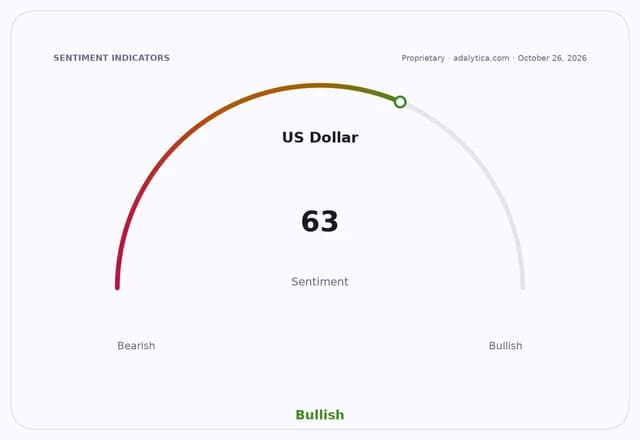
In the near term, the absence of important economic releases leaves the euro vulnerable to drift rather than a decisive trend. That matters because the common currency has already spent much of the recent period trading under pressure versus the greenback, with technical indicators showing it below both its 50-day and 200-day moving averages at 1.14 and 1.16 respectively. The RSI near 48 points to a neutral reading after earlier oversold conditions, suggesting the pair has not yet found a strong directional catalyst.
For investors, the key issue is not the day’s fractional decline itself, but what it says about conviction in the market. Dollar direction has been driven largely by shifting Federal Reserve rate expectations, while the euro has lacked a comparable policy or growth impulse to reverse the bias. A softer dollar backdrop would normally help the euro, but without stronger euro-zone data or a clearer ECB signal, rallies have struggled to hold.
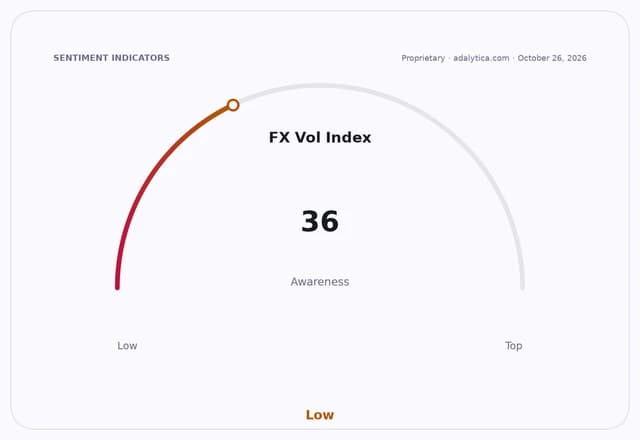
The broader market picture is one of calm rather than resolution. FX volatility indicators from Adalytica point to “Extreme Fear” in trading sentiment even as the underlying move in the euro remains muted, a sign that positioning is still sensitive to any shift in rate expectations or geopolitical headlines. The dollar’s recent move lower against major currencies has also not yet translated into a decisive rebound for the euro, which has been confined to a narrow range.
For now, the euro’s drift lower mainly reflects a market waiting for the next macro trigger. If US data or Fed commentary revive dollar strength, the pair could test the lower end of its recent band again. If US yields continue to ease and euro-zone data stabilize, the currency may regain some ground, but the burden remains on upcoming policy signals to create a sustained move.
| Entity | Gains | Losses |
|---|---|---|
| US dollar bulls | ▲Higher yield support | ▼Softer FX momentum |
| Euro | ▲Limited downside from range trading | ▼Momentum against the dollar |
| Importers into euro zone | ▲Cheaper dollar-priced goods | ▼Hedges less effective if euro weakens |
| Exporters from euro zone | ▲More competitive pricing abroad | ▼Fewer benefits if euro rebounds |