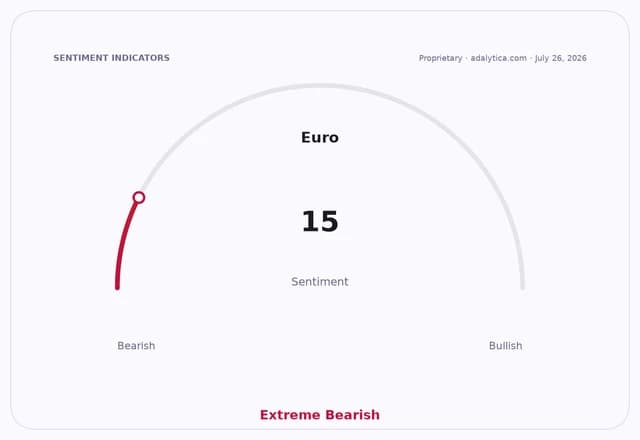
The market is underestimating how quickly the euro can weaken from here, and Lloyds’ call for EUR/USD to slide toward 1.12 is a reminder that the currency trade is still being driven by relative growth, rate expectations and risk positioning rather than headlines alone.
Euro Weakness Points to Stronger Dollar

That matters because the dollar remains the world’s funding currency, and even a modest shift in U.S.-Europe policy expectations can trigger large flows across rates, equities and commodities. A move toward 1.12 would not just pressure the euro; it would reinforce the idea that the dollar’s latest weakness is vulnerable to reversal, especially if the Federal Reserve stays restrictive for longer than markets want to believe.
Sentiment IndicatorsⓘProprietary · adalytica.com · July 26, 2026
This is a snapshot — live sentiment, awareness and momentum for 130+ markets update continuously in the dashboard.Open AlphaPulse
Technically, the picture is already losing altitude. FXE, the euro tracking fund, has slipped to 104.95 from a recent peak of 110.68, while its 50-day moving average sits at 106.14 and the 200-day at 107.06. The fund is trading below both, a bearish signal for momentum traders, and its RSI has retreated to 38.8 after briefly flashing overbought conditions earlier in the year. In plain English: the euro has already started to roll over before the broader market has fully priced in a more serious decline.
That lines up with the proprietary signals from Adalytica.com, which show extreme fear in the dollar and extreme fear in the euro at the same time — a setup that often precedes bigger trend moves rather than stability. The euro’s awareness reading remains elevated, suggesting investors are still watching the pair closely, but sentiment is weakening fast. For contrarian investors, that is exactly when currency trends tend to accelerate.
The investment case is not just about FX traders. A stronger dollar would tighten global financial conditions, weigh on multinational earnings translated back into dollars, and pressure commodities priced in greenbacks. It could also widen the gap between U.S. and European asset performance, favoring American balance sheets with domestic revenue exposure while hitting exporters in Europe that depend on a competitive currency.
For investors, the asymmetric opportunity is to position for a stronger dollar, not to chase the euro after a bounce. That can mean selective exposure to dollar-sensitive assets, caution on euro-zone cyclicals and exporters, and a closer look at U.S. companies with minimal foreign-currency drag. If Lloyds is right and EUR/USD trends toward 1.12, the market may be entering a phase where currency moves become a bigger driver of returns than many portfolios are currently prepared for.
The next catalyst is simple: if rate-cut expectations keep slipping and U.S. data stays resilient, the dollar squeeze higher could become the dominant macro trade again. In that scenario, the euro’s recent weakness is not a dip to buy — it is the beginning of a larger repricing.
| Entity | Gains | Losses |
|---|---|---|
| U.S. dollar bulls | ▲Stronger returns | ▼Less currency risk |
| Euro-zone exporters | ▲Weaker euro boost | ▼Imported inflation |
| U.S.-focused multinationals | ▲Better relative earnings | ▼Translation drag fades |
| Euro bulls | ▲Potential rebound | ▼EUR/USD downside toward 1.12 |