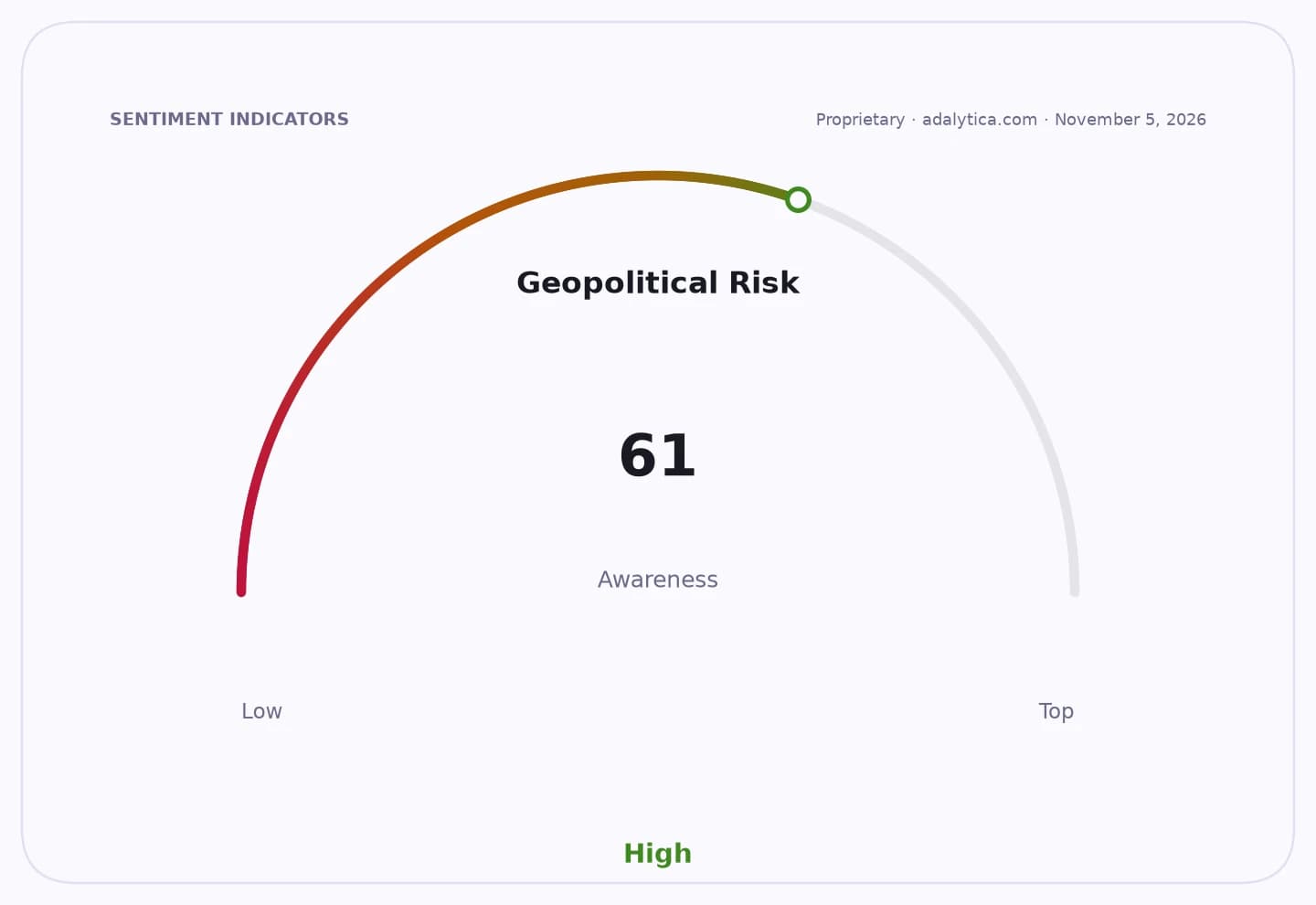
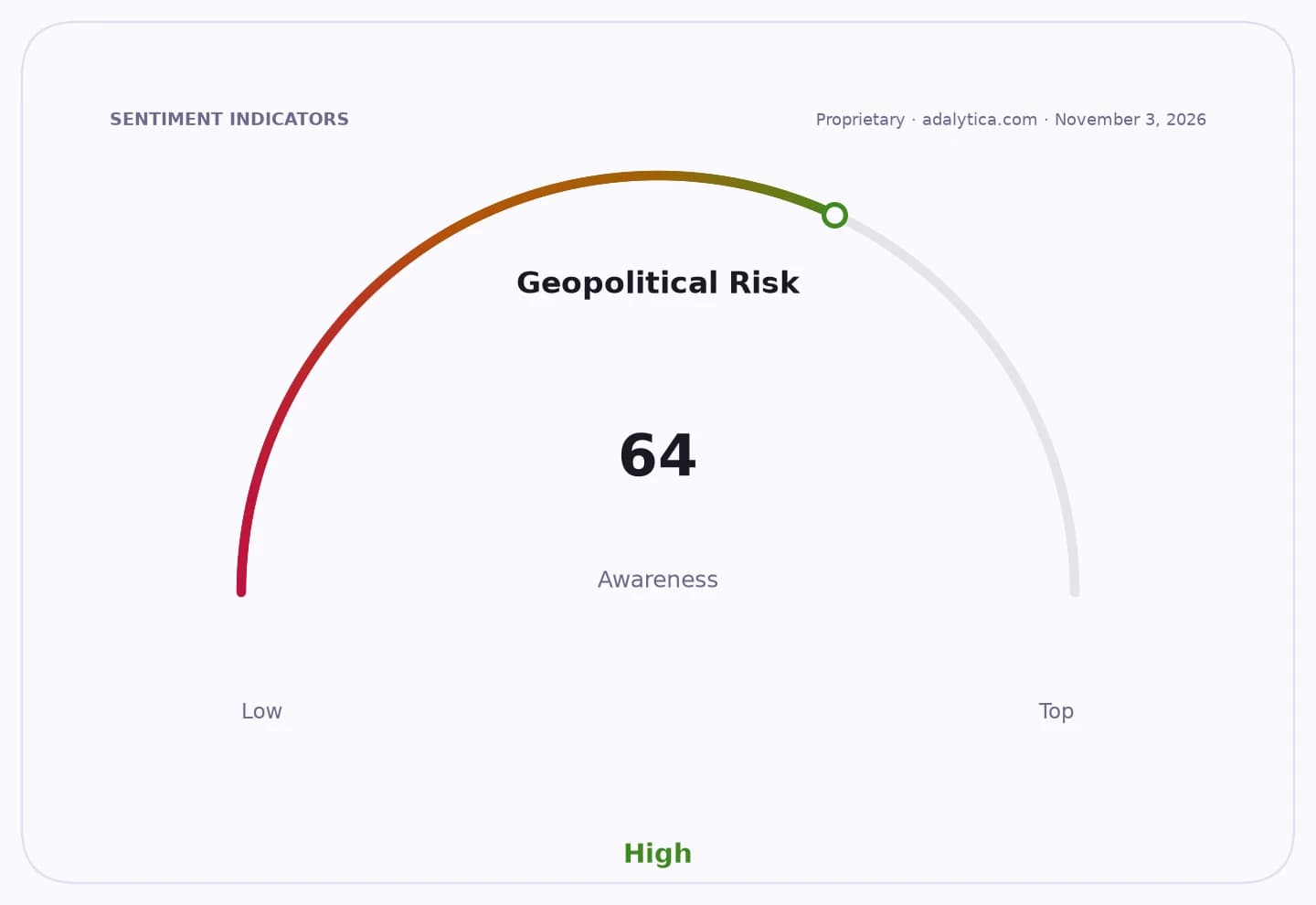
European risk assets are being pulled in opposite directions by a widening political split on both sides of the Atlantic: a Democratic victory in the U.S. Senate is easing some policy uncertainty for markets, even as Poland’s constitutional crisis intensifies and keeps pressure on the region’s institutional stability.
Europe assets split on U.S. Senate vote and Poland

The immediate market read-through is that investors are treating the U.S. result as a modestly supportive backdrop for global risk, while Poland’s turmoil remains a distinctly European drag. The iShares MSCI Germany ETF, EWG, rose to 43.50 on Nov. 4 before easing to 41.58 by Nov. 6, still well above its 50-day moving average of 42.12 and 200-day average of 41.82. That suggests traders are not abandoning European equities, but they are also not assigning a clean breakout to the region as political noise builds.
Sentiment Indicators
By contrast, the euro has been firmer. FXE, the euro-tracking fund, has held near 102.77 after touching 103.61 on Nov. 4, with Adalytica’s euro trade signals showing “extreme greed” at 90 despite a modest two-day pullback. That reflects a market narrative in which U.S. political gridlock may limit abrupt policy shifts, while the euro area is still benefiting from relative support from defense spending, fiscal plans and a stronger regional political risk premium than earlier in the year.
The Poland story matters because it is no longer just a domestic constitutional dispute. The confrontation around the court system, now described in Warsaw as a seizure of the constitutional court, raises questions about the rule of law in a key eastern EU member state at a time when Europe is already managing war in Ukraine, enlargement debates and fragile fiscal coordination. For investors, that is not an abstract institutional issue: legal instability can affect currency confidence, local asset valuations and the broader pricing of Central and Eastern Europe risk.
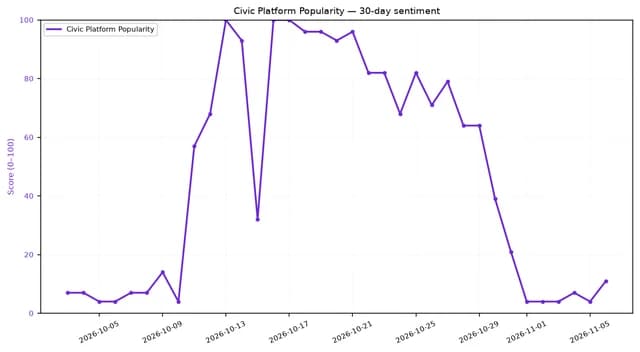
Civic Platform Popularity
The market is already showing some of that strain. Adalytica’s Polish zloty trade signals are at “extreme fear” with a sentiment score of 5, while the euro’s relative resilience suggests capital is favoring the core currency bloc over more politically exposed peripheral markets. The CEE ETF, which tracks emerging Europe exposure, closed at 18.76 on Nov. 6, below its 50-day average of 19.14 and its 200-day average of 19.86, underscoring the cautious stance toward the region.
For U.S. investors, the Senate outcome matters less for any single policy line than for the broader tone it sets. A Democratic Senate can reduce the odds of abrupt fiscal or trade shifts from Washington, which generally supports risk appetite and helps explain why investors remain willing to hold European cyclicals and the euro even as Europe wrestles with its own political fractures. Still, the bond market does not show complacency: the U.S. 10-year Treasury yield was 4.845% in the latest forecast, and high-yield credit spreads remain above recent lows at 3.405, a reminder that global rates and political risk are still in play.
The larger narrative is one of asymmetry. U.S. political clarity, even partial, is helping stabilize global portfolios, while Poland’s crisis is adding a new layer of Europe-specific institutional risk. If the constitutional standoff widens, the spillover would likely hit Central European assets first, but investors would also watch for any knock-on effects on EU cohesion, rule-of-law enforcement and the bloc’s ability to present a unified front on Ukraine and enlargement.
| Entity | Gains | Losses |
|---|---|---|
| Democratic Party / U.S. markets | ▲Policy continuity | ▼Shutdown of some reform bets |
| Core euro-area assets | ▲Relative stability bid | ▼Lower crisis premium |
| Poland / zloty | ▲None | ▼Rule-of-law confidence |
| Central/Eastern Europe equities | ▲Spillover support from euro strength | ▼Higher political risk discount |