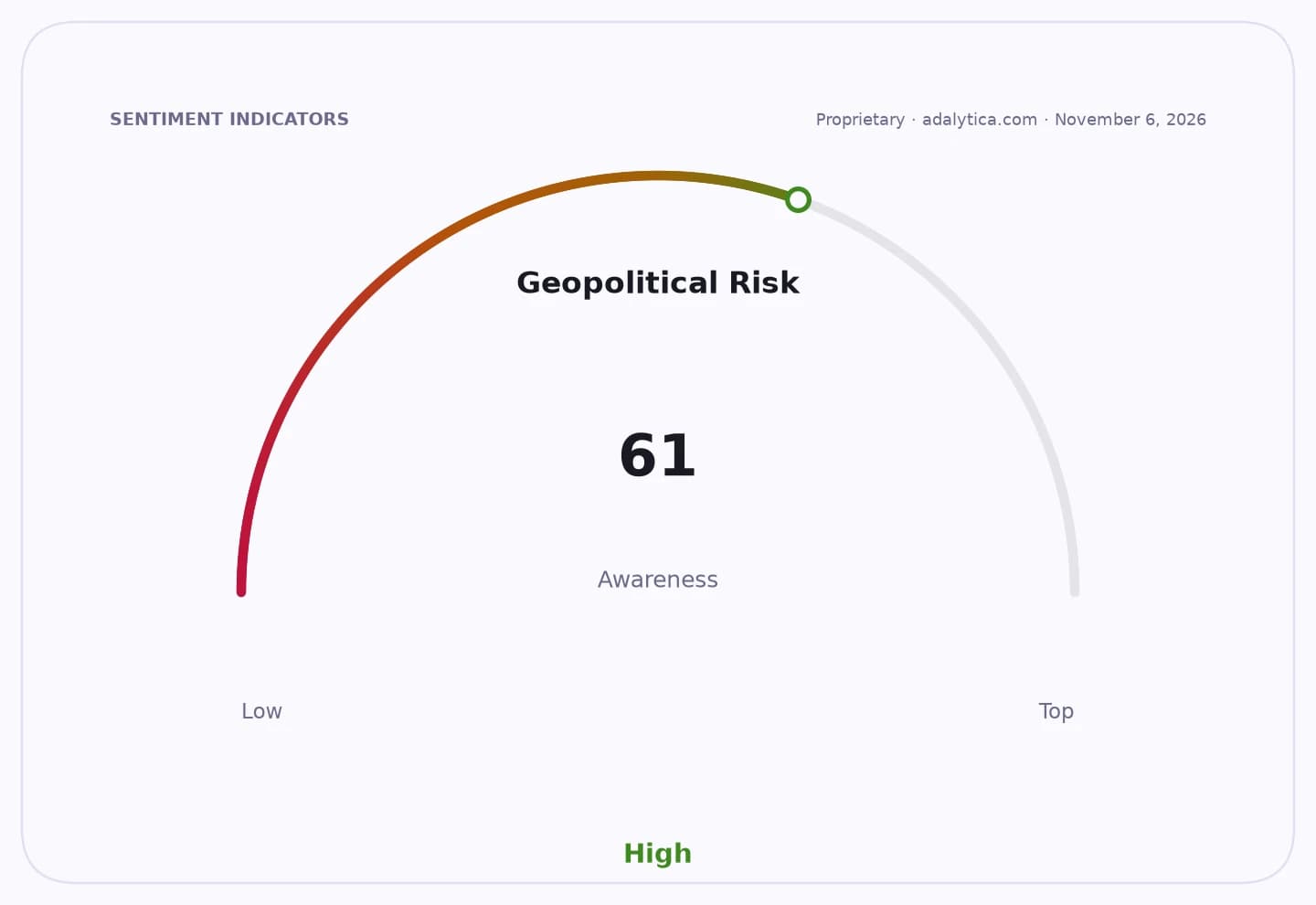
Washington is being accused of trying to shape the political map in Poland, Romania and Germany by backing figures closer to the MAGA movement, a strategy that could weaken European support for Ukraine and complicate NATO cohesion.
Trump Links to Europe Far Right and Ukraine Support

The allegations matter because they go beyond routine diplomacy. If the United States is seen as intervening in the domestic coalitions of allied governments, the result could be a more fragmented Europe at a time when the continent is being told to shoulder more of the burden for its own defense. That creates an economic and market problem as much as a geopolitical one: defense spending, energy policy and industrial cooperation all depend on political stability and aligned policy priorities.
Sentiment Indicators
The broadest concern is the contradiction at the heart of Washington’s approach. Elbridge Colby, the U.S. undersecretary of defense, has said Europe must take primary responsibility for conventional defense. Yet the Trump administration is said to be supporting politicians who oppose rearmament, resist military aid to Ukraine and, in some cases, favor looser ties with Moscow. For investors, that increases uncertainty around the pace of European defense spending, the durability of sanctions policy and the future of transatlantic coordination.
In Poland, reports in the local press cited by The Atlantic say Trump suggested to Defense Minister Władysław Kosiniak-Kamysz that he would be more welcome in Washington if he left the governing coalition and sought an alliance with nationalist and far-right parties. Kosiniak-Kamysz did not follow that advice. The episode is politically sensitive in Poland, a frontline state for Ukraine and one of the key transit hubs for Western military support.
Romania offers a more concrete example of how energy and politics are being tied together. Reuters and other outlets reported that Kimberly Guilfoyle, then U.S. ambassador to Greece, discussed the fragility of the Bucharest coalition at a dinner in Athens and promoted the Vertical Gas Corridor, a pipeline network linking Greece, Romania, Ukraine and other southeast European states, alongside purchases of U.S. liquefied natural gas. A Romanian government source said the domestic gas market made American LNG uncompetitive on price, even as the country was preparing to become a gas exporter. That underlines the tension between U.S. commercial interests and Europe’s own evolving energy economics.
The political fallout in Bucharest was notable. Later, Romania’s Social Democrats left the coalition and joined far-right parties in backing a no-confidence motion against the government of Ilie Bolojan. While the PSD and George Simion’s hard-right bloc denied any U.S. role in the split, the sequence of events has fed speculation that Washington was at least trying to cultivate more pliant partners.
Germany is the most consequential case for Europe’s balance of power. The Atlantic analysis says some German politicians believe Washington would prefer the Christian Democrats to abandon the country’s informal firewall against the far right, which could open the door to a coalition with Alternative for Germany, or AfD. Trump has publicly praised AfD’s results, while Elon Musk appeared online at an AfD event before federal elections, amplifying the party’s profile through his platform X. A senior CDU figure said party delegates visiting Washington were received at the Pentagon and State Department, but Social Democrats were not, reinforcing the perception that Washington favors the conservatives and AfD over the center-left.
For Ukraine, the stakes are direct. AfD leaders Alice Weidel and Tino Chrupalla oppose military aid, Ukraine’s EU accession and, in Chrupalla’s case, the stationing of U.S. troops in Germany. In Poland and Romania, nationalist and anti-Ukrainian narratives are also gaining traction. If those currents are strengthened by U.S. signaling, the result could be fewer reliable votes for Kyiv inside Europe at a moment when battlefield financing, air defenses and long-term security guarantees remain unresolved.
Markets are not likely to price this as a single headline event, but the implications are real. The euro and Central European currencies are vulnerable when political risk rises and policy coordination weakens. The zloty has already shown signs of strain in recent trading, with technical measures such as the RSI falling sharply from overbought levels to much weaker readings, even as the broader dollar backdrop remains unstable. More broadly, any drift toward fragmented European coalitions could support defense stocks, complicate energy sourcing decisions and keep a premium on geopolitical hedging across regional assets.
| Entity | Gains | Losses |
|---|---|---|
| MAGA-aligned European politicians | ▲U.S. visibility and backing | ▼Center-right coalition partners |
| AfD and other far-right parties | ▲Greater legitimacy | ▼Germany’s firewall politics |
| Ukraine | ▲— | ▼EU/NATO support coalition |
| Defense and security stocks | ▲Higher spending expectations | ▼Firms exposed to policy uncertainty |