Iran’s threat to strike European bases used by the United States is the latest reminder that the conflict is no longer just a Middle East problem — it is becoming a transatlantic security and market issue with direct implications for defense spending, energy flows and risk assets.
Iran Threatens Europe Bases as Geopolitical Risk Rises

The warning matters because Tehran is broadening its deterrence message beyond the Gulf and into Europe, raising the odds that any US military action could draw in NATO territory and force European capitals to think harder about force protection, missile defense and readiness. That is exactly the kind of escalation investors should watch for: it turns a regional standoff into a wider security premium that can support defense contractors, keep crude volatility elevated and pressure broader market sentiment when headlines worsen.
Sentiment Indicators
An Iranian lawmaker told Euronews that if Washington used bases in Italy or Germany, “Iran’s missiles will be fired towards Europe.” State media added that any fresh confrontation could reach “the heart of Europe,” while the IRGC pledged an “immediate, effective response without geographical limits.” The rhetoric came as Iran marked the anniversary of the US embassy seizure in Tehran, a date the regime uses to amplify anti-Western messaging.
For investors, the immediate takeaway is that geopolitical risk is not fading — it is metastasizing. That is bullish for the companies that profit from rising defense budgets and persistent security threats. Lockheed Martin, Northrop Grumman and BAE Systems remain the obvious beneficiaries if Europe accelerates air defense, interceptors, command-and-control and base-protection spending. Northrop’s stock has held above its 50-day moving average, while Lockheed has already clawed back from a sharp selloff and remains supported by long-cycle demand. BAE Systems, despite a pullback from its recent highs, is still in an uptrend relative to its 50-day average, showing how quickly the market is willing to reprice geopolitics into defense names.
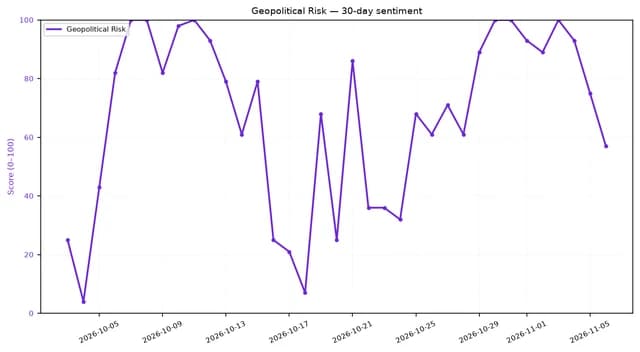
Geopolitical Risk
The broader market signal is just as important. Adalytica’s Global Stability Sentiment has fallen sharply in the past week, while the S&P 500 trade-signal gauge shows extreme awareness even as sentiment stays neutral. In plain English, investors know the risk is there, but they have not fully priced the second-order effects of a wider conflict: higher defense outlays, more energy insecurity and renewed demand for hard-asset exposure.
The next catalyst is whether Washington escalates further or forces the issue back to diplomacy. If the standoff intensifies, Europe will likely be pushed into a faster cycle of military procurement and homeland defense spending. That makes defense equities one of the cleanest ways to position for the next leg of this geopolitical regime shift. I believe investors should own the prime contractors and use any pullbacks to build exposure before the market fully re-rates the threat.
| Entity | Gains | Losses |
|---|---|---|
| Lockheed Martin, Northrop Grumman, BAE Systems | ▲Higher defense spending | ▼Geopolitical calm premium |
| European governments | ▲Defense urgency | ▼Budget flexibility |
| Oil and energy markets | ▲Risk premium | ▼Stability in supply routes |
| Broader equity market | ▲None | ▼Risk appetite, valuation multiples |