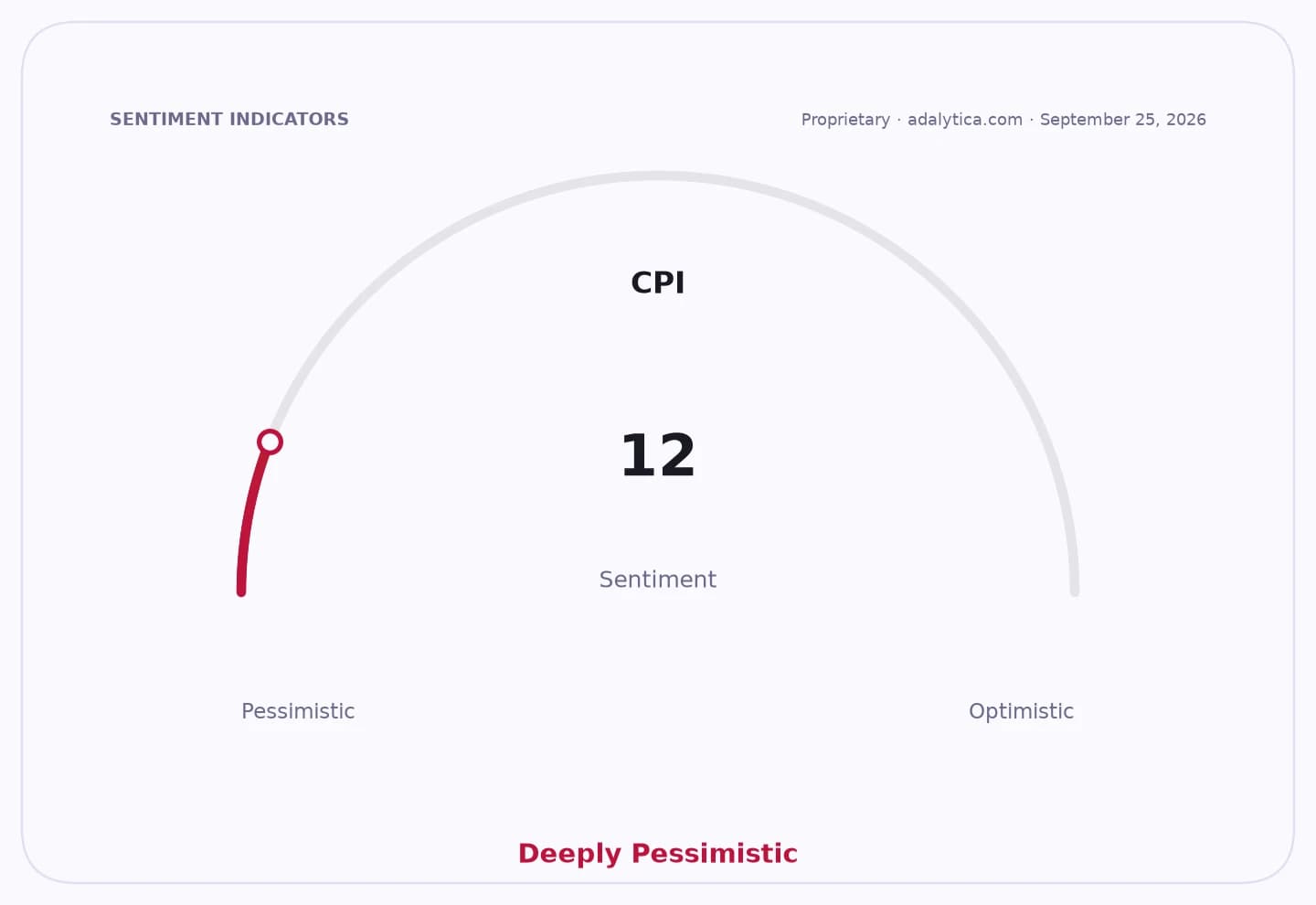
Food costs are emerging again as the clearest drain on household buying power, with U.S. consumer and producer price data pointing to fresh upward pressure just as sentiment gauges show stress building around credit use and payrolls.
Food Inflation Signals Renew Pressure on Consumers

The Consumer Price Index is forecast to rise to 335.512 in July from 332.568 in June, a gain of 0.89%, while the broader producer-price gauge is projected to climb to 295.8433 from 286.827, a 3.14% jump. That combination matters because food inflation tends to feed quickly into grocery bills and then into wage demands, squeezing real disposable income even when headline inflation looks contained.
Sentiment IndicatorsⓘProprietary · adalytica.com · July 17, 2026
This is a snapshot — live sentiment, awareness and momentum for 130+ markets update continuously in the dashboard.Open AlphaPulse

The pressure is not just macro noise. The consumer spending sentiment snapshot from Adalytica.com sits at 85, still in “Greed” territory but down 7 points on the day, while credit-card usage sentiment is in “Fear” at 30 and payroll sentiment is at 13, or “Extreme Fear.” Together, those readings point to households leaning harder on credit while becoming more cautious about labor-market prospects, a mix that typically leaves less room for discretionary spending.
Grain markets are also signaling that the inflation problem is not fully solved. The WEAT wheat ETF has jumped to $24.92 from $20.60 in late September, with its 50-day moving average at $23.36 and RSI readings above 74, while the CORN ETF is back near $17.62 after sliding as low as $16.47 in late June. DBA, the broad agriculture ETF, is trading at $27.59, above both its 50-day and 200-day moving averages, as investors position for tighter food input costs.
CPIAUCSL vs PPIACO — macro contextadalytica.com
Explore this data interactively — full history, time series and cross-market comparisons.Open AlphaPulse

The setup reflects a familiar squeeze: extreme weather, higher fuel costs and geopolitical disruptions can lift farm and transport expenses before shoppers feel the full effect at the checkout line. That keeps food inflation economically important well beyond the grocery aisle because it erodes real wages, complicates Federal Reserve policy and can hit consumer-facing companies’ margins if demand weakens.
For investors, the message is that food inflation is becoming less of a backward-looking data point and more of a near-term earnings and policy variable. Producers with pricing power may pass on some costs, but retailers, restaurants and packaged-food companies face a harder trade-off if households pull back further.
The next catalyst is the July CPI release and any follow-through in crop markets, where another weather shock or energy spike could reignite the inflation trade and deepen the hit to household purchasing power.
| Entity | Gains | Losses |
|---|---|---|
| Wheat and grain ETF holders | ▲Inflation hedge bid | ▼Consumers facing higher grocery bills |
| Food producers with pricing power | ▲Higher realized prices | ▼Margin pressure if demand softens |
| Households on fixed incomes | ▲Limited benefit from easing food costs | ▼Real purchasing power |
| Fed doves | ▲Slightly softer inflation narrative | ▼Hawks if food prices reaccelerate |