France’s latest debate over cancelling part of its public debt matters less as a policy slogan than as a test of the euro area’s legal and fiscal architecture. With French debt at 3.54 trillion euros, or 117.5% of GDP, the proposal would target bonds held by the Banque de France through the Eurosystem — but economists say Paris cannot erase that debt on its own, and any move would require a decision across the ECB and national central banks.
France debt cancellation debate over ECB holdings

That is the central economic issue: if the debt were cancelled, the French state would gain less from a reduction in gross liabilities than it might appear, because the Banque de France is part of the public sector. Critics argue the government would lose a claim on itself and could forgo future dividends from the central bank, while potentially facing recapitalisation costs. Supporters say the point is not accounting optics but creating room for new borrowing to fund defence, industrial autonomy and the energy transition without adding to the visible debt burden.
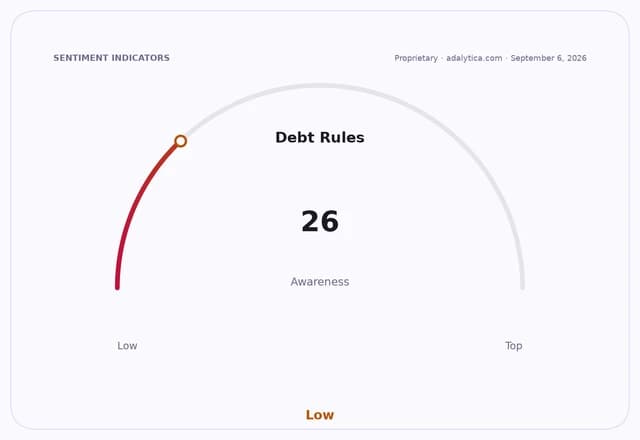
Sentiment IndicatorsⓘProprietary · adalytica.com · September 6, 2026
This is a snapshot — live sentiment, awareness and momentum for 130+ markets update continuously in the dashboard.Open AlphaPulse

The distinction matters to investors because it cuts to a core assumption behind euro-zone sovereign markets: central bank holdings are not a free fiscal asset that can simply be written off at national discretion. Jézabel Couppey-Soubeyran of Paris 1 argues that only an Eurosystem-wide decision could make such a cancellation possible, underscoring the legal and political barrier to any unilateral French move. Sylvain Bersinger, by contrast, says wiping out debt held by a central bank that does not behave like a private creditor would not change the public sector’s net position in any meaningful way.
For bondholders, the immediate message is that retail holdings, insurers, banks and funds would not be touched directly. That limits the near-term market risk, but it does not remove the broader concern that reviving debt cancellation talk could unsettle confidence in the ECB’s balance sheet and in the line separating monetary policy from fiscal financing. The idea has returned at a time when Europe is already debating how to pay for higher defence spending and the green transition, while governments face tighter borrowing conditions and slowing fiscal room.
The more politically relevant narrative is that France’s debt burden is large enough to keep generating radical proposals, but Europe’s institutional setup remains built to prevent one country from imposing a solution on the common central bank. Investors are likely to treat the debate as a reminder of the limits of fiscal experimentation inside the euro zone unless there is a broader, treaty-compatible agreement on how central bank-held sovereign debt should be handled.
| Entity | Gains | Losses |
|---|---|---|
| French state | ▲More fiscal room in theory | ▼Higher institutional/legal uncertainty |
| Banque de France / ECB | ▲No direct gain | ▼Balance-sheet credibility risk |
| OAT holders in markets | ▲Debt claims remain intact | ▼Policy noise and volatility |
| Debt-cancellation advocates | ▲Debate returns to agenda | ▼Faces legal and economic pushback |