France’s economy is falling further behind its European peers, and the market underestimates how quickly that weakness can turn into a bigger drag on growth, earnings and policy flexibility. The Insee now sees French GDP rising just 0.4% in 2026, down sharply from a 0.7% forecast, as household demand stalls, investment fades and inflation climbs back toward 2.9% by year-end.
France GDP Forecast Cut to 0.4% for 2026
That downgrade matters because France is not being hit by a single shock — it is running into a broad, economy-wide soft patch. The statistics office said all the main engines of domestic demand are “blocked,” with consumer spending still weak, business investment sliding and public projects slowing as the municipal election cycle curbs activity. Add in heatwaves that have hurt agriculture, a labor market that is “more deteriorated than the rest of Europe” and weaker public finances, and the result is a growth profile that looks increasingly fragile compared with Germany, Italy, Spain and the U.K.
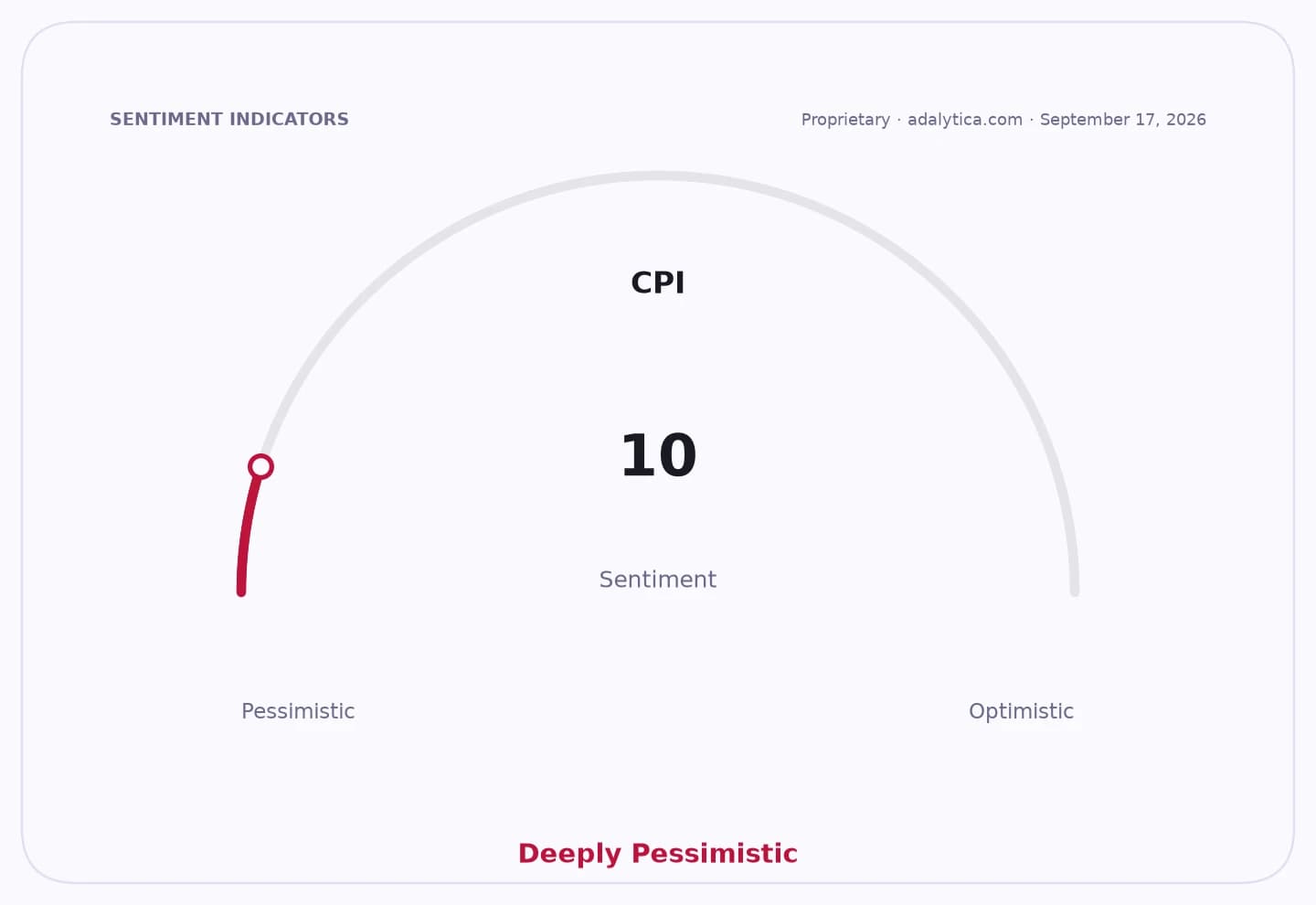
Sentiment IndicatorsⓘProprietary · adalytica.com · September 13, 2026
This is a snapshot — live sentiment, awareness and momentum for 130+ markets update continuously in the dashboard.Open AlphaPulse
The gap with neighbors is the real story. Insee said France’s economy contracted 0.2% in the first quarter and then flatlined in the second, while Spain grew 0.6% and 0.7% over the same periods, Germany expanded 0.4% and 0.3%, and Italy 0.3% and 0.2%. Even if growth improves modestly to 0.1% in the third quarter and 0.2% in the fourth, France would still end the year running at roughly one-third the pace of its peers. That is not just a statistical embarrassment; it is a warning that France is losing cyclical momentum just as households are being squeezed.
The inflation backdrop makes the slowdown harder to fix. Insee expects consumer prices to reach 2.9% by the end of the year, up from 2.4% in August, while household purchasing power is set to fall 0.4% in 2026. Consumption, the traditional pillar of the French economy, would grow only 0.3%, even as the savings rate stays elevated at 17.3%. That tells investors the consumer is not about to deliver a clean rebound, and it also suggests policymakers have less room to lean on demand without worsening fiscal stress.
For investors, the implication is straightforward: French cyclicals are facing a weaker domestic market than the broader European rally may assume. The Insee outlook argues for caution on France-sensitive retailers, consumer-facing businesses and domestically exposed industrial names, while favoring exporters, defense, infrastructure and companies with stronger overseas revenue streams. The ETF EWQ has already slipped below its 50-day moving average, with a weak RSI reading, reflecting how little conviction the market currently has in a near-term French rebound.
The better trade is to look through the slowdown, not chase it. French weakness reinforces the case for firms that can monetize Europe’s structural spending shifts — especially defense, energy resilience, digital infrastructure and cross-border industrial winners. CACI, which has held up far better on its technical profile, is the kind of stock investors favor when governments and corporations keep spending on security and networked capabilities even as household-led economies stall.
The next catalyst is whether France’s second-half improvement arrives fast enough to stabilize sentiment. If inflation stays elevated while jobs and wages remain soft, the pressure will intensify on the government to support growth without losing fiscal credibility. That is exactly the environment where the market starts rotating away from pure domestic exposure and toward companies tied to secular capex, public security and infrastructure spending. In my view, France’s downgrade is not a local macro footnote — it is another reason to own the businesses that benefit when growth gets scarce and governments are forced to spend selectively.
| Entity | Gains | Losses |
|---|---|---|
| Exporters | ▲More competitive abroad | ▼Slower domestic demand |
| French consumers | ▲Higher savings priority | ▼Lower purchasing power |
| Domestic retailers | ▲— | ▼Weak spending |
| Defense/infrastructure names | ▲Public-capex tailwind | ▼Cyclical French exposure |