Germany’s mercantile approach to defense is colliding with France’s strategic push for European autonomy, and the split is now showing up in markets that are pricing a continent still struggling to turn rhetoric into industrial scale. The gap matters because Europe’s rearmament is no longer just a geopolitical project: it is a test of fiscal capacity, industrial policy and investor confidence in the region’s ability to finance a longer period of higher military spending.
Franco-German Split Clouds Europe Defense Re-Rating
The macro backdrop is still supportive in one sense. U.S. Treasury yields remain elevated, with the 10-year at 4.62% and the 2-year at 4.26%, underscoring how expensive long-duration capital remains for governments and defense contractors alike. The 10-year/2-year curve at 0.41 percentage point suggests markets are not pricing an imminent recession, but they are also not offering a cheap funding window for Europe’s defense ambitions.
Sentiment IndicatorsⓘProprietary · adalytica.com · July 17, 2026
This is a snapshot — live sentiment, awareness and momentum for 130+ markets update continuously in the dashboard.Open AlphaPulse
That matters for Germany and France because they are approaching the rearmament push from different angles. Germany is focused on industrial throughput, procurement discipline and exportable defense capacity. France is framing defense as a sovereign, strategic project tied to European political autonomy. The result is friction over who buys what, who builds it and who leads, delaying the kind of common framework investors want for multi-year spending visibility.
The tension is visible in European equity vehicles tied to the region. The Germany ETF, EWG, closed at $41.24 on July 16, barely above its 50-day moving average of $41.64 and still below its 200-day average of $41.18, while its RSI reading of 51.6 and nearly flat MACD point to a market that has stabilized but not broken out. France’s EWQ ended at $45.18, above its 50-day average of $44.86 and 200-day average of $44.06, with a firmer technical profile. Eurozone equities more broadly, via EZU, were more resilient at $68.24, helped by a rise in the 50-day average to $67.66 and a still-positive MACD, suggesting investors prefer broader Europe exposure over a pure Germany-French policy trade.
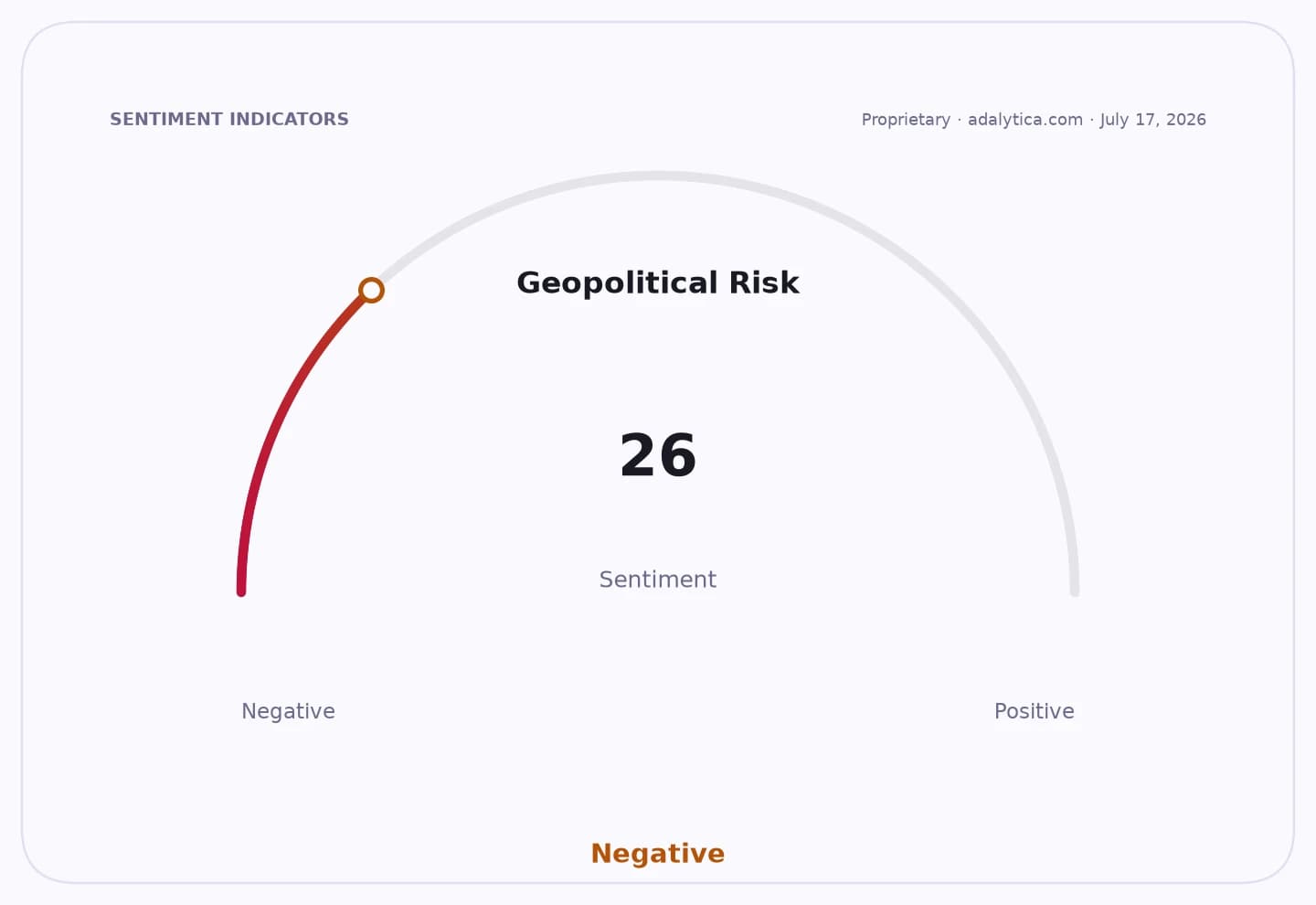
Adalytica’s Euro Trade Signals snapshot shows extreme fear, with sentiment at 3 and awareness at 5, while Global Stability Sentiment sits at 26, still in fear territory after a sharp one-day jump. That is not a direct verdict on defense policy, but it does show how fragile the market mood remains around Europe’s strategic and political direction.
For investors, the stakes are straightforward. If Berlin and Paris cannot align on procurement, industrial champions and spending priorities, Europe’s defense buildout risks becoming a collection of national programs rather than a scaled investment cycle. That would favor selected contractors and domestic champions in the near term, but it would cap the upside for broader European industrial names and keep cross-border defense valuations volatile.
The next catalyst is political, not financial: any new Franco-German agreement on joint procurement, financing or industrial consolidation could re-rate European defense exposure quickly. Without it, the malaise the seed headline points to is likely to remain a brake on Europe’s ability to convert higher military budgets into durable market confidence.
| Entity | Gains | Losses |
|---|---|---|
| German defense contractors | ▲Larger procurement orders | ▼Delayed cross-border coordination |
| French strategic-industrial policy | ▲Sovereign influence | ▼Narrower investor enthusiasm |
| Eurozone equity investors | ▲Selective defense upside | ▼Broad regional uncertainty |
| European taxpayers | ▲Security spending | ▼Higher funding burden |