China’s warning that it has “deep concern” over the latest US trade restrictions raises the risk that a tariff dispute already bruising global commerce could widen into a broader economic confrontation between the world’s two largest economies.
FXI closes at 36.32 as China trade risks widen
Beijing’s latest message matters because it points to a familiar but costly pattern: every new round of restrictions increases the odds of retaliation, prolongs supply-chain uncertainty and forces companies to delay investment decisions. China said the measures, which affect China and 59 other countries and are tied to forced-labor concerns, amount to unjustified barriers and rejected Washington’s arguments on trade imbalances and overcapacity.
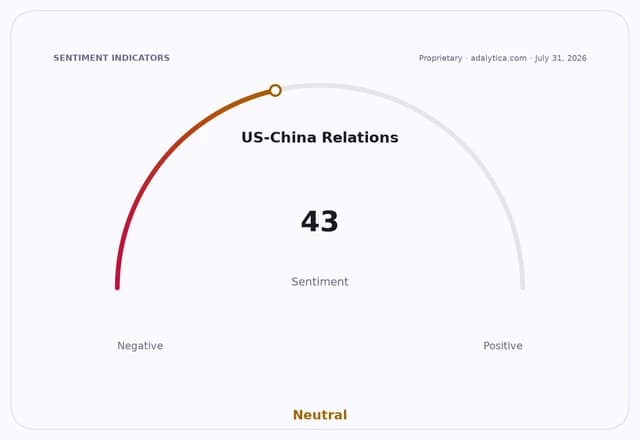
Sentiment IndicatorsⓘProprietary · adalytica.com · July 31, 2026
This is a snapshot — live sentiment, awareness and momentum for 130+ markets update continuously in the dashboard.Open AlphaPulse
For investors, the immediate issue is not only whether tariffs are enacted, but whether they become the basis for a deeper decoupling in strategically sensitive sectors. That means more risk for companies dependent on cross-border manufacturing, semiconductors, industrial inputs and consumer electronics, while exporters exposed to China and importers reliant on low-cost Chinese supply chains face higher margin pressure and potential volume disruption.
The market response has so far been cautious rather than panicked, but positioning in China-related assets shows the tension. The iShares China Large-Cap ETF, FXI, closed at 36.32 on July 31, below its 200-day moving average of 36.95 and only marginally above the lower end of its recent Bollinger Band range, a sign that the rally has lost momentum after a brief surge earlier in the month. The ETF has swung sharply in recent weeks, reflecting how quickly sentiment can shift when trade headlines dominate.
The broader equity market has also been vulnerable to geopolitical headlines. The SPDR S&P 500 ETF Trust, SPY, finished at 744.79, near its 50-day average of 744.18 and well above its 200-day average of 697.4, suggesting the US market remains firmer than China-linked assets but is not immune to escalation risk. The US dollar ETF, UUP, has held above its 50-day and 200-day averages, underscoring how investors still lean toward defensive positioning when trade frictions intensify.
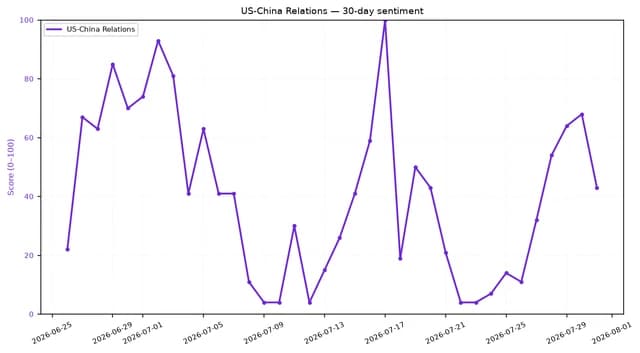
Adalytica’s US-China Relations Sentiment gauge sits at 43, in neutral territory, but awareness remains in “extreme fear,” a combination that suggests investors are alert to the issue even if they have not yet fully repriced a worst-case outcome. That kind of setup often leaves room for sharp moves if either side signals retaliation or compromise.
The bull case is that both governments still have incentives to keep the dispute contained. Trade restrictions aimed at labor and national security concerns can be calibrated, and officials may prefer negotiation over an outright rupture. The bear case is that each new tariff or export control makes compromise politically harder, especially if Beijing concludes that Washington is using trade policy to widen a strategic containment campaign.
For now, the key question is whether the latest Chinese protest becomes a bargaining tactic or the opening move in another phase of tit-for-tat restrictions. If talks stabilize, China-exposed equities could recover some of the lost ground. If not, investors should expect renewed pressure on multinational earnings, higher volatility in Asian markets and a further premium for defensive assets.
| Entity | Gains | Losses |
|---|---|---|
| US protectionist policymakers | ▲Domestic political cover | ▼Trade relations with China |
| Chinese exporters | ▲Possible diplomatic leverage | ▼Tariff exposure |
| US multinationals with China supply chains | ▲Potential negotiation window | ▼Margin pressure and uncertainty |
| Defensive assets and dollar bulls | ▲Safe-haven demand | ▼Risk-on positioning |