A Bundestag expert commission has warned that Germany and the European Union need to be able to hit back if China escalates trade disputes, sharpening pressure on Brussels to turn its China policy into a more forceful economic deterrent.
Germany panel urges tougher EU China trade response

The warning matters because it goes beyond diplomatic language and points to a more confrontational European trade posture toward the world’s second-largest economy. In the commission’s first interim report on Germany’s security-relevant economic ties with China, experts from business, labour and academia said the EU should be “counterstrike capable” in the event of escalatory measures by Beijing, arguing that access restrictions to the European single market are a central lever against China’s export-led model.
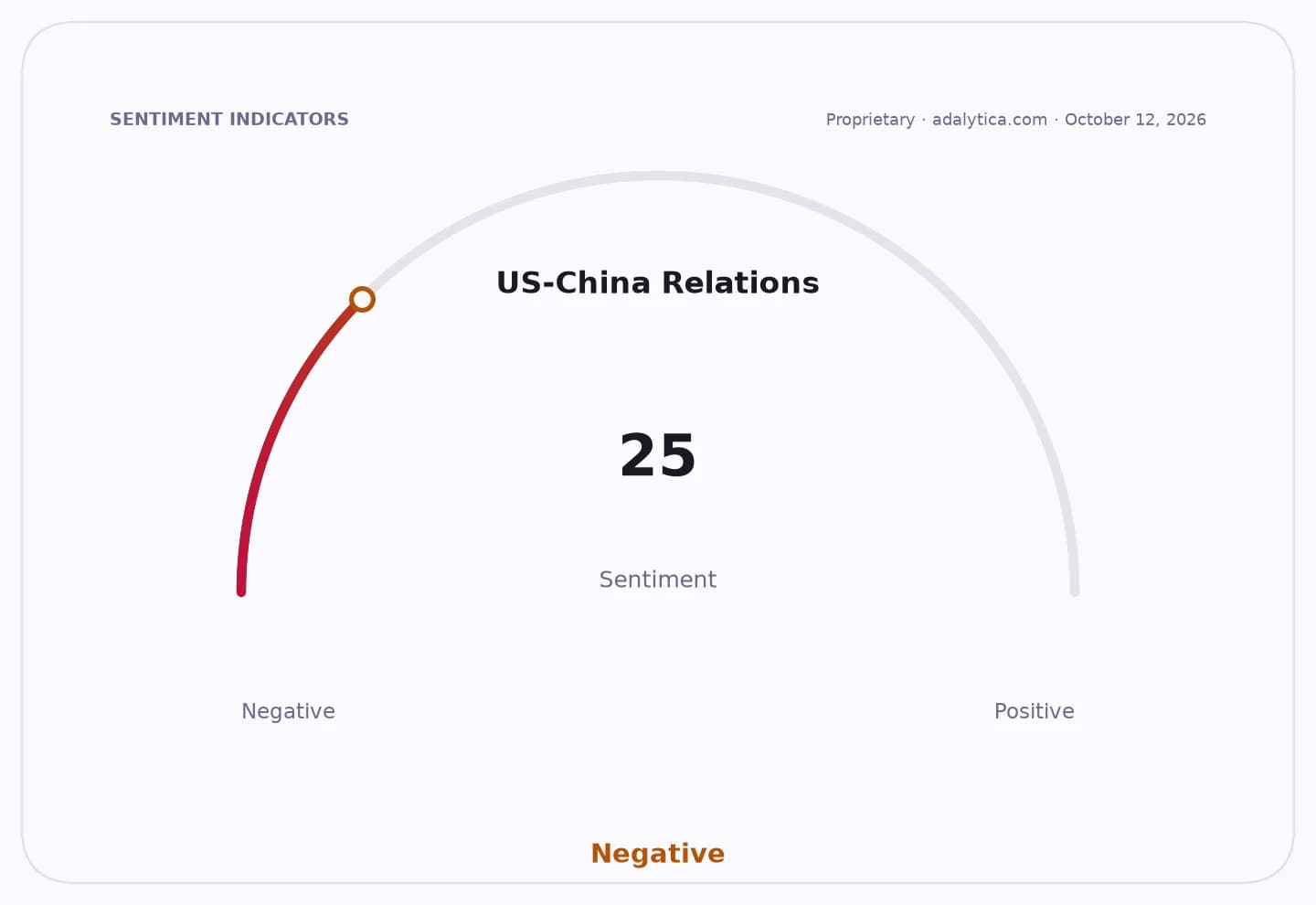
Sentiment IndicatorsⓘProprietary · adalytica.com · October 12, 2026
This is a snapshot — live sentiment, awareness and momentum for 130+ markets update continuously in the dashboard.Open AlphaPulse
That assessment reflects a broader conclusion that Germany’s long-held formula for dealing with China as “partner, competitor and systemic rival” has broken down. The report, seen by WELT AM SONNTAG, says rivalry and rising risks now overshadow the rest of the relationship, while Beijing is increasingly willing and able to use economic dependence as leverage. For investors, that raises the odds of a more durable regime of export controls, market-access limits, sanctions-style measures and retaliatory trade tools across Europe.
The economic stakes are high because Europe remains deeply embedded in Chinese supply chains even as it tries to reduce dependence on critical inputs and manufactured goods. A more assertive EU trade stance would be intended to deter coercion, but it would also increase the risk of reciprocal Chinese measures against European autos, industrials, chemicals and luxury groups that rely on the Chinese market for sales and profits. It could also accelerate the fragmentation of global trade into competing blocs, adding costs and uncertainty for companies already managing tariffs, export restrictions and supply-chain rerouting.
Markets have already been pricing that friction into China-linked assets. The iShares MSCI China ETF, FXI, is around $34.04, below its 200-day moving average of $35.94, while the iShares MSCI China ETF, MCHI, is at about $52.03 versus a 200-day moving average of $56.33, a sign investors remain cautious despite intermittent rebounds. Technical indicators on both funds have weakened again in recent sessions, with FXI’s RSI near 39.7 and MCHI’s around 33.8, underscoring how policy risk continues to hang over China exposure.
The broader geopolitical backdrop is also turning less forgiving. Adalytica’s US–China Relations Sentiment gauge is neutral at 57, but its awareness reading is at an extreme-fear level of 4, suggesting investors and policymakers are highly alert to escalation even if outright panic has not yet taken hold. That kind of environment tends to support defensive positioning in sectors exposed to trade retaliation and to favour companies with less China dependence.
The immediate question for investors is whether Berlin and Brussels translate the report’s recommendations into concrete policy tools, including broader anti-coercion measures and tighter market-access retaliation. If they do, the result would likely be a more durable floor under Europe’s willingness to respond to Chinese pressure — and a higher structural risk premium for companies and assets tied to the China-Europe trade relationship.
| Entity | Gains | Losses |
|---|---|---|
| EU policymakers | ▲stronger deterrence | ▼higher trade friction |
| Chinese exporters | ▲continued market access | ▼retaliation risk |
| European industrials | ▲less coercion vulnerability | ▼exposure to countermeasures |
| China-linked ETFs | ▲tactical rebounds | ▼policy overhang |