Germany would have one in four jobs sitting empty without immigration, a warning that goes to the heart of the euro zone’s largest economy as it confronts demographic decline and a shrinking workforce.
Germany Labor Shortages Depend on Immigration
The finding underscores a structural economic risk that is already visible in Germany’s labor market: the country has a large and persistent demand for workers in transport, health care, logistics, construction and hospitality, but a domestic labor pool that is no longer growing fast enough to fill it. Economist Herbert Brücker’s estimate that immigrants have accounted for 60% of Germany’s economic growth over the past decade points to the same conclusion — migration is no longer a marginal policy issue, but a core input into output, tax revenue and the sustainability of public services.
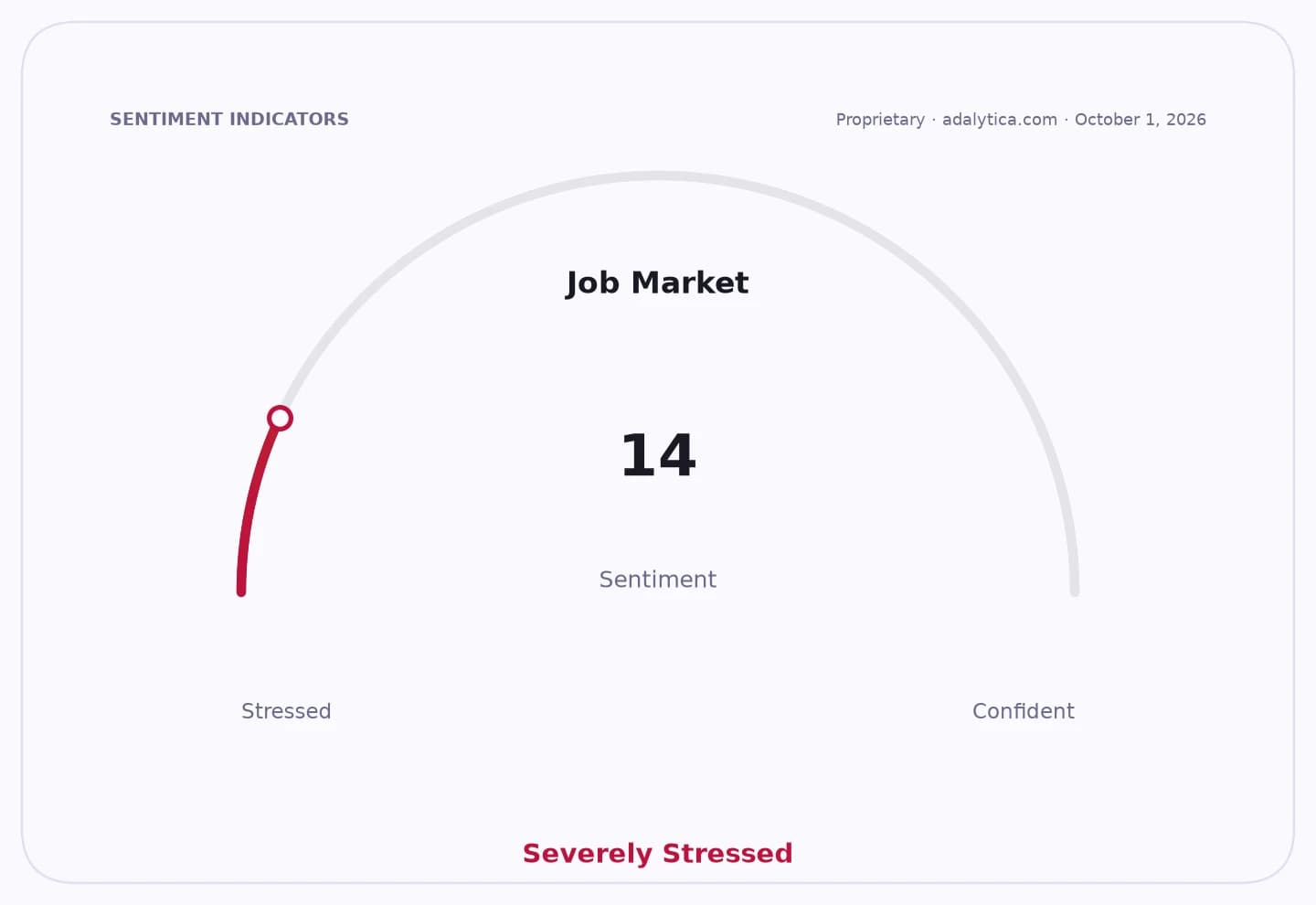
Sentiment IndicatorsⓘProprietary · adalytica.com · October 6, 2026
This is a snapshot — live sentiment, awareness and momentum for 130+ markets update continuously in the dashboard.Open AlphaPulse
About 27% of people employed in Germany have a migration background, according to the data cited in the report, and Brücker argues that without them around one in four roles would remain vacant. That would be a severe constraint on an economy that already has trouble staffing critical jobs with relatively low wages but high social importance, especially in medicine and transport. In logistics, almost half of freight drivers have a migration background, while more than half of jobs in construction are also filled by workers with migrant roots. If those workers were not available, supply chains, building activity and basic service delivery would all come under pressure.
The macroeconomic implications are even sharper given Germany’s ageing population. The current workforce stands at about 45.4 million, but without continued inflows it could fall by 10% to 41.9 million by 2040, according to the figures cited. Over the same period, 13.3 million people are expected to reach retirement age. That leaves Germany facing a widening gap between labor supply and labor demand just as more workers exit the labor force. Brücker’s preferred level of net migration — 500,000 people a year — is well above the current pace of 235,000 to 250,000, suggesting the country is still falling short of what would be needed to stabilize the labor market.
For investors, the message is twofold. Companies exposed to German labor shortages may face higher wage pressure, slower execution and weaker growth if immigration slows further. At the same time, sectors that depend on labor availability — logistics, healthcare, construction, hospitality and some industrial services — stand to benefit from policies that keep foreign workers coming. The exchange-traded fund EWG, which tracks German equities, has recently traded around the low-40s and remains below its 50-day moving average, a sign that the market is still wrestling with Germany’s growth outlook rather than pricing in a clean cyclical rebound. Deutsche Bank shares have also weakened sharply from recent highs, reflecting broader concern about German and European earnings momentum.
There is also a policy market angle. Tighter migration rules may play well politically, but they risk worsening the very shortage they are meant to address. That creates a trade-off between social and electoral pressure on one side, and productivity, tax receipts and pension sustainability on the other. The more Germany restricts inflows, the more it risks slower GDP growth and a heavier burden on the shrinking base of workers who fund pensions, health care and public administration.
The central narrative is straightforward: Germany’s labor market no longer functions without immigration. For policymakers, that means migration is becoming an economic necessity rather than an ideological debate. For investors, it means Germany’s medium-term growth, corporate margins and public finances will increasingly depend on whether the country can keep attracting and integrating foreign workers.
| Entity | Gains | Losses |
|---|---|---|
| German employers | ▲More available labor | ▼Higher vacancy pressure |
| Immigrant workers | ▲Job access and demand | ▼Tougher visa rules |
| Consumers and public services | ▲Better staffing, steadier output | ▼Service bottlenecks if migration slows |
| Restriction advocates | ▲Political leverage | ▼Lower growth and tighter labor supply |