German companies are preparing to rely more heavily on fixed-term employment contracts, with 26% saying they plan to use them more often, more than double the 12% recorded a year earlier, a signal that businesses are still treating the labor market with caution as growth remains weak.
German firms plan more fixed-term hiring
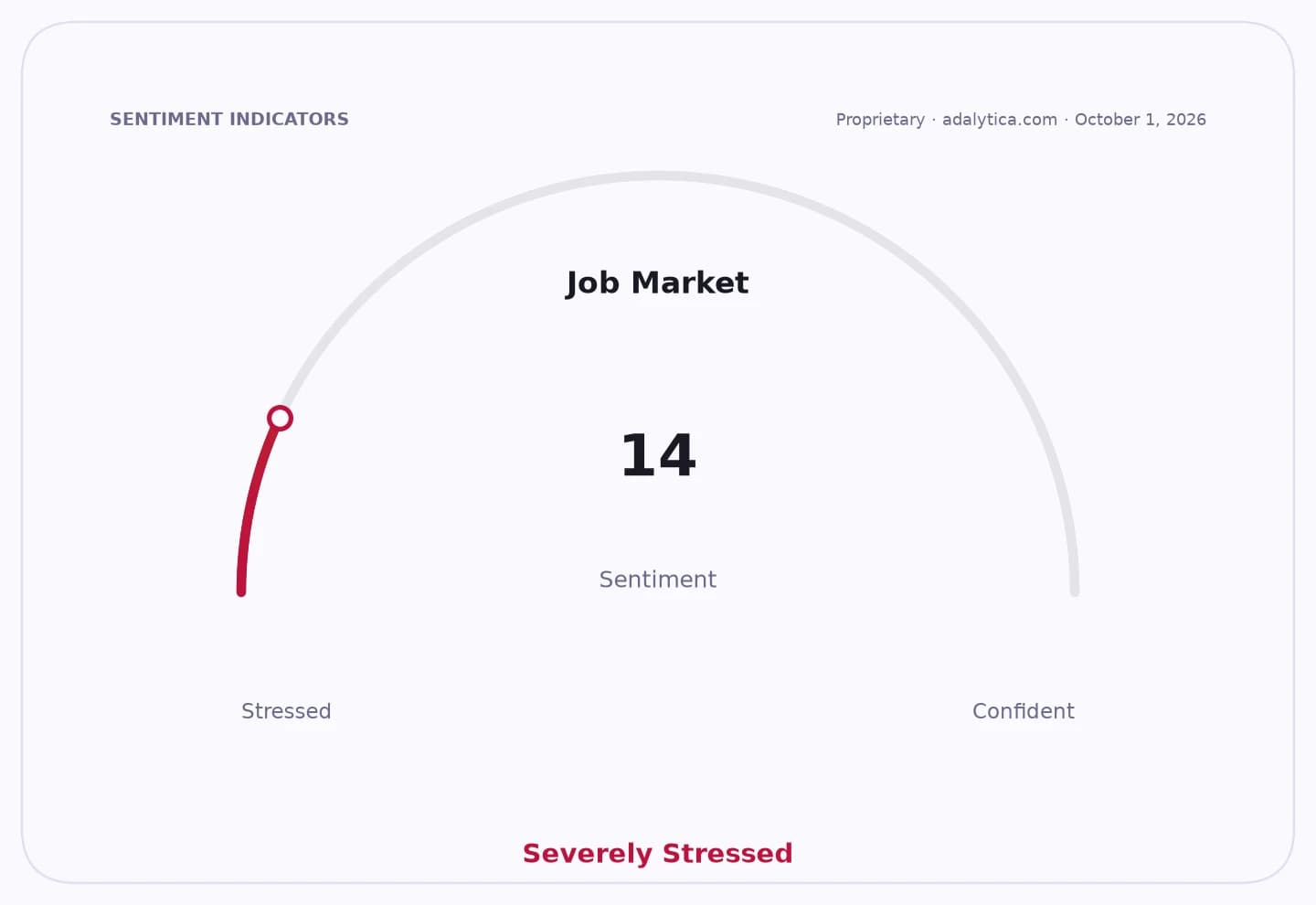
The shift matters because temporary hiring is often one of the first levers companies pull when demand softens or uncertainty rises. For Germany’s economy, it points to a more defensive employment stance at a time when firms are already wrestling with sluggish activity, restructuring, higher costs and geopolitical disruptions.
Sentiment IndicatorsⓘProprietary · adalytica.com · October 1, 2026
This is a snapshot — live sentiment, awareness and momentum for 130+ markets update continuously in the dashboard.Open AlphaPulse
The survey by Randstad and the ifo institute showed 30% of companies already use fixed-term contracts. The practice is most common in industry, where 42% of firms said they use them, compared with 24% in services and 22% in retail. Large companies are far more likely than smaller ones to use fixed-term labor, with the share reaching 59% among big firms versus about 20% among small businesses.
Employers are also leaning on other flexible labor tools. Some 33% of respondents said they plan to use time-account systems more often in the coming months, 21% expect greater use of overtime and 15% are turning to outsourcing. That mix suggests German businesses are trying to preserve output while keeping fixed staffing costs in check.
The backdrop is an economy still marked by weak momentum. Forty-four percent of companies in the survey said economic pressure was the main factor shaping relations between employees and management over the past 12 months. In industry, 17% said restructuring and job cuts are changing working conditions, more than double the share in retail, while services firms cited new work models tied to higher costs and the adoption of artificial intelligence.
For investors, the message is that labor demand is becoming more cautious rather than collapsing, which can support margins in the near term but also reinforces the view that Germany’s corporate sector is not yet seeing a broad cyclical rebound. The trend also matters for wage growth, consumer spending and the pace of any recovery in domestic demand.
The next read-through will come from whether this caution spreads into broader hiring plans, and whether stronger activity or policy support can reverse the move toward more temporary labor.
| Entity | Gains | Losses |
|---|---|---|
| German employers | ▲More staffing flexibility | ▼Less labor-cost rigidity |
| Workers on fixed-term contracts | ▲Some job access | ▼Less employment security |
| Industrial firms | ▲Easier restructuring | ▼Less stable workforce |
| Domestic demand/cyclical recovery | ▲Cost control at firms | ▼Slower wage and hiring momentum |