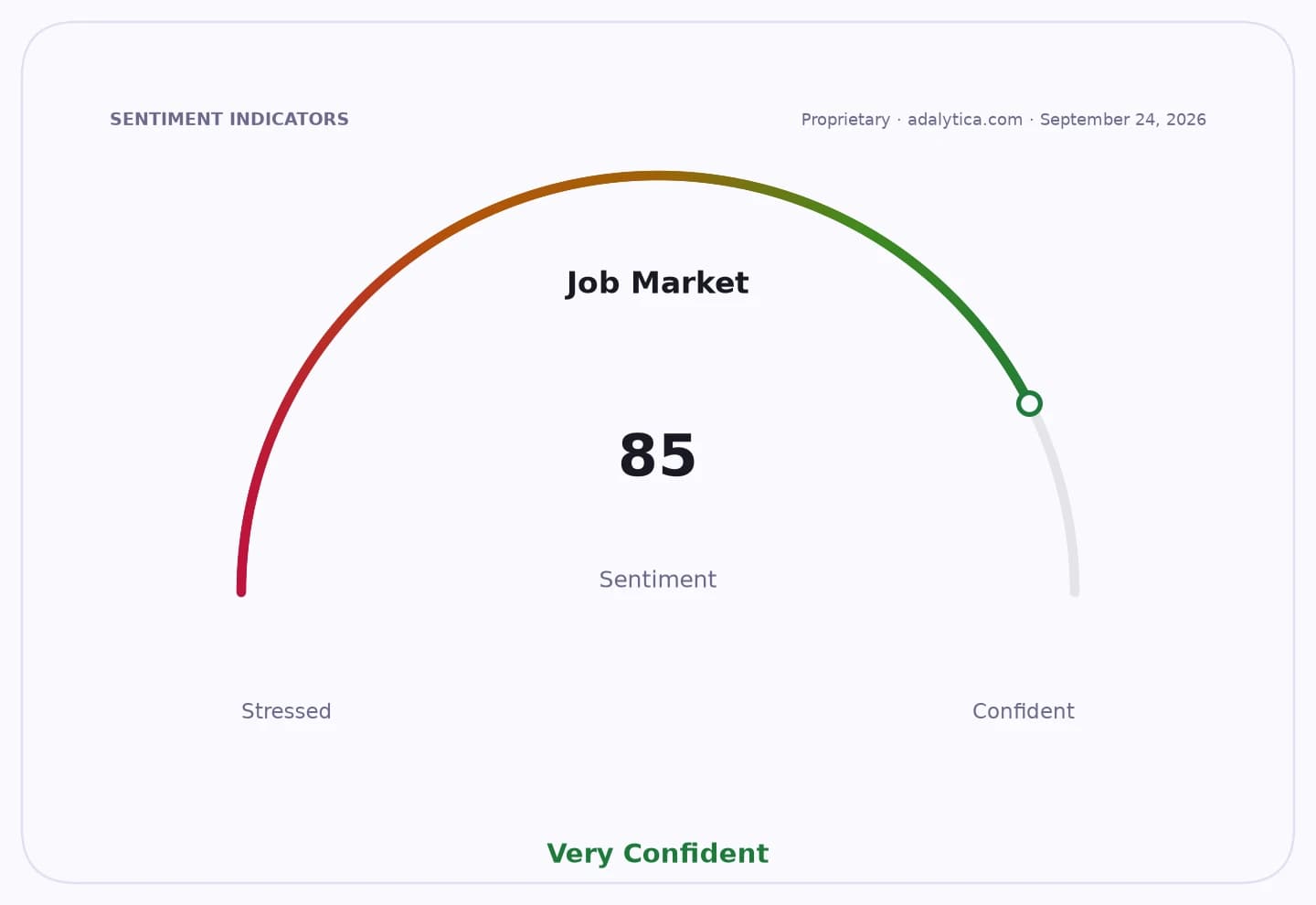
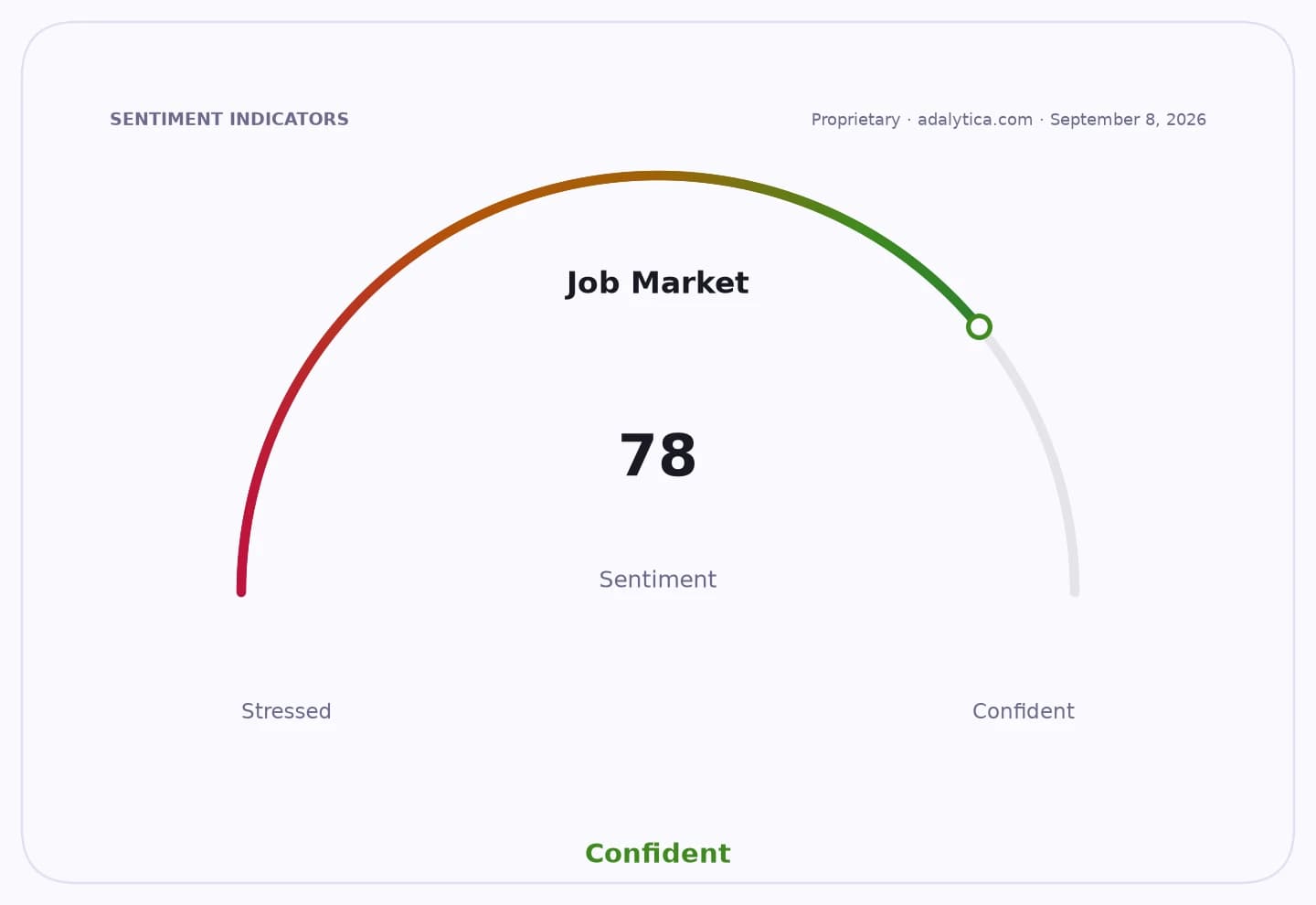
A fresh rebound in pay gains for workers who switch jobs suggests the U.S. labour market is still rewarding mobility, even as hiring slows and companies grow more selective.
U.S. job-switching pay gains rise in July

The biggest beneficiaries are younger workers, especially Gen Z, whose higher churn and lower starting pay are producing the largest percentage wage jumps when they move to a new employer. That matters because job-switching has long been one of the fastest routes to income growth in the U.S., and the latest data indicate that channel is still open despite a softer overall hiring backdrop.
Sentiment IndicatorsⓘProprietary · adalytica.com · October 1, 2026
This is a snapshot — live sentiment, awareness and momentum for 130+ markets update continuously in the dashboard.Open AlphaPulse

The premium for changing jobs rose in July to its highest level in more than three years, according to the data in the source material, and the annual average has turned higher again after a string of declines. Even so, the gain remains below pre-pandemic levels, underscoring that this is not a return to the feverish labour market of the Great Resignation, when workers had far more leverage and firms were scrambling to fill vacancies.
That middle ground matters economically. Businesses are hiring more cautiously than they were during the post-pandemic rebound, but they are still paying up for workers with scarce skills. The result is a labour market that is cooling, not collapsing: weaker than the ultra-tight conditions of the late 2010s or 2022, but still tight enough to support pay growth for workers able to move.
The strongest wage gains are appearing among weekly-paid workers, many of them hourly employees in industries such as construction, leisure and hospitality, transportation and warehousing, and parts of retail. Part of that reflects the nature of weekly pay, which can capture overtime or longer hours as well as higher base wages. But it also points to a labour market where lower-paid workers can get a bigger percentage lift from changing employers.
Gen Z is driving the mobility story. Workers in the cohort are switching jobs at the fastest rate of any generation, and the pace of moves has been rising on a year-over-year basis since February, the first such stretch since 2021. Because younger workers often start from a lower pay base, each move can generate a larger percentage increase than for older, higher-paid employees.
For investors, that has two implications. First, persistent job switching and rising pay premiums argue against a rapid deterioration in household income, which supports consumption even as payroll growth slows. Second, it suggests employers still face wage pressure in selected pockets, particularly where skills are in demand and labour supply is thinner. That could keep margins under strain in labour-intensive businesses.
There is also a distributional angle. Women continue to post larger wage gains than men when changing jobs, though the gap has narrowed to around 2018 levels. Men have recently caught up partly because their job-switching pace has edged ahead since 2024. If that trend persists, it could alter how quickly different groups move up the income ladder, especially because job hopping remains one of the most effective ways for lower-paid workers to close pay gaps.
The AI question is now the most important forward risk. So far, the data do not show mass displacement from artificial intelligence. Labour mobility remains resilient, and sectors with heavier AI use have not broadly seen structurally weaker demand for workers. In fact, the clearest early signals are more nuanced: information technology and financial and insurance services, both heavy AI users, saw some softening in labour demand over the five months to June, but that does not yet prove AI is cutting jobs outright.
That distinction matters for markets. If AI is still mainly being used to boost productivity rather than replace workers, then the near-term effect is more likely to show up in slower hiring growth, not in a sharp rise in unemployment. Companies may choose to reinvest efficiency gains into expansion, or they may use them to trim labour costs. Which path dominates will determine whether today’s job-switching wage premium becomes a temporary feature of a soft landing or the last strong leg of a still-tight market.
| Entity | Gains | Losses |
|---|---|---|
| Gen Z workers | ▲Larger wage jumps from job moves | ▼Slower progression if hiring freezes deepen |
| Employers with scarce-skill needs | ▲Access to motivated talent | ▼Higher wage and retention costs |
| Hourly and weekly-paid workers | ▲Bigger percentage pay gains | ▼More exposure to overtime-driven volatility |
| AI adopters | ▲Potential productivity gains | ▼Risk of weaker hiring flexibility |