The latest US labor data show no sign of the AI-driven job losses that many workers and investors have feared, suggesting the “jobpocalypse” narrative is running ahead of the evidence.
US labor data show no AI job losses yet

Instead, the broader message from recent employment figures is that artificial intelligence is still too early in its adoption curve to show up as a clear drag on payrolls. Nonfarm payrolls remain near record highs at 159.075 million in August, unemployment is holding at 4.1%, and the latest job openings data still show 7.24 million vacancies — a level that points to a labor market that has cooled, but not broken.
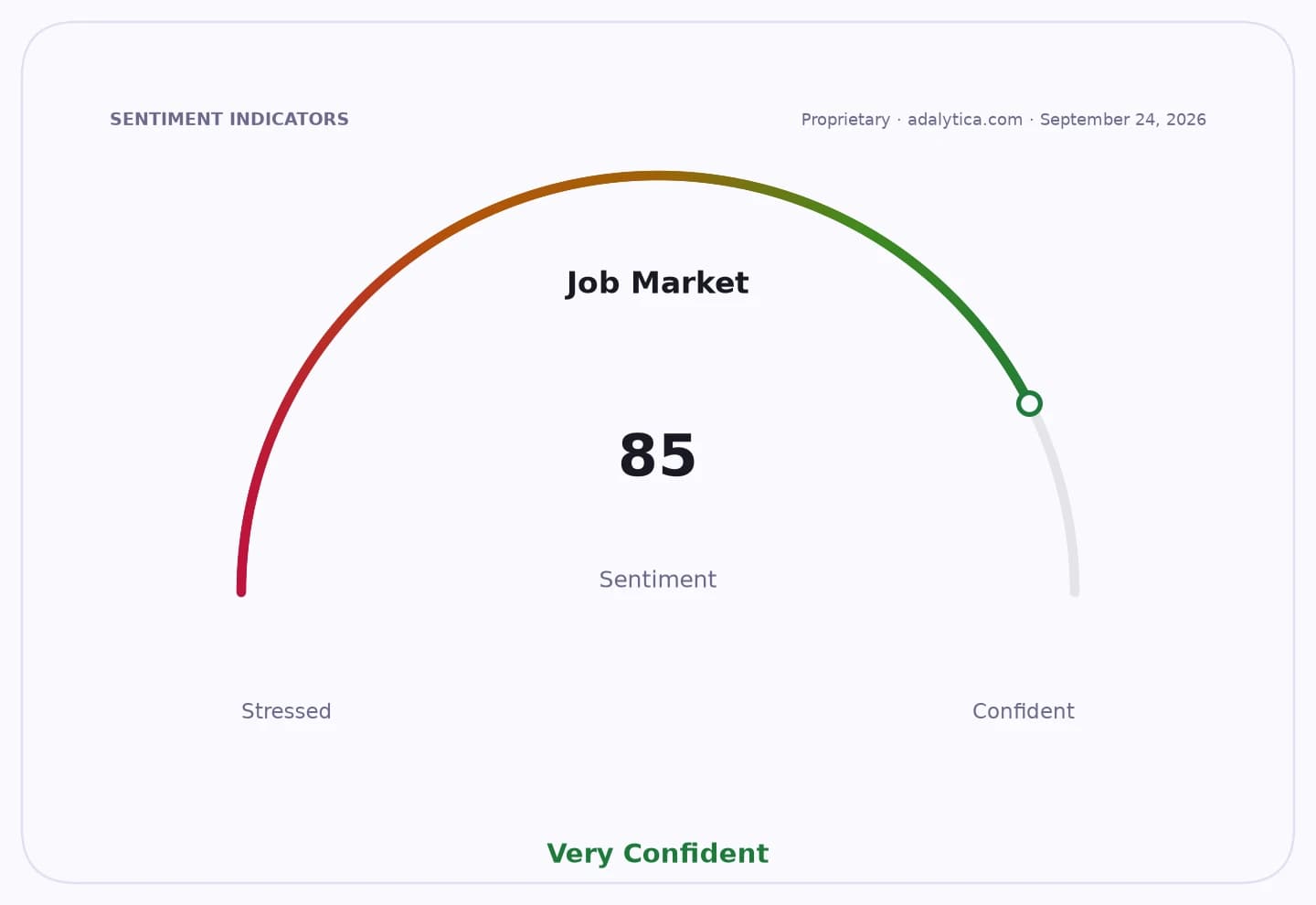
Sentiment IndicatorsⓘProprietary · adalytica.com · September 8, 2026
This is a snapshot — live sentiment, awareness and momentum for 130+ markets update continuously in the dashboard.Open AlphaPulse
That matters economically because the labor market remains one of the main channels through which AI could reshape the US economy. If automation were already eliminating jobs on a large scale, it would likely be visible first in weaker hiring, rising unemployment and a more pronounced drop in openings. So far, that has not happened. The evidence instead fits a slower, more uneven adjustment: white-collar hiring has softened, but there is no broad-based collapse in employment, and jobs for workers without college degrees remain relatively strong.
The data also help explain why economists are pushing back on the idea that AI will necessarily be a net destroyer of jobs. Noah Smith has argued that while some occupations will eventually disappear, it is still “extremely hard” to identify them in the current data. The Economist has gone further, describing an “AI jobs boom” and estimating the technology has already created about 1 million US jobs. That estimate is not a consensus figure, but it captures a key point for markets: the near-term labor impact of AI appears to be as much about reallocation and productivity gains as about outright displacement.
For investors, the distinction matters because labor weakness would feed directly into the macro backdrop for earnings, wages and Federal Reserve policy. A rapid AI-driven rise in unemployment would increase recession risk and could force faster monetary easing. The absence of that pattern is more supportive for consumption, credit quality and corporate earnings resilience, especially in sectors dependent on steady employment and household spending.
It also changes how markets should think about AI winners and losers. The current evidence suggests AI adoption is still translating into demand for specialized skills rather than a clean substitution of machines for workers. That tends to benefit software, cloud, semiconductor and enterprise automation companies, while limiting the bearish case that AI will quickly destroy labor income across the economy. The bear case remains that displacement will come later, after companies have finished deploying more capable models and workflow automation. But if that is the path, it is not yet showing up in the national payroll numbers.
The more immediate story is that AI is changing who gets hired and where, not that it is eliminating jobs at scale. That keeps the labor market from becoming a near-term drag on growth, and it leaves investors focused less on a sudden employment shock than on the slower question of how AI reshapes productivity, wages and sector leadership over the next several quarters.
| Entity | Gains | Losses |
|---|---|---|
| AI adopters | ▲Higher productivity | ▼Labor cost gains delayed |
| Workers with AI skills | ▲Stronger demand | ▼Routine roles under pressure |
| Employers | ▲More efficient hiring | ▼Need for retraining |
| Labor-market bears | ▲Narrative challenged | ▼Jobpocalypse thesis weakened |