AI is no longer just boosting productivity in China’s service economy — it is starting to reshape who gets hired, who gets cut and which skills still command a premium.
China AI Reshapes White-Collar Hiring

That matters because the pressure is now landing on entry-level and mid-tier office jobs that have long served as the ladder into China’s urban middle class. Junior analysts, content producers, accountants and administrative staff are increasingly exposed to automation, while employers use AI to do more with fewer people and, in some cases, push clients to bring work back in-house. The result is a labour-market shift that could dampen wage growth, weaken consumption and make an already fragile job market even more uneven.
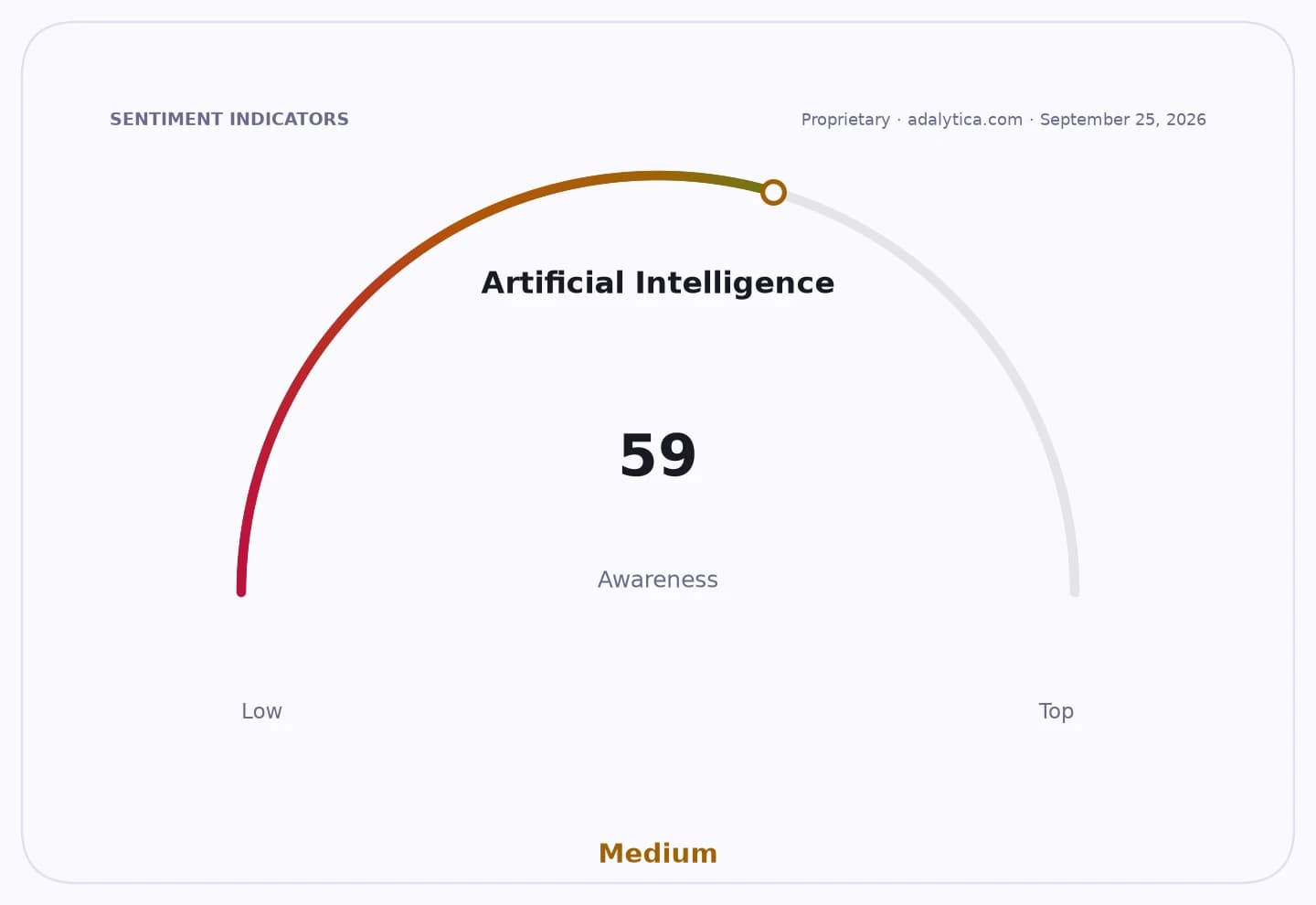
Sentiment IndicatorsⓘProprietary · adalytica.com · September 6, 2026
This is a snapshot — live sentiment, awareness and momentum for 130+ markets update continuously in the dashboard.Open AlphaPulse
Clare Zhang’s experience in Beijing captures the change. Her employer told her late last year that AI had reduced the number of analysts it needed and could afford, after software could collect records, run comparisons and produce reports in a fraction of the time. She later found that clients were also reducing demand for outsourced research, preferring cheaper AI-generated material despite concerns about accuracy. Zhang submitted 40 to 50 job applications in her first month after the layoff and eventually began considering domestic work, childcare or supermarket packing — a telling downgrade for a white-collar worker who once produced 500-page market studies.
The pressure is showing up in broader labour data. ShanghaiTech University said 33.2% of 40.01 million Chinese job postings published between January and April involved tasks highly exposed to AI. The most vulnerable roles were in basic operations, accounting, visual content production and telephone sales, with the greatest strain falling on jobs requiring one to three years of experience and paying 5,000 yuan to 8,000 yuan a month. That is the salary band where many young graduates and early-career workers cluster, making the transition politically and socially sensitive.
At the same time, AI is not eliminating demand across the board. PwC found AI application roles rose by nearly 90,000 last year, or 50.8%, while development positions increased by about 30,500, or 15.5%. That supports the bullish case that AI is a reallocation story, not just destruction: workers who can build, deploy or supervise AI systems remain in demand. But the bear case is more immediate for the mass of workers whose tasks are easier to digitize than to reinvent.
The risk is that the middle of the white-collar labour market gets hollowed out faster than new roles are created. An illustrator in Beijing, Juno Zhu, said entire projects that once took 10 people can now be done by two or three, and that employers increasingly want hires who can deliver immediately rather than learn on the job. For firms, that improves margins and speed. For workers, it means a steeper climb into roles that are either highly technical or difficult to automate, such as manufacturing, healthcare, care work and equipment maintenance.
Beijing is already confronting the legal and social fallout. In May, a Chinese court ruled it was illegal to fire a worker simply because an AI replacement would be cheaper, underscoring how fast employers are testing the boundaries of labour law. But regulation will not stop the underlying economic force: companies are using AI to compress labour costs, while workers are being pushed toward jobs that are physically demanding and less scalable by software.
For investors, the implications run beyond China’s labour market. A weaker path for white-collar employment could weigh on consumption, small-business demand and service-sector growth, even as it supports margins for companies that can substitute AI for staff. The winners are AI infrastructure providers, software vendors and employers able to integrate automation efficiently. The losers are staffing-heavy research, content and back-office businesses — and the workers whose careers were built on those functions.
The key question now is whether China can absorb the displacement fast enough through retraining and new AI-related hiring. If not, the AI boom may deepen the very economic softness it is supposed to help solve.
| Entity | Gains | Losses |
|---|---|---|
| AI-enabled employers | ▲Lower labour costs | ▼Higher wage bills |
| AI developers and platform providers | ▲More demand for tools | ▼Slower enterprise adoption risk |
| White-collar entry-level workers | ▲New AI skills opportunities | ▼Job displacement |
| Consumers and domestic demand | ▲Efficiency gains over time | ▼Near-term income pressure |