Germany’s plan to replace the fixed eight-hour day with a 48-hour weekly cap is putting flexibility at the center of the labour debate, with implications for hiring, retention and productivity across Europe’s biggest economy.
Germany proposes 48-hour weekly work cap reform
The proposed overhaul of the Arbeitszeitgesetz would let employers stretch work into longer days if offset by more free time later, a shift businesses say would help them handle order peaks and staffing shortages. Unions argue it would weaken health protections and increase pressure on workers, especially in logistics, shift work and project-based jobs where long days can quickly turn into fatigue, mistakes and higher absenteeism.
Sentiment IndicatorsⓘProprietary · adalytica.com · September 30, 2026
This is a snapshot — live sentiment, awareness and momentum for 130+ markets update continuously in the dashboard.Open AlphaPulse
The issue matters economically because labour availability has become one of the tightest constraints on growth in Germany and across the euro area. With unemployment at 4.1% and job openings still elevated at 7,079, the balance of power in the labour market remains with workers, making predictable schedules and better conditions a bigger draw than simply more freedom on paper.
That is why the reform debate has moved beyond hours worked to the broader question of who gets to control time. Companies want more room to adjust staffing to demand, but employees are increasingly choosing employers that offer planability, fair compensation for overtime and clear boundaries on after-hours availability.
For investors, the stakes cut across consumer, industrial and labour-intensive sectors. Consumer-discretionary stocks are already under pressure, with the XLY ETF trading below both its 50-day and 200-day moving averages and its RSI in the low 30s, while smaller companies tracked by IWM have also lost momentum and now trade well under their 50-day average. That signals a market already sensitive to weaker demand and tighter margins if labour costs rise without a matching lift in output.
Banking shares have also softened, with XLF sliding below key moving averages and its RSI near oversold levels, underscoring how wage pressure and policy uncertainty can feed into broader earnings expectations. In that backdrop, flexible work rules may help some employers manage staffing, but they also raise the risk of higher churn if workers see the new regime as less predictable rather than more autonomous.
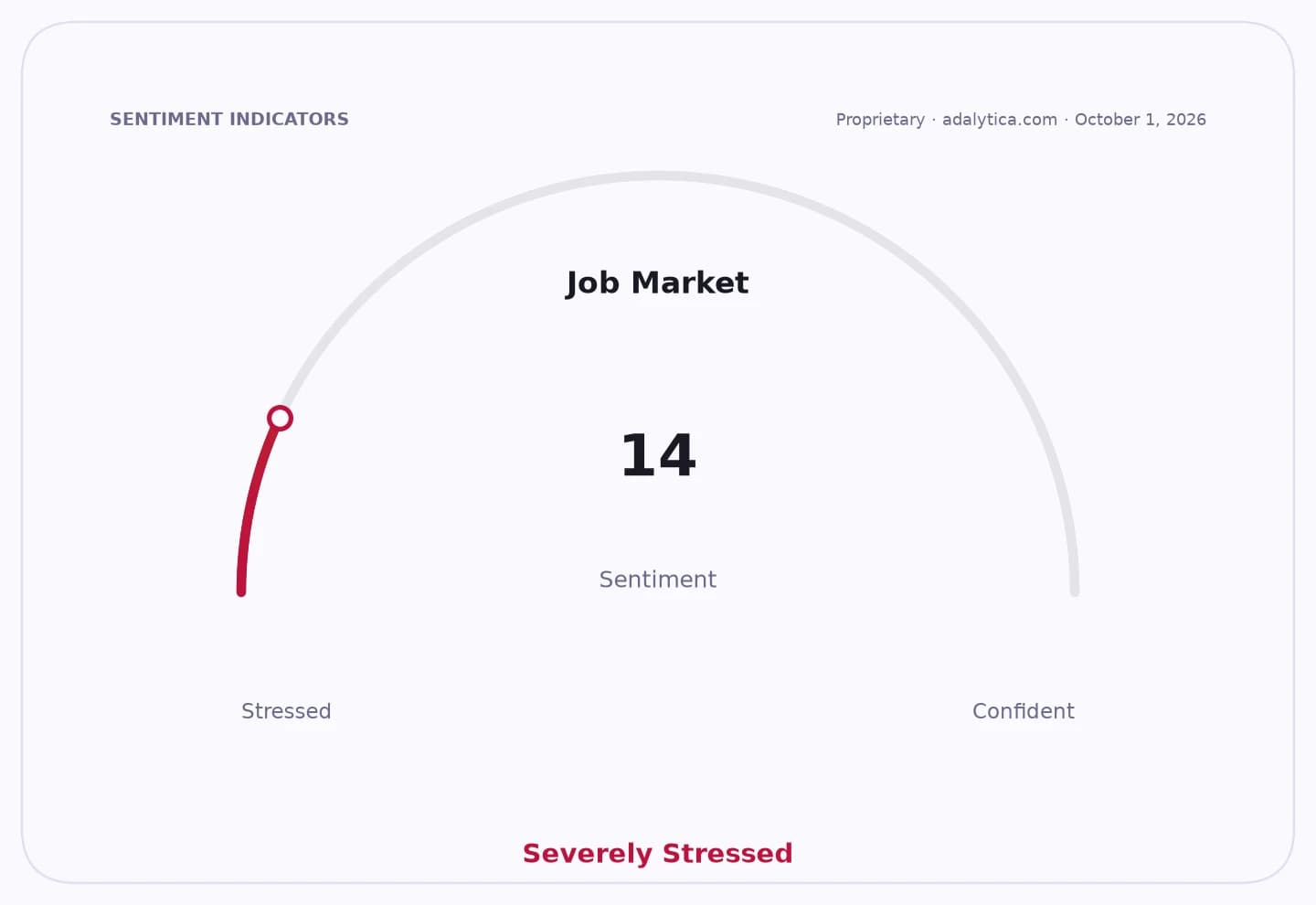
Adalytica’s Job Market Sentiment gauge sits at 43, neutral, after a sharp weekly drop, showing how quickly perceptions around work and employment can shift. The likely near-term catalyst is the German legislative process, which will determine whether flexibility becomes a tool for competitiveness or another flashpoint in Europe’s fight over labour costs and worker protections.
| Entity | Gains | Losses |
|---|---|---|
| German employers | ▲More scheduling flexibility | ▼Higher compliance complexity |
| Workers seeking autonomy | ▲Better planning options | ▼Greater risk of longer days |
| Unions | ▲Stronger bargaining leverage | ▼Weaker push for reform |
| Labour-intensive sectors | ▲Easier peak staffing | ▼Higher fatigue and turnover risk |