Gold is no longer just a hedge against war, inflation and financial-market stress — in parts of Europe it is increasingly becoming a payment instrument, with Czech operator IBISINGOLD/FireGOLD saying customers can now use gold balances in restaurants, cafes, hotels and even at some dentists.
Gold spending via IBISINGOLD expands in Europe
That matters because it marks a small but notable shift in gold’s role inside the financial system. For decades, the metal’s appeal rested on what it could preserve, not what it could buy. A payment network that lets users spend gold without first converting it into local currency gives the asset more practical utility, and that can reinforce demand at a time when investors are already treating bullion as a store of value against geopolitical risk, inflation and currency volatility.
Sentiment IndicatorsⓘProprietary · adalytica.com · October 15, 2026
This is a snapshot — live sentiment, awareness and momentum for 130+ markets update continuously in the dashboard.Open AlphaPulse
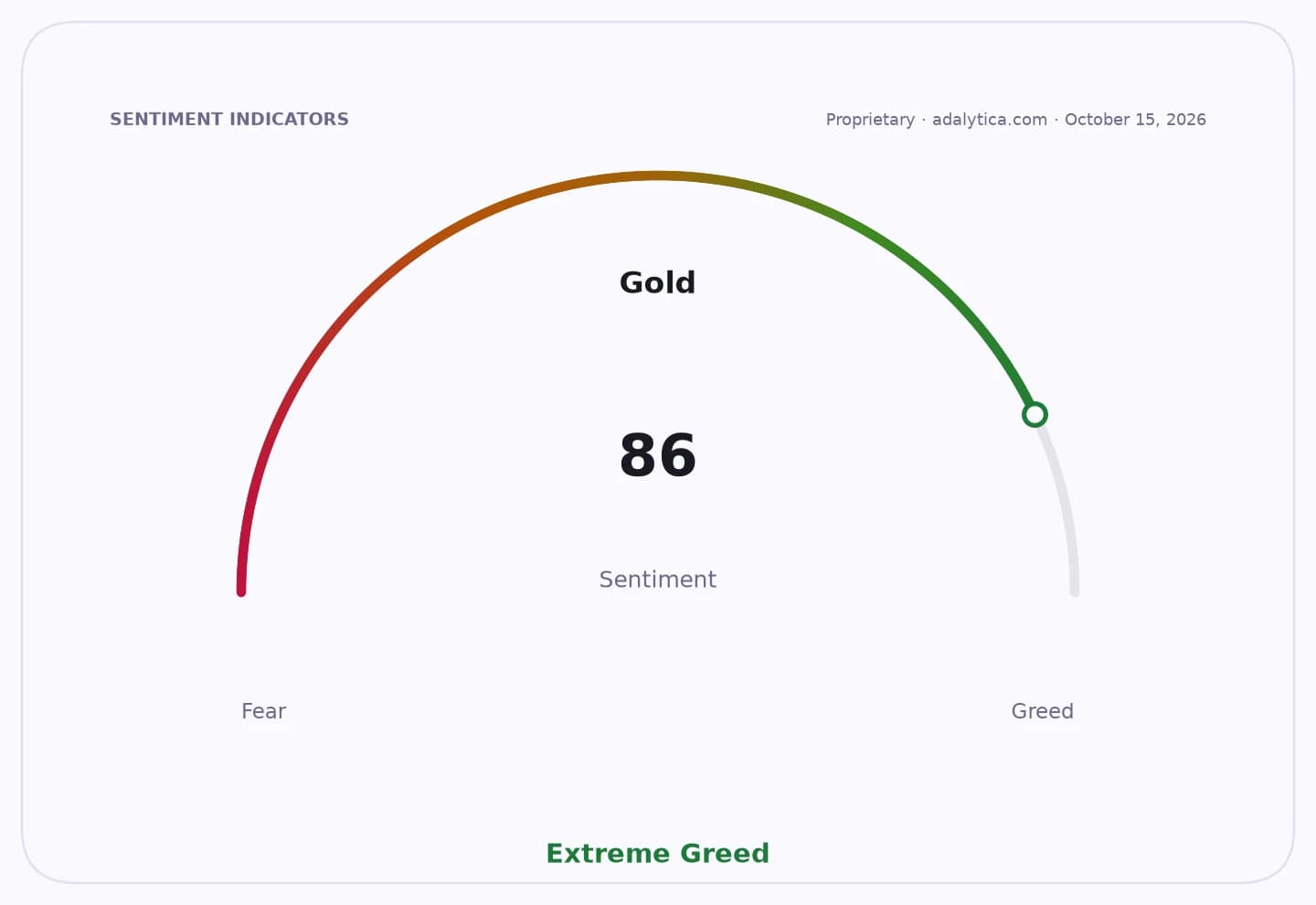
The timing is favorable for that pitch. Adalytica’s Gold Fear & Greed Index is at 86, in “Extreme Greed,” after a 75-point jump over the past week and a 71-point rise over the past month, suggesting elevated interest in the metal. Even after a recent pullback, gold remains near the center of investor attention, while the U.S. dollar signal has weakened, with the awareness gauge in “Fear.” In other words, the macro backdrop is still supportive of assets seen as alternatives to cash and fiat money.
The price action, however, shows how far gold has moved from a one-way trade. Gold futures on COMEX traded at $4,163.70 an ounce on Oct. 15 after reaching $5,311.60 in early March, while the SPDR Gold Trust, the biggest gold-backed ETF, was last at 375.99 on Oct. 14, below its 50-day and 200-day moving averages. The ETF’s relative strength index was 35.9, a level that points to a technically oversold market after a sharp correction from this year’s highs.
That volatility helps explain why proponents of the payment model are stressing accumulation over timing. Robert Vlášek of FireGOLD said investors should average into gold rather than try to catch the exact bottom, and that smaller denominations can make the metal more usable if customers want to spend only part of their holdings. The company says its system spans 21 European countries and includes several hundred to about a thousand merchants in the Czech Republic, Slovakia and Poland.
For merchants, the appeal is different. Accepting payment directly in gold could give businesses a way to diversify cash balances away from a single currency, especially in an environment where consumers are still anxious about savings protection. For customers, it removes an extra conversion step: they can spend from a gold account rather than sell metal for koruny first and then pay. That may sound niche, but it lowers friction enough to make the product more relevant for affluent households and small firms looking for an inflation hedge.
The bull case is that this is an early sign of gold’s gradual monetization in the digital era, especially in markets where distrust of paper money is high and physical bullion already has cultural resonance. The bear case is that it remains a narrow, operationally complex niche, dependent on merchant adoption, spreads, storage arrangements and the willingness of users to think of bullion as money rather than merely an asset.
Still, the direction is clear: gold is being repositioned from a passive reserve into a transactional medium. If that model spreads beyond Central Europe into the Gulf, North America or Australia — all markets the company says it is targeting — investors may start to view bullion not only as a crisis hedge, but as a financial infrastructure asset with a payments use case.
| Entity | Gains | Losses |
|---|---|---|
| Gold account providers | ▲Merchant adoption | ▼Execution risk |
| Consumers holding bullion | ▲Direct spending option | ▼Conversion friction |
| Merchants accepting gold | ▲Diversified receipts | ▼FX/price complexity |
| Cash and fiat balances | ▲Less appeal | ▼Store-of-value share |