Consumer appetite is holding up better than expected this festive season, even as war-related disruptions continue to weigh on confidence, suggesting households are still willing to spend on discretionary goods and giving retailers an important near-term lift.
Holiday Spending Holds Up Despite Fragile Sentiment

That matters because festive sales often set the tone for the year-end retail cycle and can help determine whether brands protect margins or are forced into deeper discounting. In a market where consumers are juggling inflation, geopolitical headlines and uneven sentiment, resilient spending implies demand is being sustained by employment, wage growth and a still-functional household balance sheet rather than by exuberance.
Sentiment IndicatorsⓘProprietary · adalytica.com · July 26, 2026
This is a snapshot — live sentiment, awareness and momentum for 130+ markets update continuously in the dashboard.Open AlphaPulse
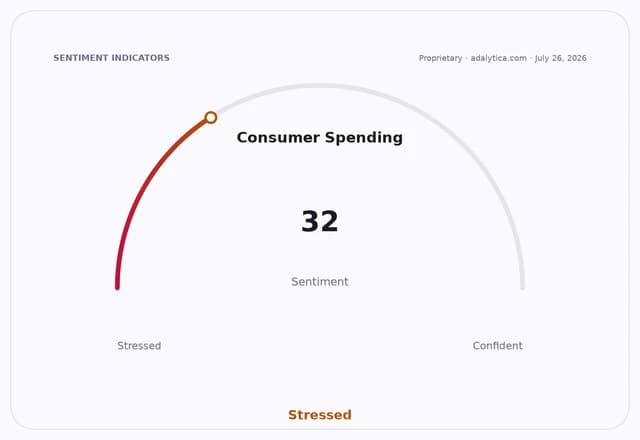
The latest data points in that direction. A broad consumer spending gauge tracked by Adalytica.com shows sentiment at 32, classed as neutral, after a sharp deterioration over the past month in awareness, which sits at an extreme-fear reading of 11. Retail sales sentiment is firmer at 67, but still sits below earlier-year highs, indicating shoppers remain cautious even if they are not pulling back in a meaningful way.
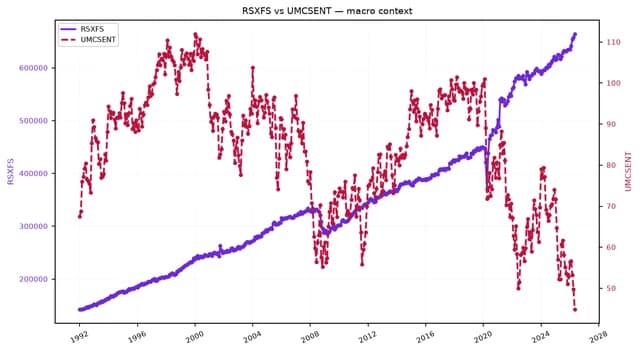
Macro conditions help explain the split. The U.S. unemployment rate has edged down to 4.2% in the latest reading, while a measure of consumer sentiment from the University of Michigan remains deeply depressed at 44.8 in May, underscoring a familiar pattern: households are pessimistic about the outlook, but labour-market stability is still supporting actual purchases. In other words, sentiment is weak, spending is not.
That gap is important for companies exposed to festive demand. Stronger-than-feared footfall and basket sizes improve revenue visibility for retailers and consumer brands at a time when inventory discipline remains crucial. The SEC filings of major chains including Macy’s, Walmart and Target point to a continued focus on assortment, pricing and comparable-sales growth, suggesting management teams are still calibrating for value-seeking shoppers rather than a broad collapse in demand. Costco’s recent filings similarly show healthy ticket growth and shopping frequency, reinforcing the view that consumers are trading carefully rather than disappearing.
The market has been sending mixed signals. The SPDR S&P Retail ETF, XRT, has recovered from a sharp spring selloff and is now trading around its 50-day and 200-day moving averages, with the relative strength index in neutral territory, reflecting a market that has rebuilt some confidence but is not yet pricing in a strong consumer boom. Amazon’s shares have also been volatile, a sign that even the strongest retail platforms are being judged on execution and conversion rather than on a simple demand tailwind.
For investors, the key implication is that the festive season may prove better for volume than for pricing power. That favors scaled operators with disciplined inventory, strong supply chains and value propositions, while leaving more exposed discretionary names vulnerable if promotions intensify. The bullish case is that resilient spending, supported by a tight labour market, keeps holiday revenue growth positive. The bearish case is that confidence remains fragile and any shock from geopolitics, rates or fuel prices quickly pushes consumers back toward caution.
What to watch next is whether festive demand broadens beyond essentials and promotions into higher-margin discretionary categories. If it does, retailers could exit the season with cleaner inventories and better earnings momentum. If not, the apparent strength may prove narrow, with the benefits concentrated among the biggest chains and value players while the rest of the sector remains trapped in a fight for wallet share.
| Entity | Gains | Losses |
|---|---|---|
| Large retailers | ▲Higher holiday sales | ▼Margin pressure from promotions |
| Value-focused chains | ▲Traffic from cautious shoppers | ▼Less pricing power |
| Discretionary brands | ▲Stronger festive orders | ▼Slower premium spending |
| Consumers | ▲More choice and discounts | ▼Little relief from uncertainty |