The widening rift between Egypt and Ethiopia is turning the Horn of Africa into a higher-risk geopolitical corridor, with investors now forced to price not just a Nile water dispute but the possibility that regional rivalries could spill into the Red Sea and nearby markets.
Horn of Africa risk rises on Egypt-Ethiopia rift
That matters because the Horn sits at the intersection of food security, energy supply, shipping lanes and sovereign risk. A breakdown in diplomacy among Ethiopia, Egypt, Sudan and Eritrea raises the odds of disrupted trade flows, tighter financing conditions and a broader security premium across east African assets. It also complicates already fragile economic planning for governments that rely on external funding, commodity imports and cross-border transport routes.
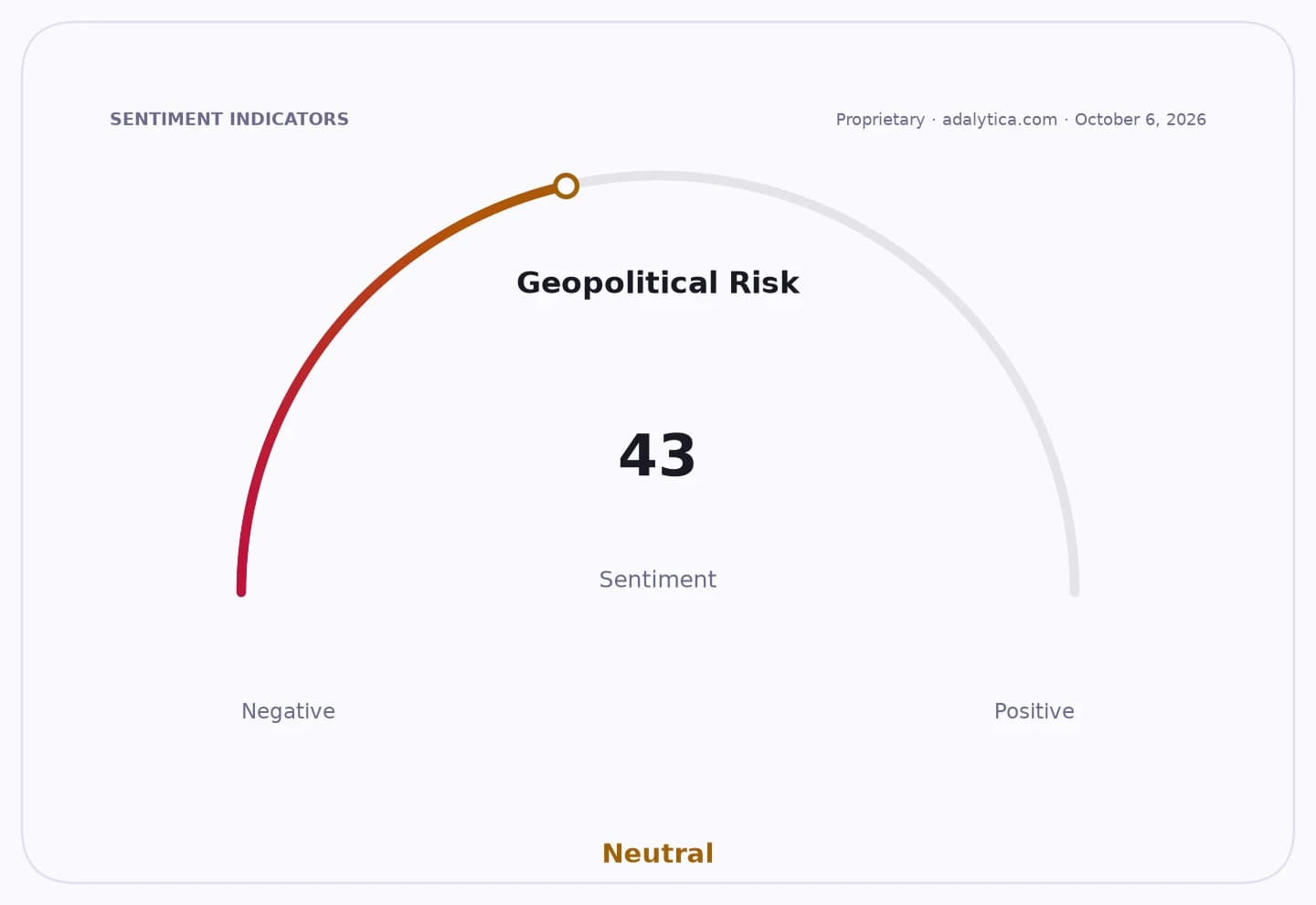
Sentiment IndicatorsⓘProprietary · adalytica.com · October 6, 2026
This is a snapshot — live sentiment, awareness and momentum for 130+ markets update continuously in the dashboard.Open AlphaPulse
The conflict is rooted in geography and memory. Ethiopia’s drive to secure strategic influence in the Nile basin has long been viewed in Cairo as an existential threat to water security, while Addis Ababa sees attempts to constrain its development as a legacy of older regional hierarchies. That historical grievance now overlaps with a sharper security backdrop, after Ethiopia severed diplomatic ties with Eritrea and accused its neighbor of hostile intentions. Eritrea has rejected those claims and accused Prime Minister Abiy Ahmed’s government of expansionism.
The immediate market implication is not a direct asset shock so much as a gradual repricing of political risk. Adalytica’s Global Stability Sentiment gauge is still neutral at 43, but its awareness reading is at 4, or “Extreme Fear,” underscoring how quickly attention has shifted toward instability. For investors, that combination usually means elevated tail-risk rather than a clean directional trade: the market may not be in panic, but it is preparing for a wider range of outcomes.
That matters across multiple asset classes. Frontier debt investors typically demand a higher risk premium when diplomatic breakdowns raise the chance of military escalation or sanctions. Shipping and logistics firms face a less visible but very real threat: even limited unrest can disrupt Red Sea and land corridor routes, lengthening delivery times and pushing up insurance and freight costs. Commodity markets are also exposed, since any deterioration in regional stability can reverberate through grain imports, fuel distribution and metals supply chains.
The region’s fragility amplifies the risk. Ethiopia’s internal conflicts have already strained state capacity, while Sudan remains destabilized by war and political fragmentation. Against that backdrop, a sharper Egypt-Ethiopia confrontation would stretch regional institutions that are already weak. U.S. calls for restraint reflect a recognition that once local disputes link up with wider competition over the Nile and the Red Sea, containment becomes much harder.
For Egypt, the stakes are strategic as well as economic. Water security is tied to agriculture, inflation and social stability, meaning any perceived loss of leverage on the Nile can carry domestic political consequences. For Ethiopia, projecting strength at home and abroad is bound up with access to strategic depth and development priorities. Neither side has much room to look weak, which makes compromise politically costly and raises the risk of miscalculation.
Investors should watch for three things: whether diplomatic channels reopen, whether Eritrea or Sudan become more directly involved, and whether shipping or border security begins to deteriorate enough to affect trade insurance and sovereign spreads. For now, the market is signaling caution rather than capitulation. But the narrative is clear: a water dispute rooted in history is mutating into a broader security problem that could redraw the economic map of the Horn of Africa.
| Entity | Gains | Losses |
|---|---|---|
| Regional security assets | ▲Higher risk premia | ▼Stability assumptions |
| Importers and shippers | ▲Little | ▼Higher freight/insurance costs |
| Egypt | ▲Leverage in diplomacy | ▼Water security, inflation risk |
| Ethiopia | ▲Strategic room to maneuver | ▼Financing, regional trust |