HCA Healthcare’s sharp drop from this year’s highs is forcing investors to confront a simple but uncomfortable truth: hospital balance sheets are once again being repriced around liquidity, not just earnings.
Hospital Stocks Reprice on Liquidity Concerns
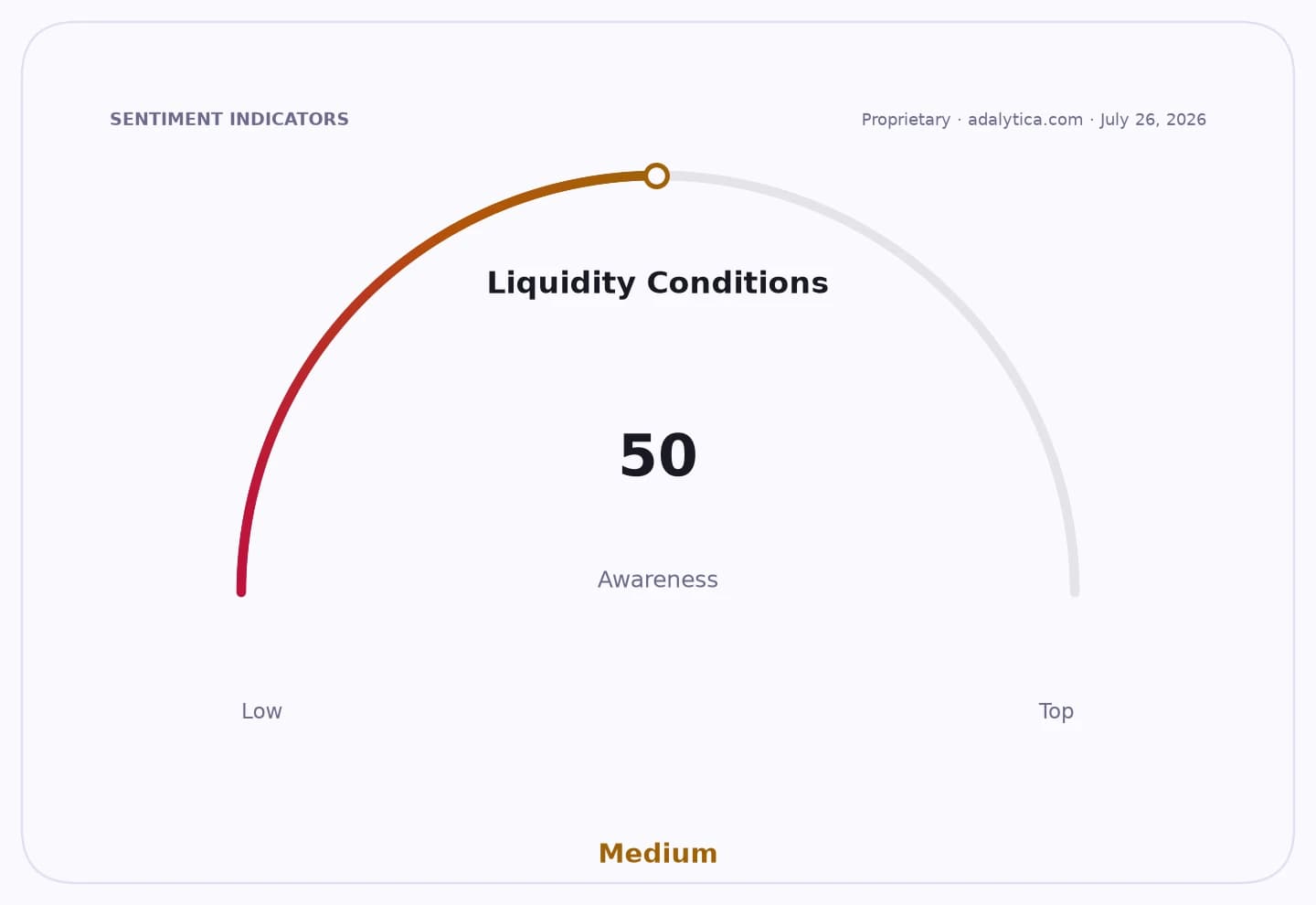
That matters because healthcare is one of the market’s most defensive sectors until funding conditions tighten. When a bellwether like HCA falls more than 20% from its March peak, while Tenet Healthcare and Universal Health Services remain under pressure, the market is signaling that operating cash flow, reimbursement timing and refinancing flexibility are becoming more important than patient volumes alone. For investors, that is a warning that the winners in healthcare will be the operators with the strongest cash generation and the cleanest funding access, while weaker balance sheets may be forced into a costlier capital cycle.
Sentiment IndicatorsⓘProprietary · adalytica.com · July 26, 2026
This is a snapshot — live sentiment, awareness and momentum for 130+ markets update continuously in the dashboard.Open AlphaPulse
HCA, the largest U.S. hospital chain, closed at 382.19 on Friday, far below its 50-day moving average of 388.63 and well under the 200-day average of 456.39. The stock has slid from 543.23 in early March, a stunning reversal that came with heavy trading volume and a deeply oversold reading in June before a partial rebound. The technical damage underscores a broader shift: investors are no longer paying up simply for scale and defensive exposure, but are scrutinizing the liquidity cushion behind that defense.
The story is bigger than one company. Healthcare systems sit in the middle of an economy where borrowing costs are still elevated, payer pressure remains real and public funding is politically contested. Even if government-led healthcare expansion and biomedical investment support long-term demand, they do not eliminate near-term strain on providers that must finance payroll, equipment, IT upgrades and capex while waiting on reimbursement. That is why liquidity commentary is resonating now: it cuts straight to the sector’s ability to convert revenue into free cash flow.
The market is already separating the field. Tenet has ripped to 233.20 from 199.02 just one day earlier, a dramatic move that suggests investors are chasing relative liquidity and earnings upside where balance-sheet risk looks manageable. UHS, by contrast, remains far below its 200-day average near 192.30 even after a bounce to 155.75, reflecting lingering concern that recovery in hospital fundamentals may not be enough if funding conditions stay tight. In other words, this is not a broad “healthcare” trade anymore; it is a liquidity trade.
For investors, that creates a clear asymmetric setup. The market underestimates how quickly hospital valuation multiples can compress when cash generation becomes the first question. It also underestimates the opportunity in the best-positioned operators: those that can use scale, pricing power and access to capital to consolidate distressed assets, invest through the cycle and emerge with more market share. If liquidity stress persists, the sector’s next winners will not be the most cyclical names — they will be the most financeable ones.
The message from HCA is straightforward: this is the point in the cycle where quality balance sheets start to matter more than operating headlines. If you want exposure to healthcare, own the operators with fortress cash flow and avoid the names where liquidity is becoming part of the thesis.
| Entity | Gains | Losses |
|---|---|---|
| Strong balance-sheet hospitals | ▲Lower funding risk | ▼Less attractive for bargain buyers |
| HCA Healthcare | ▲Potential rebound buyers | ▼Valuation pressure |
| Tenet Healthcare | ▲Relative momentum | ▼Bears on weak liquidity names |
| UHS and leveraged peers | ▲Distressed-asset appeal | ▼Higher refinancing risk |