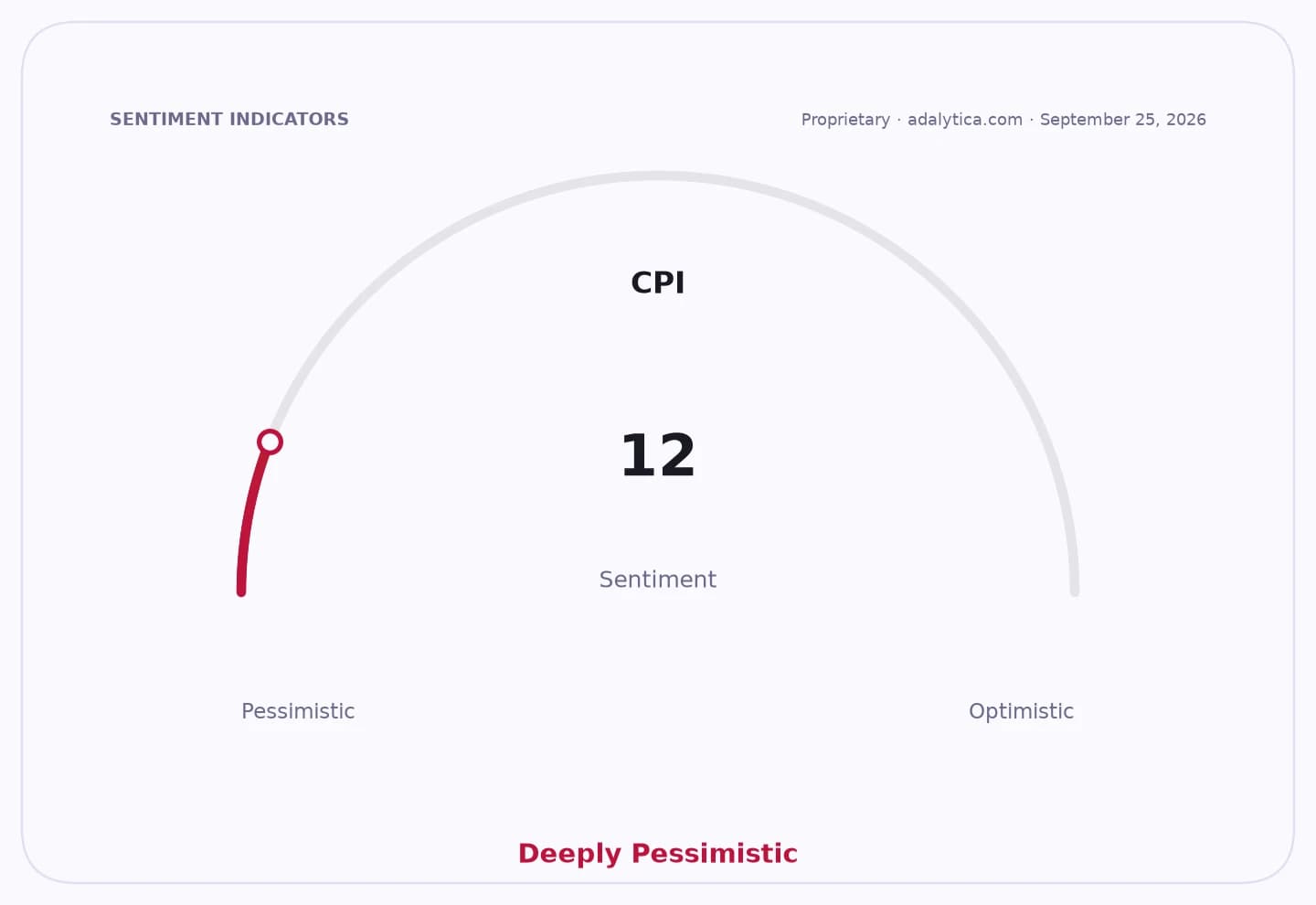
Household debt pressure is worsening even as credit card usage remains elevated, a combination that raises the risk of missed payments, tighter consumer spending and rising losses for lenders.
Household debt stress at 96 as credit card usage stays high
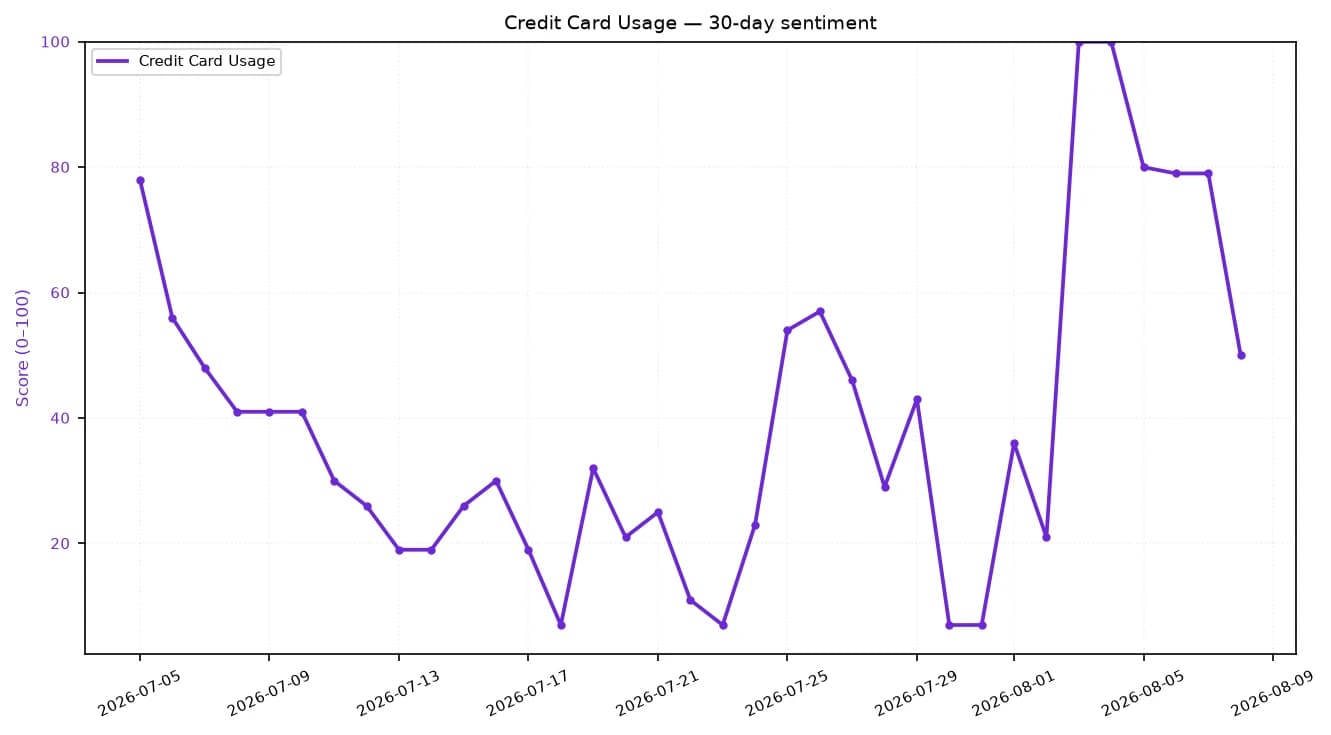
Adalytica’s Household Debt Stress sentiment stood at 96, a level that points to acute financial strain, while its Credit Card Usage sentiment cooled to neutral after briefly spiking to extreme greed. The divergence suggests consumers are still relying on revolving credit, but the ability to service that debt is becoming more fragile. For banks, card issuers and payment firms, that is not just a behavioral shift: it is an early warning that delinquencies could rise if wages, rates or employment weaken further.
Sentiment IndicatorsⓘProprietary · adalytica.com · August 9, 2026
This is a snapshot — live sentiment, awareness and momentum for 130+ markets update continuously in the dashboard.Open AlphaPulse
The economic significance lies in the consumer, which accounts for the bulk of demand in many economies. When households are borrowing to bridge everyday spending rather than to finance durable purchases, credit growth can mask stress for a time but eventually feeds into weaker consumption. That matters for growth, inflation and policy. If households cut back to stay current on debt, retailers, travel firms and discretionary names feel it first. If they do not, lenders absorb the hit through higher charge-offs and provisioning.
The market backdrop helps explain the tension. Credit card balances have historically held up well late in the cycle because consumers prioritize staying current on unsecured borrowing, but that resilience can break quickly when stress becomes broad-based. The recent swing in Adalytica’s debt-stress readings, with the 7-day change still deeply elevated, suggests the pressure is not isolated. It is showing up as a structural squeeze rather than a one-off event.
For investors, the message is two-sided. On the bullish side, higher card usage can support transaction volumes for payment networks and near-term interest income for card lenders. On the bearish side, the same trend can quickly turn into higher defaults, slower loan growth and larger reserve builds. That is especially relevant for lenders exposed to lower- and middle-income borrowers, where interest-rate sensitivity and debt-service burdens tend to be highest.
The key issue now is whether debt stress is peaking or still building. If households continue to lean on credit while sentiment around debt remains extreme, the next phase is usually a deterioration in credit quality rather than a smooth normalization. That would favor defensive balance sheets and payment franchises with pricing power, while weighing on subprime lenders, consumer discretionary retailers and any company dependent on easy credit.
| Entity | Gains | Losses |
|---|---|---|
| Card issuers | ▲Higher revolving balances | ▼Rising charge-offs |
| Payment networks | ▲More transaction volume | ▼Consumer pullback risk |
| Banks with strong reserves | ▲Fee and interest income | ▼Funding for weak borrowers |
| Households | ▲Short-term cash flow bridge | ▼Longer-term debt burden |