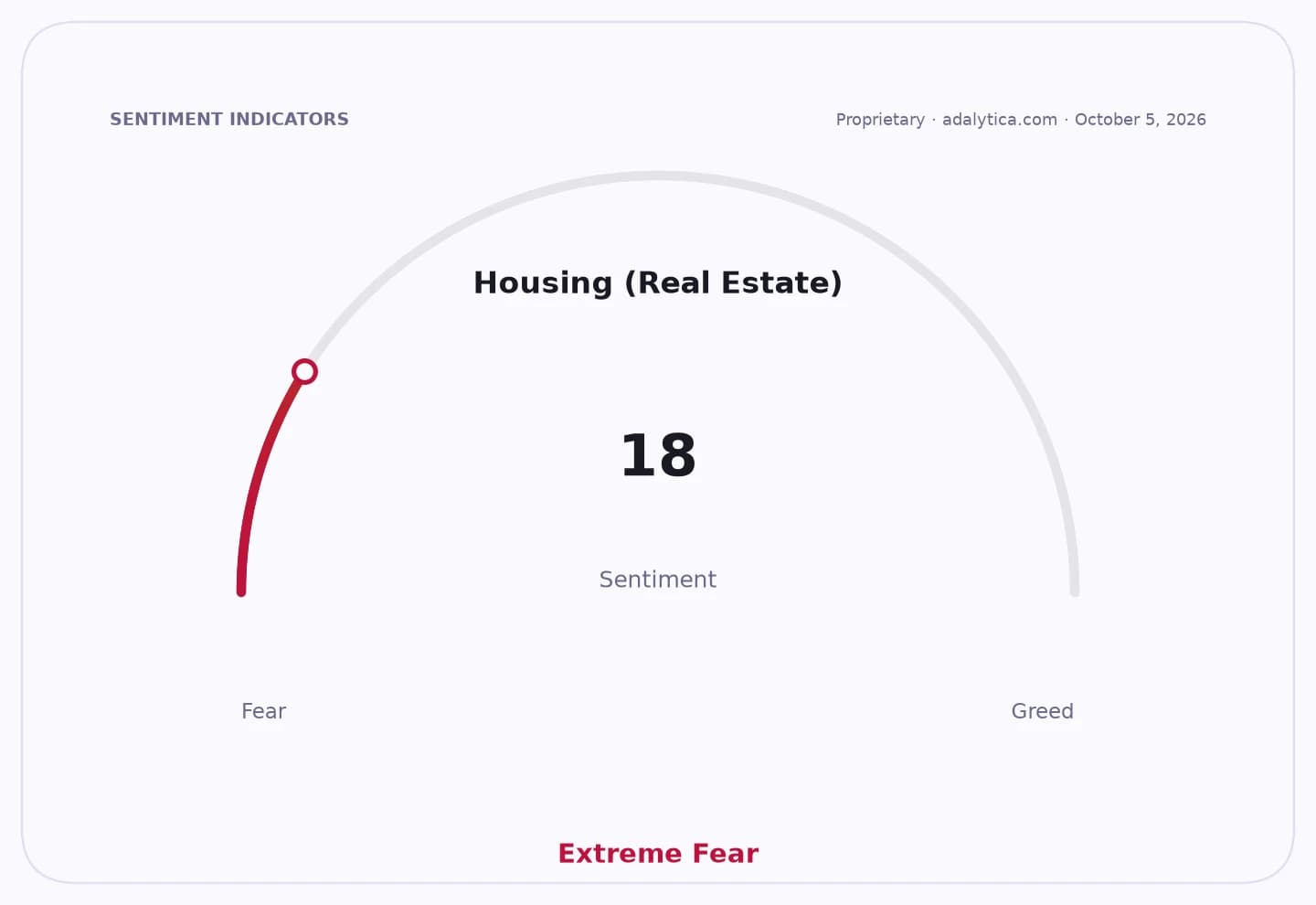
The housing trade is losing altitude as borrowing costs climb back toward cycle highs, squeezing affordability and dragging homebuilder and real-estate ETFs lower even as housing sentiment remains elevated.
Housing ETFs Fall as Mortgage Rates Rise
The 30-year mortgage rate has risen to 7.4% and is forecast at 7.567% in the near term, levels that materially worsen monthly payments and threaten demand just as the U.S. housing market had been stabilizing after years of price gains. That matters because housing is one of the most rate-sensitive parts of the economy: when mortgage costs jump, transaction volumes typically soften, builders lean harder on incentives, and rental demand can improve as would-be buyers stay on the sidelines.
Sentiment IndicatorsⓘProprietary · adalytica.com · October 14, 2026
This is a snapshot — live sentiment, awareness and momentum for 130+ markets update continuously in the dashboard.Open AlphaPulse
The policy backdrop has not offered much relief. Home prices, as measured by the Case-Shiller index, have climbed to 337.306 from 308.055 in mid-2022 and are forecast to keep edging higher, reinforcing the affordability squeeze. At the same time, housing starts remain volatile and are projected at 1.2785 million in September after 1.275 million in August, a level that suggests builders are still operating well below the kind of momentum seen during earlier housing upcycles.
Equities are already pricing in that pressure. The iShares U.S. Home Construction ETF, ITB, closed at 82.93 on Oct. 14, down from 104.16 in early December and well below its 50-day moving average of 91.59 and 200-day average of 95.93. The weakness in XHB is similar: the SPDR S&P Homebuilders ETF ended at 92.36, below both its 50-day average of 100.88 and its 200-day average of 105.02. VNQ, the broader Vanguard Real Estate ETF, has also slipped to 90.5 from a recent peak above 95, showing that the selloff is extending beyond homebuilders into the wider property complex.
The technical picture reinforces the macro message. ITB’s RSI has fallen to 31.7, while XHB’s is at 34.0, levels that indicate the group is oversold but not yet clearly washed out. VNQ’s RSI of 46.0 is less severe, suggesting the broader REIT market is weaker in a more measured way. In Adalytica’s Housing Fear & Greed Index, sentiment is at 86, or “Extreme Greed,” while awareness is just 4, or “Extreme Fear,” a combination that often points to crowded positioning against a fragile fundamental backdrop.
There are still bullish arguments. Public homebuilders such as D.R. Horton, Lennar and PulteGroup have been able to use incentives, lot discipline and backlog management to defend margins, and residential landlords including Invitation Homes and American Homes 4 Rent continue to report rent growth in the low single digits. But the bear case is now harder to ignore: at 7%-plus mortgage rates, every incremental rise in borrowing costs hits first-time buyers hardest, delays trade-up purchases and keeps pressure on affordability even if home prices stop accelerating.
For investors, the key question is whether the housing slowdown becomes a soft landing for builders or a longer squeeze on volumes, margins and valuation multiples. If mortgage rates stay near current levels, the market is likely to reward balance sheets, rental income and pricing discipline over pure growth exposure. If rates ease, the levered rebound in homebuilders could be sharp — but for now, the weight of the data argues that the easy money in the housing boom has already been made.
| Entity | Gains | Losses |
|---|---|---|
| Landlords/REITs | ▲Higher rental demand | ▼Slower homebuying |
| Homebuyers | ▲Potential price moderation | ▼Higher mortgage payments |
| Homebuilders | ▲Incentive-driven sales | ▼Lower volumes, weaker margins |
| ITB/XHB holders | ▲Oversold rebound potential | ▼Ongoing sector de-rating |