The biggest takeaway for India’s public-sector workforce is simple: the 8th Pay Commission could deliver a far larger jump in salaries and pensions than many employees are currently baking in, and that makes the eventual government order a major consumer-spending catalyst.
India 8th Pay Commission Could Lift Salaries

If the next commission follows the 7th Pay Commission’s 2.57 fitment factor, an employee with a basic salary of 44,900 rupees in Pay Level-6 could see that base reset to about 115,400 rupees, according to the widely circulated calculation in Gujarati-language reporting. That is not a marginal revision; it is the kind of jump that can materially alter household budgets, loan eligibility and discretionary spending for millions of central government employees and retirees.
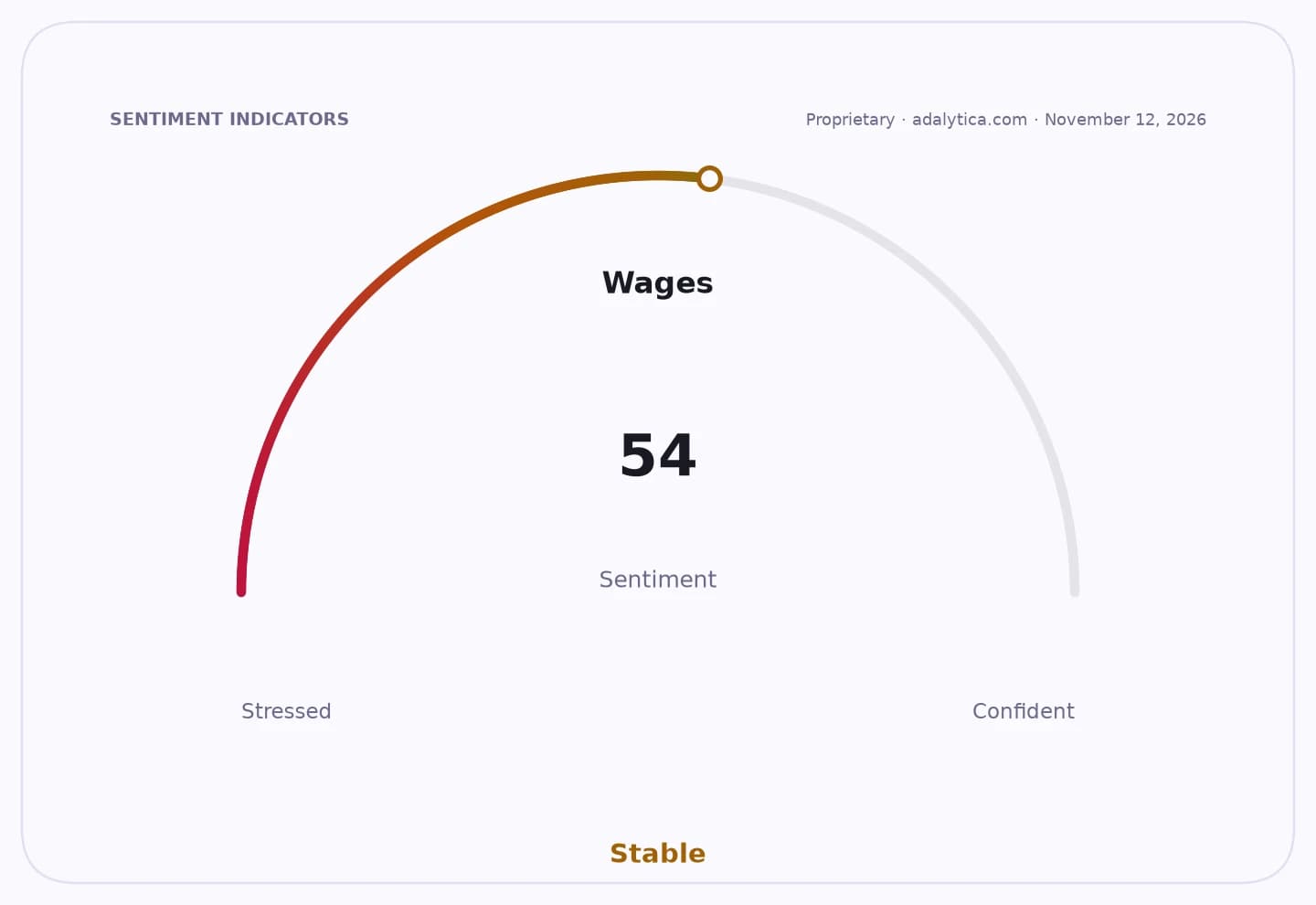
Sentiment Indicators
The economic stakes are bigger than the pay packet itself. Central government salaries and pensions feed directly into consumption, savings and tax collections, while also shaping sentiment in a labor market where wage growth remains uneven. A higher revised pay scale would also lift arrears if implementation is delayed, with one estimate putting 12 months of arrears at roughly 514,000 rupees under the same assumptions.
That is why the timing matters as much as the arithmetic. The commission is expected to submit recommendations by May-June 2027, even though the revision is likely to be considered effective from Jan. 1, 2026. Until the government sets the final fitment factor and rollout date, the market will be trading on expectations rather than certainty.
For investors, the second-order effects matter most. A large pay revision would be a tailwind for consumer durables, housing, autos, travel and retail, especially if arrears are paid in a lump sum. It would also support banks and non-bank lenders through stronger credit demand and cleaner repayment capacity, while pension-linked household spending could give a further lift to staples and healthcare.
The market is underestimating how powerful this can be as a domestic demand impulse. Even without official approval yet, the prospect of a meaningful salary reset is enough to keep salary-sensitive sectors on the radar, particularly if the government chooses a generous fitment factor closer to employee demands for 2.92 to 3.83 rather than the 7th commission’s framework.
The real inflection point will come when New Delhi finally fixes the formula. Until then, the smartest positioning is to watch the beneficiaries of a broad-based income upgrade — and to remember that in India, public pay revisions are not just an HR event, but a consumption event.
| Entity | Gains | Losses |
|---|---|---|
| Central government employees | ▲Higher salary and arrears | ▼Waiting period until rollout |
| Pensioners | ▲Larger monthly pension | ▼Delay in revision |
| Consumer-linked sectors | ▲Stronger spending demand | ▼— |
| Government finances | ▲— | ▼Higher wage and pension bill |