India needs to build more of its own physical AI hardware if it wants to capture the next wave of artificial intelligence investment, with industry executives saying the country still relies on imports for 90% to 95% of current usage in devices such as IoT equipment, cameras and computer vision systems.
India AI Hardware Push Could Boost Local Makers
That matters because the AI boom is no longer just about software and cloud services. As companies and governments add intelligence to machines, sensors and networked equipment, the bigger economic prize shifts toward manufacturing, supply chains and industrial capacity — areas where India is trying to reduce dependence on foreign vendors.
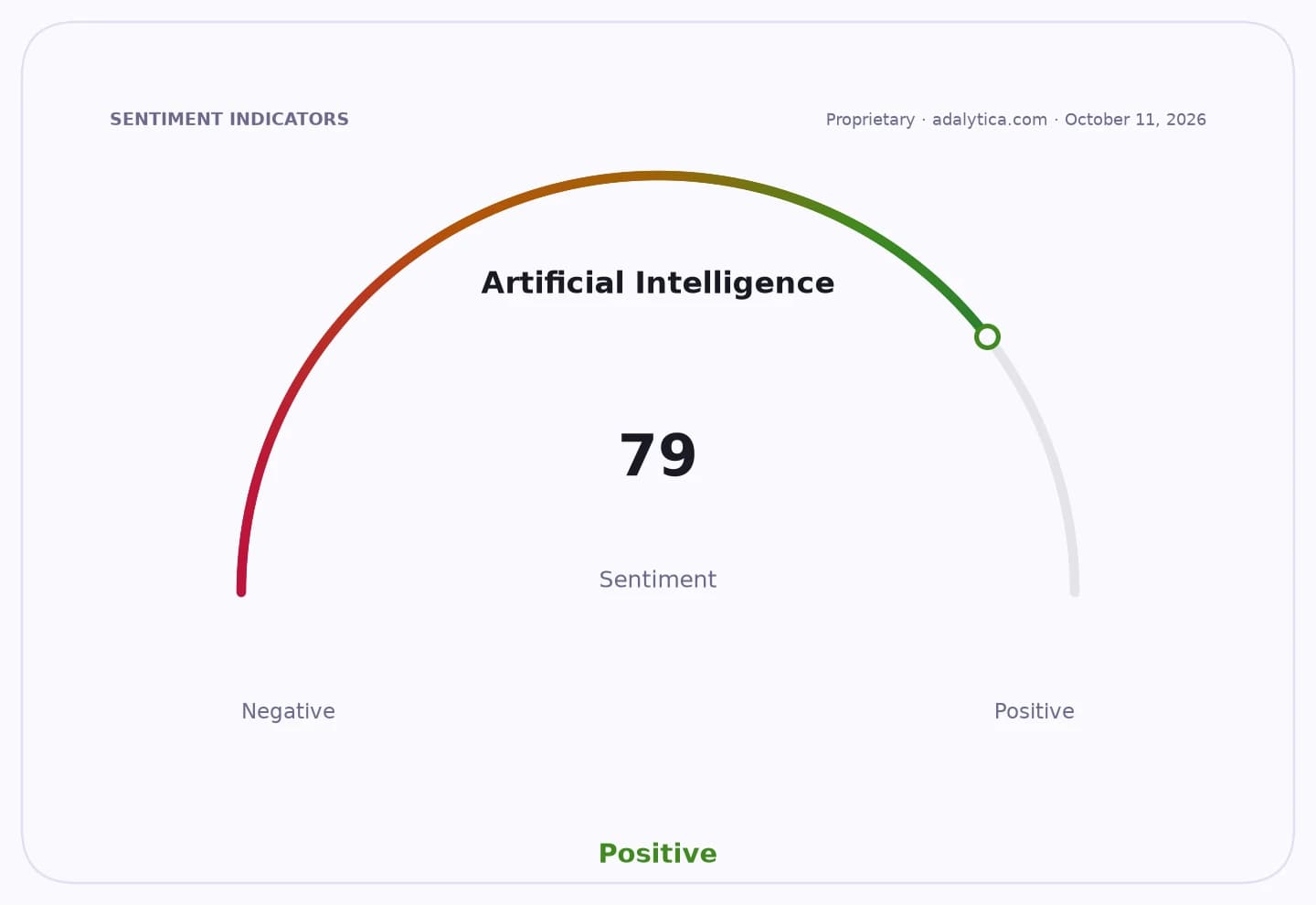
Sentiment IndicatorsⓘProprietary · adalytica.com · October 11, 2026
This is a snapshot — live sentiment, awareness and momentum for 130+ markets update continuously in the dashboard.Open AlphaPulse
Purushothaman KG, national AI leader and head of technology transformation at KPMG in India, said the next stage of AI growth will extend into “physical AI,” creating opportunities for domestic producers of AI-enabled devices. He said India should seize that opportunity as global spending accelerates around embodied AI systems and connected hardware.
The argument fits New Delhi’s broader push to move from being a services powerhouse to a maker of products. India has already used telecom production-linked incentive schemes and proposed manufacturing zones to encourage local output, and policymakers are now trying to position the country to capture more of the value chain as demand grows for cameras, sensors, embedded software and network equipment.
For investors, the implication is that India’s AI story may increasingly favor local manufacturers, telecom equipment makers and industrial technology suppliers rather than only software exporters. It also points to a potential import-substitution tailwind for firms able to meet domestic demand as enterprise customers expand into data centers, healthcare, fintech and digital transformation.
The timeline also matters. Purushothaman said commercial 6G rollout is unlikely before 2029 or 2030, giving India time to build out network architecture, hardware and embedded software before the next upgrade cycle. That creates a runway for capital spending, vendor partnerships and policy support, but also a risk that India remains a buyer rather than a producer if local capacity does not scale fast enough.
| Entity | Gains | Losses |
|---|---|---|
| Indian manufacturers | ▲Local demand for AI hardware | ▼Import dependence |
| Telecom operators | ▲Enterprise revenue opportunities | ▼Consumer-only growth model |
| Foreign hardware suppliers | ▲Existing India sales | ▼Market share if local production rises |
| Investors in AI infrastructure | ▲Longer capex runway | ▼Pure software exposure |