India’s trade gap with China has blown past $100 billion in just nine months, underscoring a structural dependence on Chinese inputs that is proving far harder to unwind than New Delhi’s “Make in India” campaign suggests.
India China trade deficit tops $100 billion

That matters because this is not a one-off surge in bilateral commerce; it is a balance-of-power issue inside Asia’s supply chain map. India’s deficit reached $105.93 billion in the January-September period, already above the $100 billion mark and on pace to exceed the record $116.12 billion set for all of 2025, according to Chinese customs data released Oct. 14. Even after Indian exports to China jumped 40.7% to $19.26 billion, imports rose 23.3% to $125.19 billion, leaving the flow of goods tilted roughly 6.5-to-1 against India.
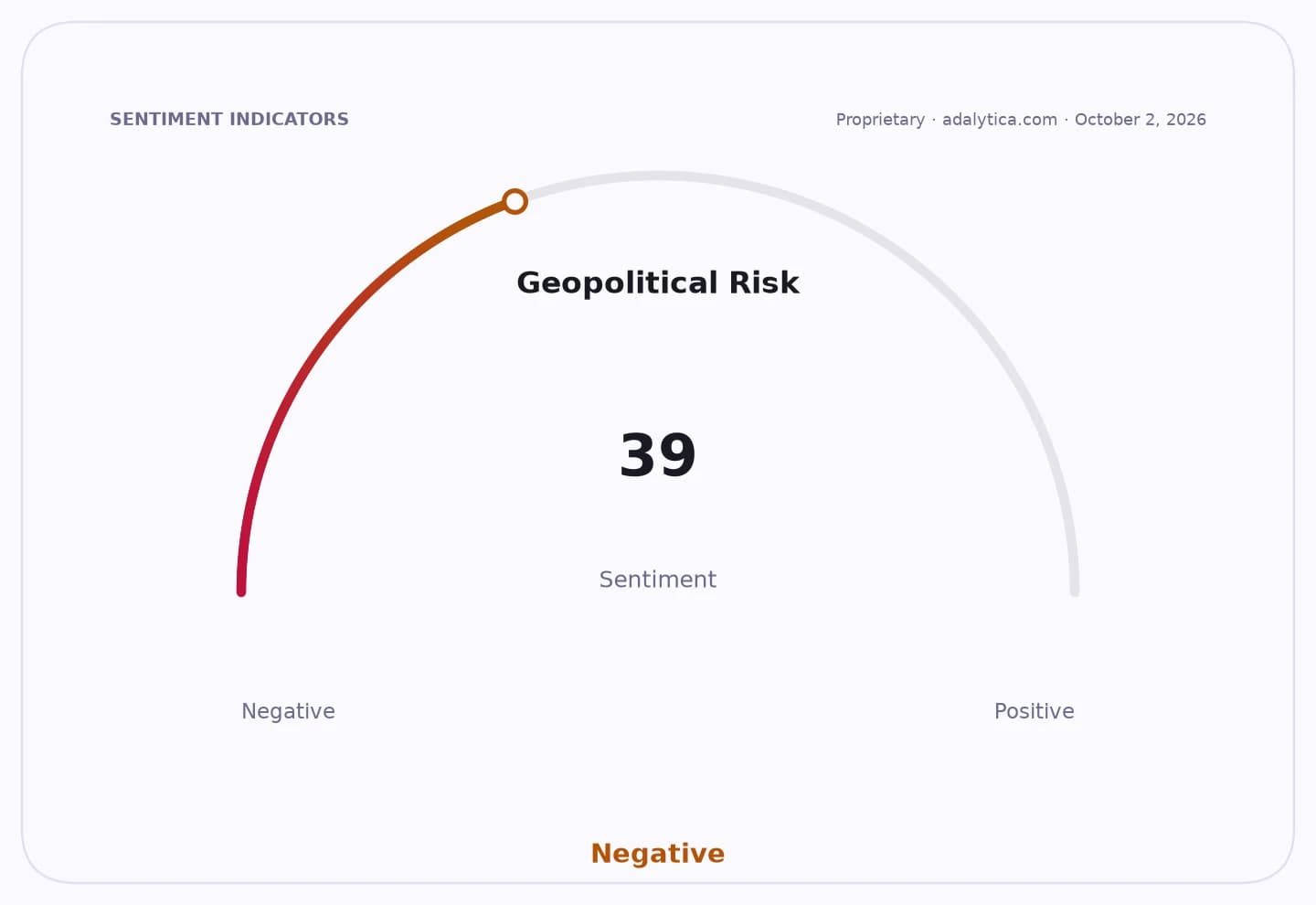
Sentiment IndicatorsⓘProprietary · adalytica.com · October 15, 2026
This is a snapshot — live sentiment, awareness and momentum for 130+ markets update continuously in the dashboard.Open AlphaPulse
For investors, the message is clear: India’s industrial story still runs through China. The country may be one of the world’s fastest-growing major economies, but its manufacturers remain dependent on Chinese intermediates, electronics components, machinery and industrial equipment. That dependence limits India’s ability to capture more value at home, keeps its import bill elevated and makes supply-chain resilience a market theme rather than a solved policy objective.
It also sharpens the geopolitical edge of trade. New Delhi has grown more concerned about Beijing’s tighter export controls on strategic items such as fertilizers and rare earths, which can ripple through Indian production lines and raise costs for domestic industry. The problem is not simply access to the Chinese market; it is that Indian firms still need Chinese goods to make everything from consumer products to industrial equipment.
The numbers show how difficult it will be to rebalance quickly. Indian exports to China are rising from a low base, with seafood, petrochemicals and printed circuit boards among the main items, but they remain dwarfed by the scale of imports. That leaves policymakers with the familiar, and politically awkward, choice between accelerating domestic manufacturing capacity and accepting a trade relationship that keeps widening even as diplomatic ties inch toward normalization.
The market implication is that the beneficiaries are not broad-based Indian exporters, but the “picks-and-shovels” of import substitution: local component makers, industrial suppliers, logistics firms and capital-goods names tied to domestic capex. The losers are Indian manufacturers still reliant on Chinese feedstock, as well as any investor betting that improved diplomacy alone will translate into a fast reset in trade flows.
In my view, the market underestimates how persistent this imbalance can be. As long as India’s growth model depends on imported intermediates and machinery, the China deficit will remain a drag on external accounts and a reminder that strategic decoupling is far behind the rhetoric. The real trade is not between India and China alone — it is between a nation trying to build industrial capacity and a supply chain that still sits largely across the border.
| Entity | Gains | Losses |
|---|---|---|
| Indian exporters to China | ▲Higher sales growth | ▼Still small share of trade |
| Chinese suppliers | ▲Larger export volumes | ▼Trade frictions risk |
| Indian manufacturers | ▲Potential localization push | ▼Higher input dependence |
| India’s policymakers | ▲More urgency for industrial policy | ▼Wider deficit, supply risk |