The global flexible office market is moving from a post-pandemic stopgap to a more durable part of corporate real estate strategy, with India now emerging as the strongest growth engine and a test case for how the sector scales.
India flexible office market grows in 2026

That shift matters because flexible workspaces are no longer just a cost-saving tool for small tenants. They are increasingly used by multinational companies and global capability centers to enter new markets quickly, expand without large upfront capital and keep occupancy risk lower in an uncertain economy. For landlords, that changes the tenant mix and the economics of office buildings; for operators, it raises the stakes on scale, capital access and service quality.
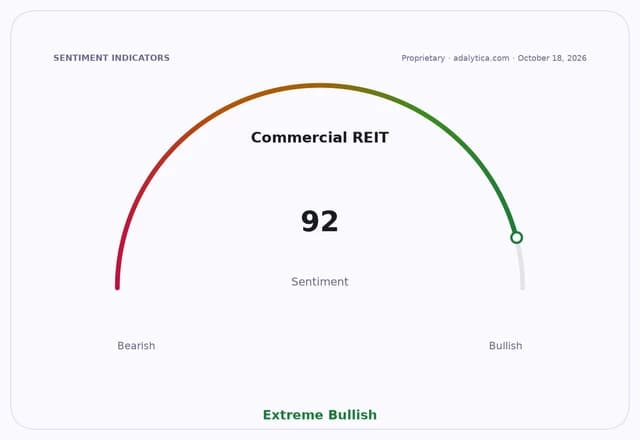
Sentiment IndicatorsⓘProprietary · adalytica.com · October 18, 2026
This is a snapshot — live sentiment, awareness and momentum for 130+ markets update continuously in the dashboard.Open AlphaPulse
Cushman & Wakefield said in its 2026 global flexible office trend report that India is now the world’s most mature flexible-office market, while also becoming the second-most active market globally. Upflex data cited in the report showed the United States still leads global demand, accounting for 38.7% of bookings in the first half of 2026, but India’s role is widening rapidly as occupiers build flexibility into core real estate decisions rather than treating it as a temporary fallback.
In India, flexible offices now account for roughly one-fifth of office leasing activity, making the segment one of the market’s largest tenant categories. Total flexible office supply reached 8.24 million square meters in the first half of 2026, after operators leased 4.1 million square meters, or more than 720,000 seats, between 2023 and 2025. Cushman & Wakefield expects supply to double by 2030, underscoring how quickly the category is moving from niche to institutional.
The broader macro backdrop helps explain the acceleration. Elevated financing costs and a still-uneven leasing environment have pushed occupiers to preserve balance-sheet flexibility, while demand for faster deployment, easier expansion and lower operating risk has increased. That is particularly relevant for multinational firms and global service hubs, which use managed space to enter new cities without committing to long leases or heavy fit-out spending.
The market is also becoming more globalized in both directions. Indian operators are expanding abroad, while international and regional providers are increasing their presence in India. Smartworks is moving into Singapore, and Table Space plans to enter the Philippines through an investment in KMC Solutions, while JustCo and Middle Eastern operators are expanding in India. That cross-border flow suggests the competitive field is consolidating around larger platforms that can deliver consistent standards across markets.
For investors, the implication is that flexible office is becoming a structural demand driver for the office sector rather than a cyclical fringe. That could support leasing volumes for landlords with premium buildings and managed-space capabilities, but it may pressure owners without the capital or operating expertise to participate. The winners are likely to be operators and landlords with scale, institutional funding and the ability to bundle workspace, fit-out and managed services.
The bullish case is that strong demand and rising occupier expectations create a long runway for premium flexible space, especially in Asia-Pacific markets such as Singapore, the Philippines and Malaysia. The bear case is that rapid supply growth could lead to overcapacity if expansion outruns tenant demand or if operators lean too heavily on leverage. Either way, the sector is moving into a phase where execution, not just growth, will determine returns.
For now, the message from India is clear: flexible office is no longer simply about saving money. It has become part of how companies grow, and that makes it one of the more important trends shaping the future of global office demand.
| Entity | Gains | Losses |
|---|---|---|
| Flexible office operators | ▲Higher demand, larger scale | ▼Greater execution risk |
| Landlords with managed-space capability | ▲Better occupancy, richer tenant mix | ▼Traditional landlords without upgrades |
| Multinational tenants | ▲Faster expansion, lower risk | ▼Long-term lease commitments |
| Smaller or undercapitalized operators | ▲Niche demand | ▼Share to scaled platforms |