Non-banking financial companies accelerated credit growth to 15.8% year-on-year in August 2026, a sign that India’s shadow banking lenders are still leaning into retail borrowers and farm-linked demand even as business lending loses momentum.
India NBFC credit growth rises to 15.8% in August
The latest Reserve Bank of India sectoral data show the pace of NBFC lending rose from 10% a year earlier, powered by a 22% jump in retail loans and a 17.4% increase in credit to agriculture and allied activities. That matters because NBFCs are a key channel for consumer finance, vehicle loans, gold-backed lending and smaller-ticket credit that often fills gaps left by banks.
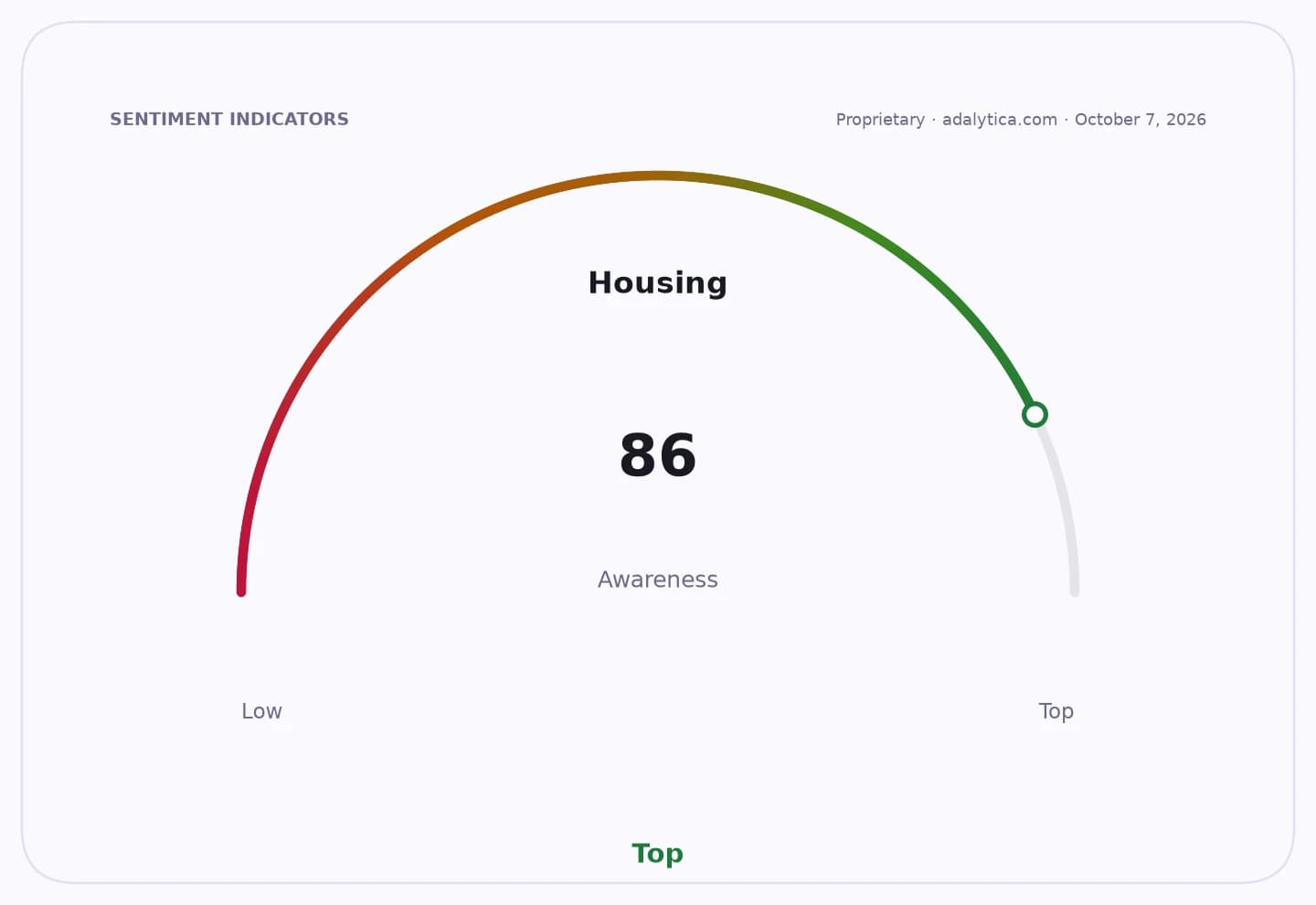
Sentiment IndicatorsⓘProprietary · adalytica.com · October 7, 2026
This is a snapshot — live sentiment, awareness and momentum for 130+ markets update continuously in the dashboard.Open AlphaPulse
Housing loans, loans against gold jewellery and consumer durables were the fastest-growing retail categories. Housing credit rose 12.1% from 3.8% a year earlier, gold jewellery loans surged 69.1% and consumer durables lending climbed 56.4%, while vehicle loans also held up with 15.4% growth.
The shift points to resilient household borrowing appetite and continued demand for secured or semi-secured credit, which tends to be a steadier source of earnings for NBFCs than corporate lending. It also suggests lenders are finding traction in segments linked to consumption and rural income, both of which can support loan books even if wider industry demand remains uneven.
Credit to industry edged up only 8.4%, barely above the 8.3% pace seen a year earlier, while services lending slowed to 16.2% from 24%. Within services, commercial real estate stayed buoyant at 21.8%, but trade and transport operators lost steam, underscoring a more mixed picture outside consumer-facing lending.
For investors, the data are constructive for NBFCs with exposure to housing finance, gold loans, consumer durables and rural finance, while lenders dependent on commercial and transport-linked businesses may see less operating leverage. The figures also reinforce the broader credit-cycle view that lending growth remains supportive of financial-sector earnings in coming quarters.
The RBI sample covers NBFCs in the upper and middle layers, along with housing finance companies, representing about 87% of total NBFC credit. Markets will now look for whether the retail-led momentum carries into the next monthly print and whether slower service-sector demand starts to weigh on overall asset growth.
| Entity | Gains | Losses |
|---|---|---|
| Retail-focused NBFCs | ▲Faster loan growth | ▼None |
| Gold-loan, housing-finance lenders | ▲Higher credit demand | ▼Softer corporate demand |
| Agriculture-linked lenders | ▲Stronger rural credit | ▼Weakness in services lending |
| Trade and transport borrowers | ▲Easier access to credit | ▼Slower loan growth |