Thailand’s household debt burden has climbed to a record 794,945 baht per household, underscoring how weak income growth and stubborn living costs are still squeezing spending power even as the country’s debt-to-GDP ratio is set to edge lower by year-end.
Thailand Household Debt Hits Record 794,945 Baht
The latest survey from the University of the Thai Chamber of Commerce shows household debt remains a structural drag on Southeast Asia’s second-largest economy. While the share of indebted households eased to 91.8% from 95.1% a year earlier, the average debt load rose 7.3% and monthly repayments increased to 21,935 baht, a level that points to continued strain on cash flow rather than repair in household balance sheets.
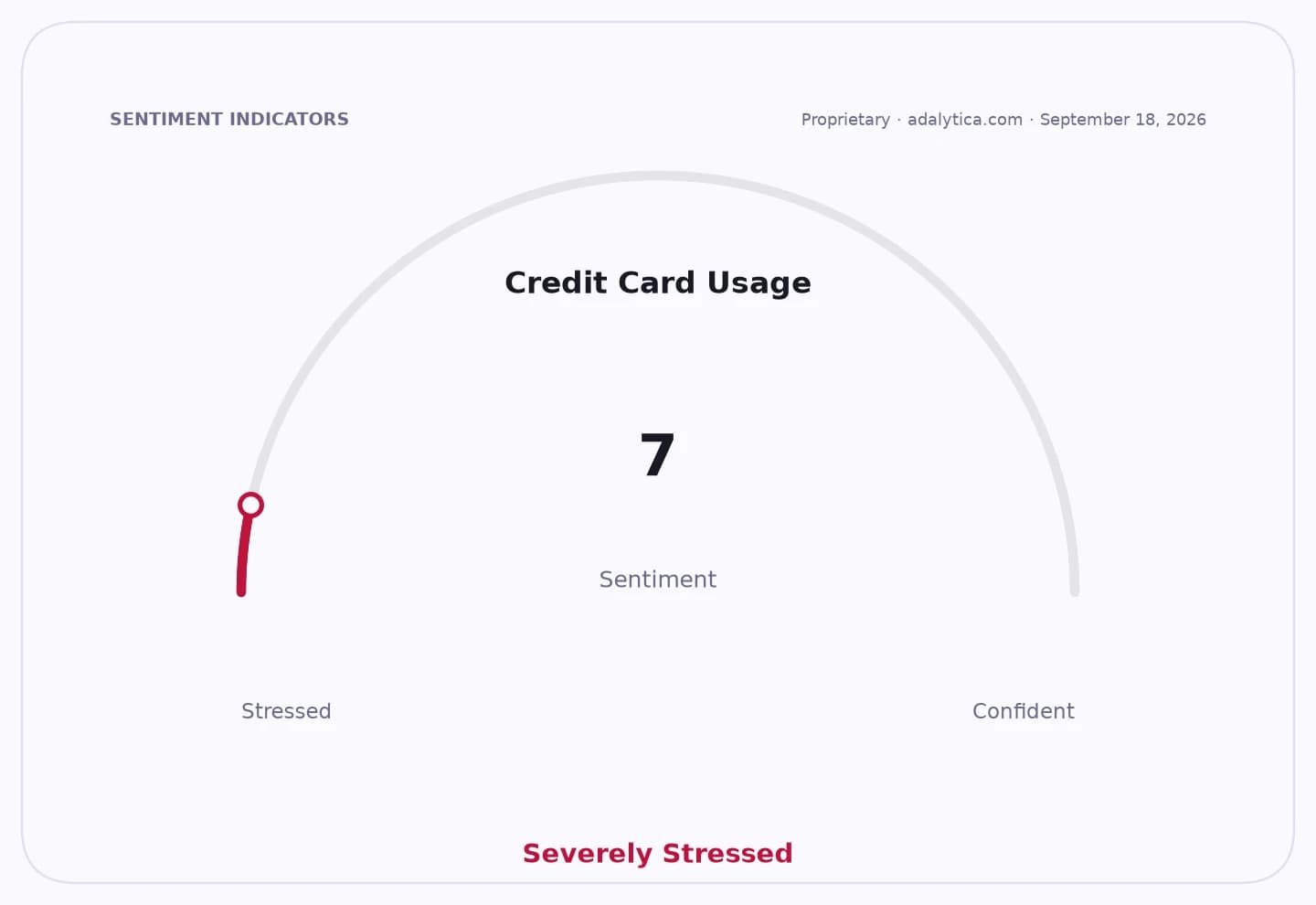
Sentiment IndicatorsⓘProprietary · adalytica.com · September 18, 2026
This is a snapshot — live sentiment, awareness and momentum for 130+ markets update continuously in the dashboard.Open AlphaPulse
That distinction matters for the economy. A falling debt-to-GDP ratio can look like progress, but it may reflect slower credit growth and a still-soft economy more than an actual reduction in stress. Thanawat Polvichai, who led the survey, said the problem remains especially acute for lower-income borrowers and households facing high expenses, with energy costs cited as a major pressure point. The survey found that 15.5% of respondents took on more debt because income was insufficient to cover spending, while 14.1% blamed higher living costs.
For policymakers, the message is that debt serviceability is deteriorating even if headline debt ratios improve. The university estimates household debt could reach 16.5 trillion to 16.6 trillion baht by the end of 2026, while the household debt-to-GDP ratio may fall to about 84% in the fourth quarter if the economy expands 2.5% this year. A weaker 2% growth rate would leave the ratio closer to 84.4%, while 2.8% growth could pull it to 83.7%. In other words, GDP growth rather than balance-sheet repair is doing much of the work.
The composition of debt also points to fragility. Credit card borrowing was the most common form of debt, followed by personal loans and vehicle finance, while buy-now-pay-later balances have more than doubled from a year earlier to 14.2%. That suggests households are relying on short-term, high-cost credit to bridge routine spending, not just to fund durable assets or investment. Among those borrowing for business, more than half used the money for working capital, reflecting the same liquidity squeeze on small firms.
For banks and other lenders, the near-term risk is not a broad collapse in borrowing, but a rise in delinquencies and cautious credit demand. The survey found 67.5% of respondents had missed or delayed a payment in the past year, while only 73.1% said they could still pay on time. Adalytica’s Household Debt Stress Sentiment gauge remains in neutral territory, but the sharp deterioration in the credit-card usage reading points to persistent consumer caution and weaker discretionary spending.
The bull case is that lower debt-to-GDP could ease pressure on the financial system and give households some breathing room if growth improves and inflation stays contained. The bear case is that the headline ratio will continue to fall for the wrong reason — because lenders are tighter and households are too stretched to borrow more, even as arrears rise.
For investors, the implications run through Thai consumer stocks, banks, retailers and lenders exposed to unsecured credit. A household sector that is still servicing record debt is likely to keep consumption subdued, limit margin expansion at discretionary retailers and keep credit quality under scrutiny. Unless wages rise faster or the government delivers more effective debt restructuring and income support, Thailand’s household debt problem is likely to remain a brake on growth into next year.
| Entity | Gains | Losses |
|---|---|---|
| Thai lenders | ▲Lower headline leverage ratios | ▼Higher delinquency risk |
| Households with stable income | ▲Slight easing in debt ratios | ▼Rising repayment burden |
| Retailers and consumer brands | ▲Some support from credit use | ▼Weaker discretionary spending |
| Policymakers | ▲Room to cite improving debt/GDP | ▼Pressure to lift wages and support borrowers |