When corporate profits soar but staff wages stagnate, India is getting a warning sign that goes beyond fairness: the economy may be making money for shareholders without building the household income growth needed to sustain demand.
India Profits Rise as Factory Wages Lag

That matters because profits alone do not create a self-reinforcing expansion. If companies are earning more, but workers are not sharing meaningfully in the gains, consumption stays weak, private investment remains cautious and the economy risks becoming trapped in a loop of high corporate margins and sluggish job creation. For long-term investors, that is not just a social issue — it is a signal about the durability of India’s growth engine.
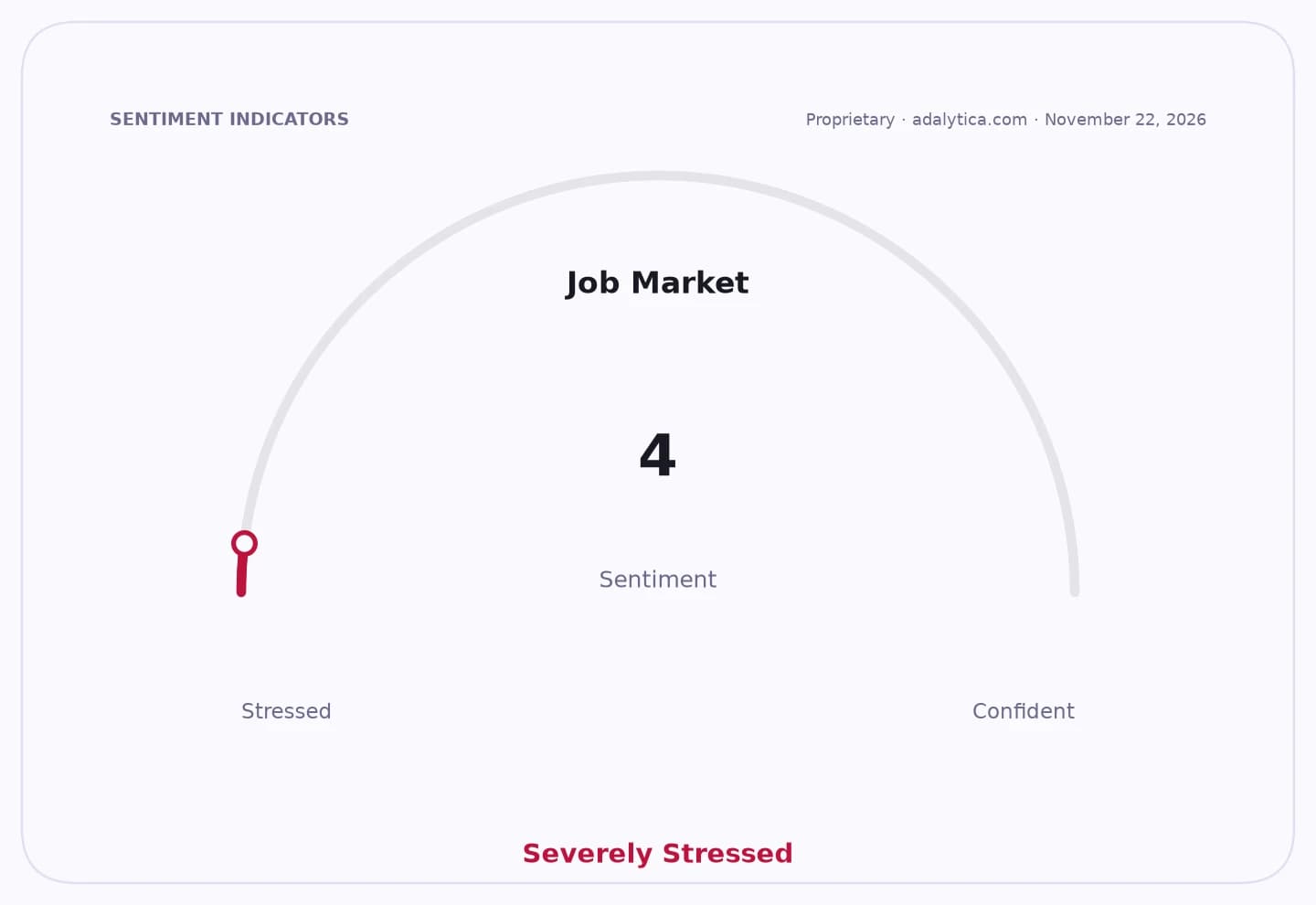
Sentiment Indicators
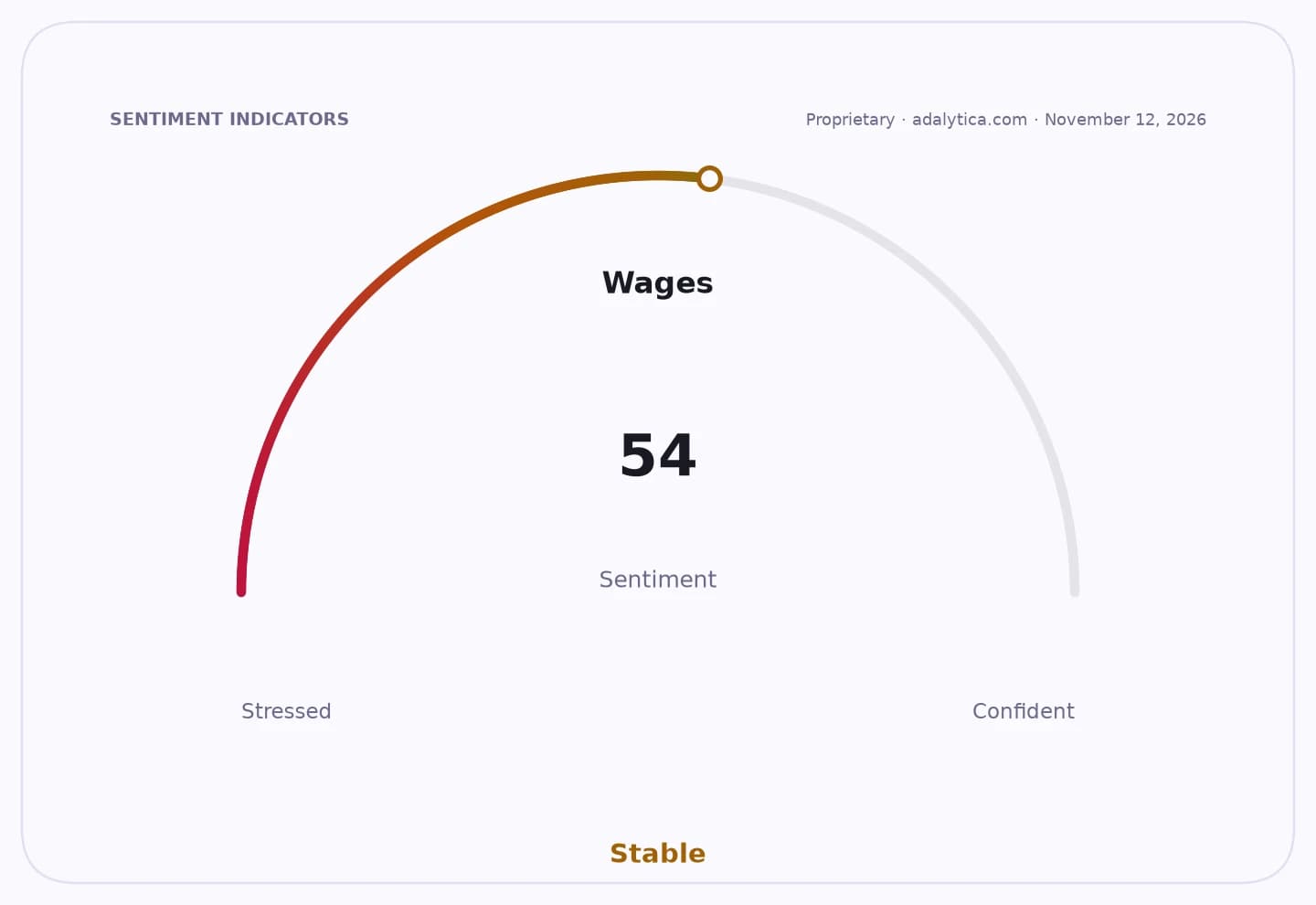
Wages
The numbers underline the gap. Combined annual profits at the Nifty 500 companies climbed from Rs 6.5 lakh crore in 2020-21 to Rs 18.1 lakh crore in 2025-26, a compound annual increase of nearly 23%, and now stand at 5.2% of GDP, an all-time high. Yet factory pay has barely budged in real terms. The latest Annual Survey of Industries shows the average factory worker earned Rs 2.28 lakh in 2024-25, or about Rs 19,000 a month, with inflation-adjusted wages up just 0.7%. In five of the past six years, real factory wages have risen by less than 1% a year.
That divergence helps explain why India’s corporate tax cut in 2019 has not produced the surge in private investment policymakers wanted. Companies do not expand simply because profits rise or taxes fall; they invest when they see enough demand to absorb the extra output. If household incomes are flat, confidence in future sales stays fragile. In that setting, the rational corporate response is often to pay down debt, hoard cash, buy financial assets or raise dividends rather than build new factories and hire more workers.

For investors, that creates an important distinction between earnings quality and earnings breadth. Big listed companies can deliver strong profit growth even when the wider economy is not generating enough wage income to support broad-based consumption. That tends to favor firms with pricing power, export exposure or exposure to wealthier consumers, while leaving mass-market businesses more dependent on credit-fueled demand. It also raises a simple question: how long can profits outpace wages before domestic demand becomes the bottleneck?
The policy backdrop is just as important. Narendra Modi’s unusually sharp criticism of India Inc reflects a growing recognition in New Delhi that the private sector cannot be expected to solve the problem alone. India has spent years trying to promote manufacturing, formal employment and higher productivity, but those gains are harder to sustain if labor remains weakly bargaining and workers see little improvement in living standards. The rise of contract labor, outsourcing and casual work has widened the gap between permanent employees and workers doing similar jobs. Trade unions have weakened, leaving employees with less leverage to claim a fairer share of productivity gains.
That imbalance is not abstract. Industrial unrest has periodically flared when workers conclude that growth is passing them by. At the same time, the spread of gig work has created new forms of labor precarity, even as platforms continue to describe drivers and delivery workers as independent partners. India’s new labor codes acknowledge gig and platform workers, but recognition without stronger income protection will not change the economics of consumption.
There is also a broader macro point here for investors tracking India’s long game. Economies grow sustainably when productivity gains are shared enough to lift spending power. If wages lag too far behind profits, household borrowing often fills the gap — but debt cannot substitute for income forever. The result is weaker consumption, less incentive for capacity expansion and fewer good jobs, which then feeds back into weak wage growth. That is the cycle India needs to break if it wants its profit boom to become a genuine development story.
For long-term investors, the takeaway is not to flee India. It is to understand where the strongest compounding is likely to come from. Companies that can translate productivity into better pay, stronger demand and recurring investment may prove more durable than those relying only on margin expansion. The broader economy will look healthier — and investable — if wage growth finally starts catching up. Until then, this remains a story worth watching closely, especially for anyone betting on India’s consumer market over the next 3 to 10 years.
| Entity | Gains | Losses |
|---|---|---|
| Large listed companies | ▲Higher profits, stronger cash flow | ▼Pressure to share more with workers |
| Workers and households | ▲Little real wage growth now | ▼Weak purchasing power and rising debt |
| Indian economy | ▲Potential productivity gains | ▼Slower consumption and investment |
| Long-term investors | ▲Selective winners with pricing power | ▼Broad consumer demand thesis if wages stay flat |