India’s white-collar job market accelerated in August, and the key takeaway for investors is that demand for specialized tech labor is still strong enough to support hiring even as broader global growth remains uneven.
India white-collar hiring rose in August
Recruitment activity rose 14% from a year earlier, according to Naukri’s JobSpeak index, which climbed to 3,028 from 2,664. The strongest demand came from artificial intelligence and machine learning roles, which grew 31%, underscoring how India’s labor market is being reshaped by enterprise spending on software, automation and digital infrastructure rather than just traditional headcount expansion.
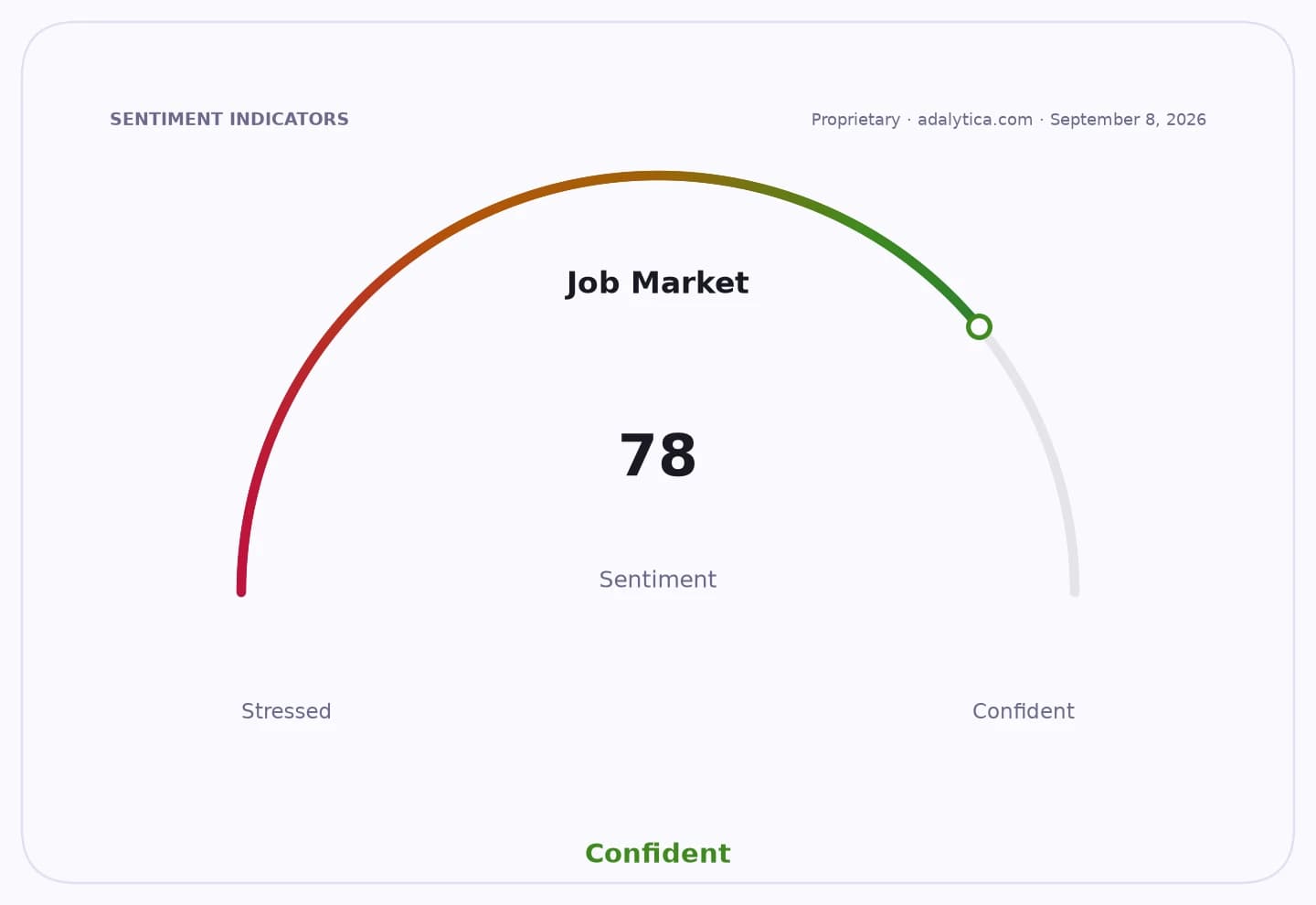
Sentiment IndicatorsⓘProprietary · adalytica.com · September 8, 2026
This is a snapshot — live sentiment, awareness and momentum for 130+ markets update continuously in the dashboard.Open AlphaPulse
That matters economically because white-collar hiring is one of the cleaner reads on private-sector confidence in India. When companies are still adding AI, cybersecurity and GCC talent, they are usually also committing capital to transformation projects, not just replacing staff. The report showed IT and information security demand jumping 32%, while Global Capability Centre hiring rose 10%, a sign that multinationals continue to deepen India as a back-office and technology hub.
The strength was not limited to tech. Automobile hiring increased 19%, healthcare 16% and retail 15%, pointing to a broadening rebound in domestic business activity. Fresher hiring rose 15%, while recruitment for professionals with 13 to 16 years of experience jumped 18%, suggesting firms are hiring both entry-level talent and more experienced operators to scale projects and manage execution.
For investors, the message is that India’s employment engine still has a structural tailwind, especially in sectors tied to digital transformation, outsourced services and premium consumption. Hyderabad led metro hiring growth at 23%, followed by Kolkata at 22% and Chennai at 20%, with Bengaluru and Pune both up 14%, reinforcing the role of India’s tech and business-service hubs in absorbing specialized demand.
The market underestimates how much this can support the next leg of India’s investment story. A firmer white-collar labor market tends to feed income growth, urban spending and services demand, while also strengthening the case for companies exposed to IT services, staffing, business process outsourcing, healthcare services, auto ancillaries and exchange-traded funds tied to Indian equities. The Adalytica Job Market Sentiment gauge is already in Greed territory, reflecting that improvement in hiring conditions.
There are weak spots, of course. Hospitality and travel declined 4% and education fell 8%, showing the recovery is uneven and still vulnerable to pockets of soft demand. But the dominant narrative is clear: India’s job market is not just healing, it is upgrading. The winners are businesses supplying AI, cloud, cybersecurity and skilled labor; the losers are sectors still lagging the digital and capex cycle.
For investors looking for asymmetric exposure, the right trade is not just on India’s consumer rebound but on the infrastructure of white-collar growth itself. That means the picks-and-shovels names tied to IT services, staffing, GCC buildouts and enterprise technology should keep outperforming as hiring turns into a longer-cycle earnings story.
| Entity | Gains | Losses |
|---|---|---|
| AI and machine learning firms | ▲Higher enterprise demand | ▼Talent shortages |
| IT services and GCC operators | ▲More hiring and project flow | ▼Margin pressure from wage inflation |
| India-focused equities | ▲Better growth outlook | ▼Slower sectors like travel and education |
| Jobseekers and freshers | ▲More openings | ▼Candidates in weaker industries |