Indian government bonds are likely to open stronger after a sharp rally in US Treasuries, though investors are still reluctant to chase prices higher because the Reserve Bank of India’s hawkish stance and the risk of hotter domestic inflation keep the market on edge.
Indian government bonds open firmer on lower US yields
The most immediate support for local debt comes from the retreat in US yields, which is easing some of the global pressure that has kept Indian bond prices under strain. But that relief is only partial: traders say the benchmark 6.94% 2036 government bond is likely to move in a narrow 7.37%-7.42% range after closing at 7.3999%, underscoring a market that is willing to buy on dips but not yet to commit to a broader rally.
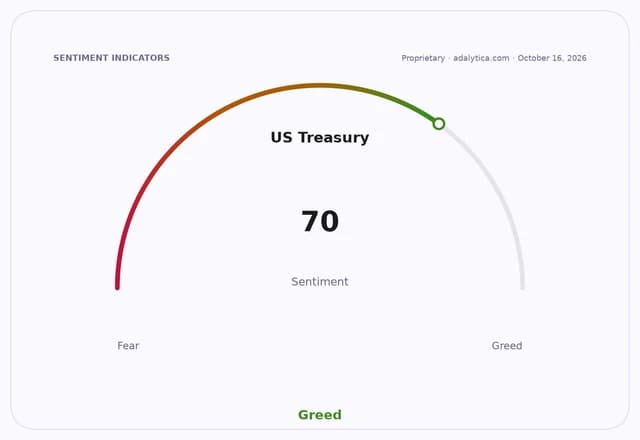
Sentiment IndicatorsⓘProprietary · adalytica.com · October 16, 2026
This is a snapshot — live sentiment, awareness and momentum for 130+ markets update continuously in the dashboard.Open AlphaPulse
That caution matters economically because India’s sovereign yield curve is being pulled in opposite directions. Lower US Treasury yields typically improve demand for emerging-market debt by reducing the relative attractiveness of dollar assets and easing external financing conditions. At the same time, RBI Governor Sanjay Malhotra’s comments this week reinforced expectations that policymakers remain alert to financial stability risks and are not finished with tightening. Traders are also bracing for September consumer inflation to breach 6%, which would keep pressure on the central bank to preserve its anti-inflation credibility.
The bond market’s reaction has already shown how fragile sentiment is. Overnight indexed swap rates rose sharply in the previous session, with the one-year OIS up 10.25 basis points to 6.4375%, the two-year up 8 basis points to 6.5950% and the five-year up 4.75 basis points to 6.7925%. A modest pullback in swaps on Thursday would suggest some profit-taking after that spike, but it would not change the broader message: rate expectations in India remain sticky, and the market is still pricing a difficult policy path.
For investors, the key issue is whether the Treasury-led relief can offset domestic headwinds enough to restore duration demand. Global fixed income has improved after Wednesday’s US CPI reading and the subsequent Treasury rebound, which helped drive borrowing costs lower in Asian trading. That move supports Indian bonds at the margin, especially for real-money accounts looking for yield near 7.40% on the benchmark paper. But the near-term upside appears limited unless inflation data undershoots and the RBI signals a softer stance.
The setup leaves Indian debt vulnerable to two-way trading rather than a clean trend. Bulls can argue that the market has already repriced a great deal of hawkishness and that the current yield levels offer value compared with other emerging markets. Bears will counter that any rally is likely to be sold into as long as inflation risks, higher policy rates and a still-uncertain global rates backdrop remain in play.
For now, the more likely outcome is a firmer open with restrained follow-through. The next catalyst will be India’s inflation print, which will help determine whether the current bond-market repricing is near exhaustion or merely pausing before another leg higher in yields.
| Entity | Gains | Losses |
|---|---|---|
| Indian bond bulls | ▲Buy at higher yields | ▼Miss a sustained breakout |
| Indian bond bears | ▲Rally limited by RBI caution | ▼Face short-covering risk |
| Treasury buyers | ▲Safe-haven demand | ▼Higher inflation worries |
| RBI | ▲More room to stay hawkish | ▼Pressure if inflation exceeds 6% |