Indonesia’s economy accelerated in the third quarter of 2026, but the more important signal for investors is that household consumption, the engine that usually keeps growth broad and durable, contracted quarter on quarter.
Indonesia Q3 GDP Rises as Consumption Falls
That mix matters because a faster headline GDP print can look reassuring even when the underlying drivers are less balanced. The country posted 5.47% year-on-year growth, up from 5.29% in the previous quarter, according to the statistics agency. Yet the pullback in consumer spending suggests the recovery is still leaning on areas other than the domestic buyer, which is the part of the economy most closely tied to job creation, retail sales and corporate earnings across staples, banks, telecoms and consumer names.
Sentiment Indicators
For long-term investors, that is the key tension in the story. When households spend less, businesses selling food, discretionary goods, appliances and services tend to feel it first. Weaker consumption can also ripple through credit demand and margins, especially if firms are forced to rely more heavily on exports, investment spending or government support to keep growth intact. In a market like Indonesia, where domestic consumption has historically been a central pillar of growth, any crack in that pillar deserves attention.
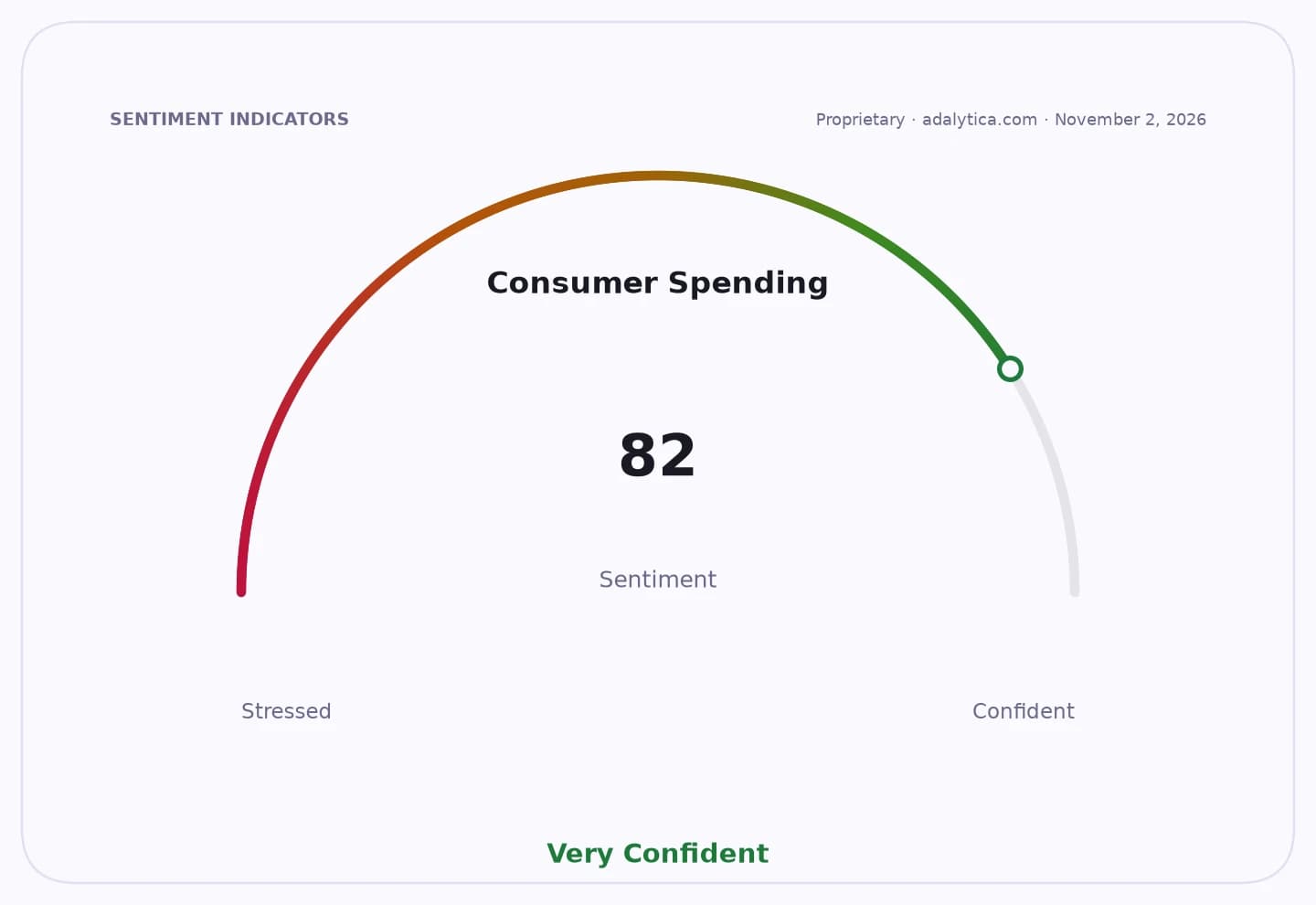
There are also signs that consumers are losing confidence. Adalytica’s Consumer Spending Sentiment sat in “Fear” territory at 18, while awareness was in “Extreme Fear” at 11. That doesn’t tell you exactly how GDP will print next quarter, but it does reinforce the idea that households may remain cautious about big-ticket purchases and nonessential spending. At the same time, the unemployment rate stayed near 4.1% to 4.2%, which helps explain why growth has not rolled over completely: the labor market is still holding together, even if confidence is weak.
The narrative, then, is not a simple growth scare. It is a reminder that Indonesia’s expansion is becoming more uneven. Stronger headline GDP can coexist with fragile household demand, and that usually means investors should separate the broad macro story from the earnings story. Exporters, industrial names and companies tied to public spending may be better insulated than businesses dependent on consumers trading up, eating out or buying durable goods.
For investors, the takeaway is straightforward: Indonesia is still growing at a respectable pace, but the quality of that growth matters more than the headline. If household spending recovers, the economy can broaden and listed consumer businesses may regain momentum. If it doesn’t, growth may remain healthy on paper while corporate earnings underneath stay patchy. That makes this a market worth watching, not chasing.
| Entity | Gains | Losses |
|---|---|---|
| Indonesia’s economy | ▲Stronger headline GDP | ▼Softer growth mix |
| Exporters and state-linked firms | ▲Less reliant on consumers | ▼— |
| Consumer stocks and retailers | ▲— | ▼Slower household demand |
| Long-term investors | ▲Better entry points if sentiment improves | ▼Near-term earnings uncertainty |