Indonesia’s unemployment rate has eased to 4.75%, but the labor market is still not generating enough work for a large and fast-growing workforce, leaving 7.38 million people without jobs and underscoring how uneven the recovery remains.
Indonesia Unemployment Falls to 4.75%
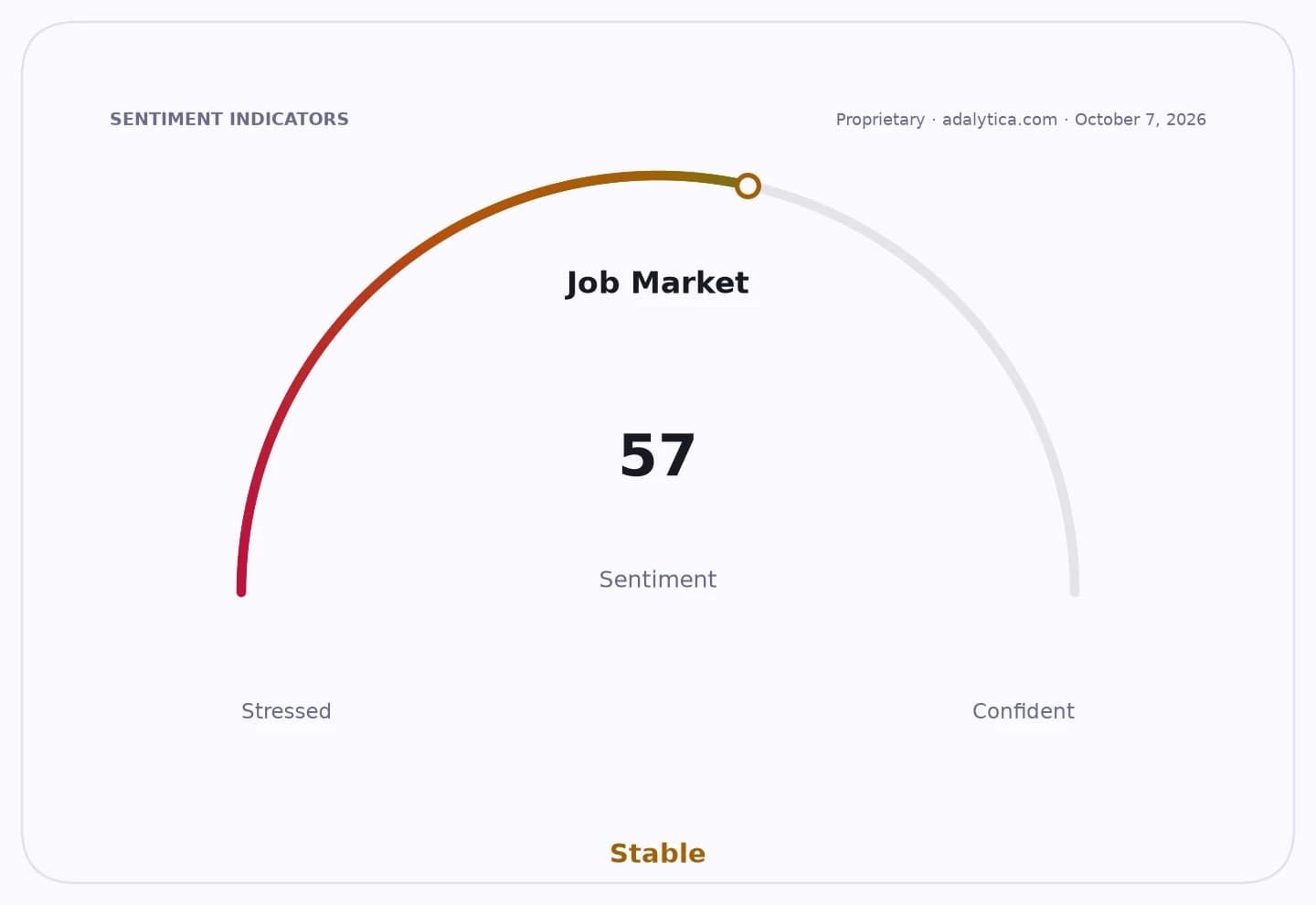
Job Market
The decline of 77,000 unemployed from the previous reading is directionally positive and supports the government’s claim that the open unemployment rate could fall to 4.65% by end-2026, which would be the lowest since 1994. But the headline improvement masks a more complicated picture: around half of Indonesia’s 12.8 million workers remain outside stable employment, pointing to weak job quality, underemployment and a still-fragile absorption of labor into the formal economy.
Sentiment Indicators
That matters economically because Indonesia needs employment growth not just to reduce poverty, but to sustain household spending, which is the main engine of the economy. A labor market that improves only gradually limits wage growth and keeps consumption vulnerable, even if GDP remains resilient. For policymakers, the risk is that headline unemployment falls while broader labor slack remains elevated, leaving a gap between official progress and lived conditions for workers entering the market.
For investors, the message is two-sided. A firmer jobs picture would support retail spending, telecom usage, transport demand and broader domestic consumption, sectors that depend on household income rather than exports. But persistent slack argues for caution on the pace of earnings recovery in consumer-facing companies and on the strength of any demand-led upcycle. Telecom Indonesia, for example, has already seen its shares swing sharply in recent months, and a labor market that is improving only slowly may temper expectations for a broad-based lift in discretionary demand.
The government is pitching the latest data as evidence that its labor and growth agenda is working, and the target of a 4.65% unemployment rate implies further improvement ahead. The key question for markets is whether those gains come from higher-quality jobs and stronger real incomes, or from a labor force that is still struggling to fully re-enter productive employment.
| Entity | Gains | Losses |
|---|---|---|
| Indonesian workers in jobs | ▲Better employment prospects | ▼Limited wage bargaining power |
| Unemployed workers | ▲Lower jobless rate | ▼Still weak job absorption |
| Consumer-facing companies | ▲Potential spending support | ▼Demand recovery remains uneven |
| Government policymakers | ▲Progress toward 4.65% target | ▼Pressure to deliver higher-quality jobs |