Indonesia’s economy expanded 5.47% in the third quarter, and the key reason investors should care is that household consumption is again doing the heavy lifting.
Indonesia Q3 GDP rises 5.47% on household spending

That matters because consumer spending is the backbone of Indonesia’s growth story. When households keep buying, the expansion is broader, more durable and less reliant on one-off boosts from commodities or government outlays. It also gives policymakers room to argue that Indonesia can still deliver solid growth even as global demand stays uneven and oil prices remain elevated around the $100-a-barrel mark.
Sentiment Indicators
For long-term investors, the headline is reassuring, but not because it points to an explosive new cycle. It suggests Indonesia is still resilient enough to keep compounding at a mid-single-digit pace, which is exactly the kind of environment that can support banks, telecoms, retailers and consumer brands over time. Telkom Indonesia, for example, tends to benefit when economic activity stays steady, while consumer-facing companies gain from a healthier domestic demand base.
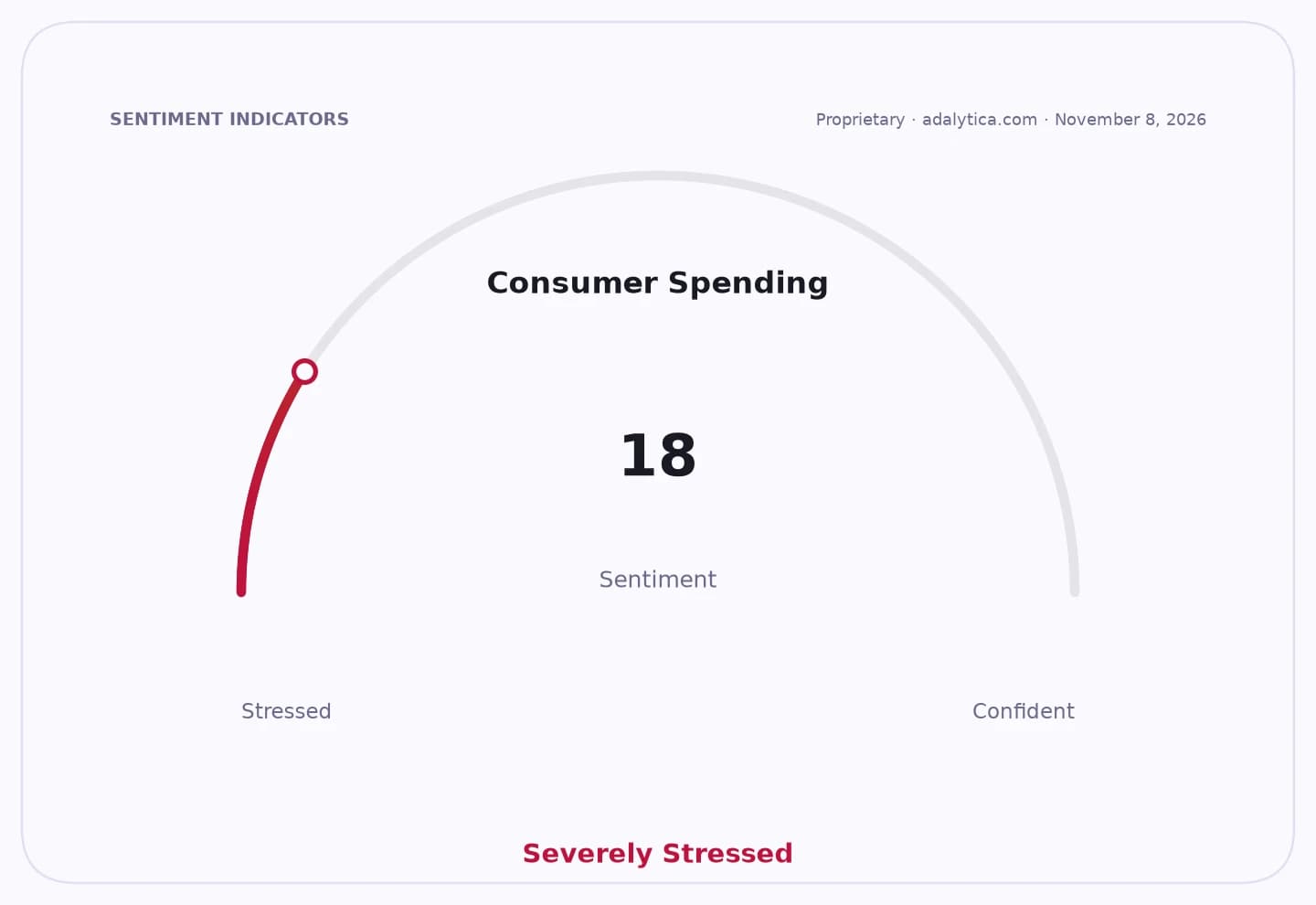
The challenge is that the recovery is not unambiguously strong beneath the surface. Adalytica’s consumer spending sentiment gauge remains only neutral at 32, with awareness still showing fear, which fits the broader concern that purchasing power is improving, but not uniformly. That is why economists and investors continue to watch employment, wages and credit growth closely. A growth rate above 5% is encouraging, but it becomes far more valuable if it is matched by stronger labor absorption and steadier household confidence.
Bank Indonesia has already signaled it sees growth in a 4.9% to 5.7% range for 2026, and that puts the third-quarter print right in the middle of a constructive long-term narrative. Manufacturing is also helping, with the October PMI at 54, its strongest in nearly three years, but the main takeaway remains the same: Indonesia’s economy is proving resilient because domestic demand is still there.
For investors, that means the story is less about chasing a single quarter and more about identifying businesses that can compound as the country’s consumer base slowly deepens. If spending keeps firming and inflation stays contained, Indonesia remains a market worth watching over the next several years.
| Entity | Gains | Losses |
|---|---|---|
| Indonesian households | ▲More spending power | ▼Higher cost pressures if inflation rises |
| Domestic retailers and lenders | ▲Steadier demand | ▼Slower growth if consumption cools |
| Exporters tied to global demand | ▲Stronger local economy | ▼Less benefit from weak rupiah/export swings |
| Cautious investors | ▲A more durable growth backdrop | ▼Limited upside if growth stays only mid-single-digit |