Inflation remains only slightly above target and looks broadly stable for now, but markets are still pricing a tougher rate backdrop, with the 10-year Treasury yield climbing to 5.3% as investors keep a close eye on how long policy will stay restrictive.
Inflation stays steady as 10-year yield nears 5.3%
Fresh inflation gauges show the story is still one of moderation rather than reacceleration. The CPI forecast for September points to a 0.08% monthly dip after a 0.4% rise in August, while core CPI is seen rising 0.08% after a 0.29% increase. That leaves inflation elevated, but not signaling a fresh price shock.
Sentiment IndicatorsⓘProprietary · adalytica.com · October 1, 2026
This is a snapshot — live sentiment, awareness and momentum for 130+ markets update continuously in the dashboard.Open AlphaPulse

For investors, the key issue is that stability in inflation has not translated into easier financial conditions. The 10-year yield ended at 5.26% on Sept. 29 and was forecast to edge up to 5.3%, keeping pressure on duration-sensitive assets. The iShares 20+ Year Treasury Bond ETF, TLT, fell to $77.78 on Sept. 30 from $85.67 on Nov. 5, 2025, while its 50-day moving average at $81.66 and 200-day moving average at $84.13 show the fund remains under sustained technical pressure.
Gold has also cooled as real-rate expectations stay firm. GLD closed at $380.84 on Sept. 30, down from a recent peak near $398.55 in August and below both its 50-day moving average of $396.05 and 200-day moving average of $416.30, suggesting investors are not yet betting on an imminent policy pivot.
CPIAUCSL vs CPILFESL — macro contextadalytica.com
Explore this data interactively — full history, time series and cross-market comparisons.Open AlphaPulse
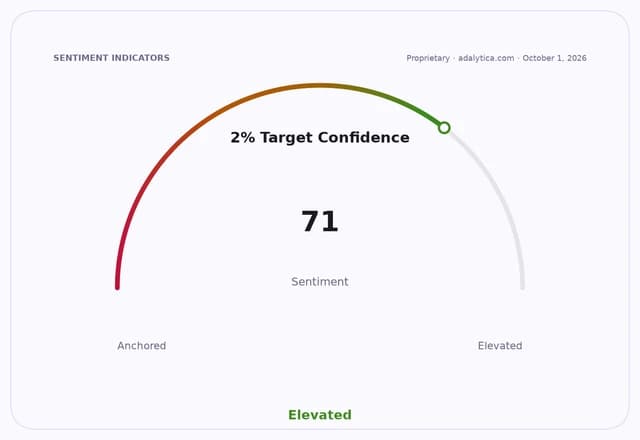
Adalytica’s INFL2 gauge, which tracks confidence in the Fed’s 2% inflation target, sits at 71 with a “Greed” reading after a 60-point jump over the past week. Long-term inflation expectations are neutral at 54, while wage inflation sentiment dropped to 32, indicating the market sees price pressure as contained but not fully resolved.
That combination matters for policymakers because it supports the case for patience rather than urgency: inflation is no longer running away, but it is not low enough to force rapid easing. For investors, the setup favors a higher-for-longer rates narrative, with bond yields, gold and rate-sensitive assets likely to react to every new inflation print and Fed signal over the next few weeks.
| Entity | Gains | Losses |
|---|---|---|
| Fed hawks | ▲Stronger case for restrictive rates | ▼None |
| Bond investors | ▲Yield income from higher rates | ▼Price losses on duration |
| TLT holders | ▲None | ▼Falling bond prices |
| Gold holders | ▲Inflation hedge demand if data worsens | ▼Higher real-rate pressure |