President Donald Trump’s decision to postpone a large-scale attack on Iran, after advisers warned that US anti-aircraft missile inventories were running down, underscores a more immediate constraint on Washington’s war planning: the finite supply of high-end interceptors in an era of persistent missile and drone threats.
Interceptor Strain Supports Defense Stocks

That matters economically because missile defense munitions are not interchangeable, are slow to replenish and are expensive to produce. A pause in offensive planning suggests the Pentagon is balancing escalation risks against the need to preserve air-defense capacity for US forces, allies and shipping lanes already exposed to spillover from the conflict. It also points to the strain on supply chains built around a limited set of contractors, where demand can surge faster than manufacturing can respond.
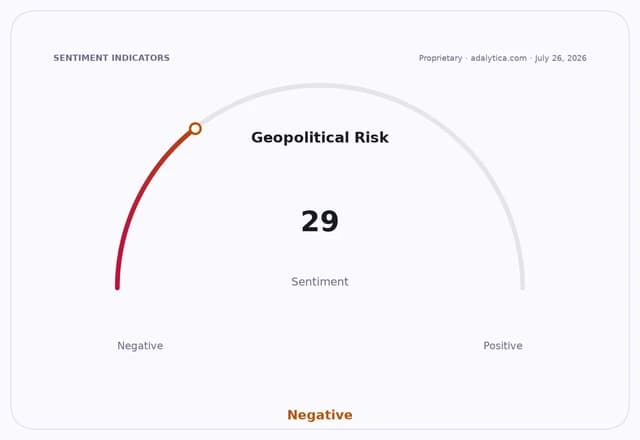
Sentiment IndicatorsⓘProprietary · adalytica.com · July 26, 2026
This is a snapshot — live sentiment, awareness and momentum for 130+ markets update continuously in the dashboard.Open AlphaPulse
The market has already begun to reflect that reality. Lockheed Martin, the main producer of Patriot interceptors and other missile-defense systems, has rallied sharply, with its shares rising to $582.60 on Friday from $496.21 on Oct. 20. That move leaves the stock well above its 50-day moving average and near the upper end of its recent Bollinger Band range, a sign investors are pricing in sustained demand. RTX, another key supplier through its missile and radar businesses, climbed to $212.79 from $150.03 over the same span, while Northrop Grumman rose to $542.24 from $565.02 earlier in the period after a volatile spring selloff. The rebound in defense stocks reflects a simple thesis: the more persistent the missile threat, the more valuable the industrial capacity to intercept it.
The strategic problem is that the US has to manage both inventory and deterrence. If Washington is reluctant to expend interceptors in a broader Iran campaign, it implies the Pentagon may have less slack than markets and policymakers would prefer. That raises the risk of a more measured US response, but it also increases the likelihood of a prolonged standoff in which regional air defenses remain under pressure. For investors, that can support defense primes in the near term, but it also highlights execution risk if production bottlenecks, funding delays or export priorities limit how quickly backlogs convert into revenue.
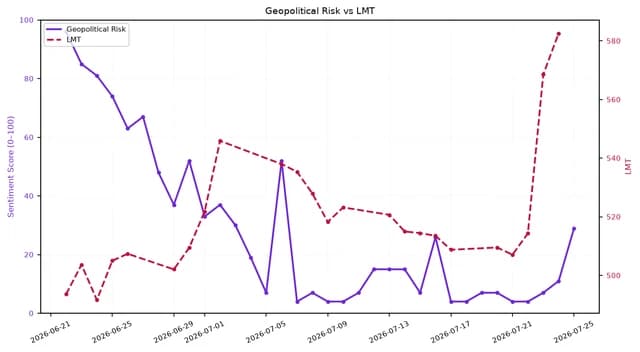
The geopolitical backdrop is deteriorating quickly. Higher regional risk generally benefits defense contractors and can lift energy-market volatility, while hurting airlines, transport firms and broader risk assets if the confrontation widens. Adalytica’s Global Stability Sentiment has dropped to 29, in “Fear,” even as awareness remains elevated, a combination that suggests investors and policymakers are focused on the crisis without seeing a near-term resolution. The S&P 500 trade signal snapshot shows “Extreme Fear,” while the dollar signal has also weakened, reflecting the possibility that a prolonged conflict could undermine confidence without yet producing a classic safe-haven bid.
For now, the key question is whether the delay signals prudence or constraint. If the administration can rebuild interceptor stocks quickly, the pause may simply buy time for a better prepared strike option. If not, it would imply that the US is entering a more dangerous phase of the confrontation with less military depth than assumed, a development that would keep defense shares supported but raise the odds of broader market stress and further escalation in the Gulf.
| Entity | Gains | Losses |
|---|---|---|
| Lockheed Martin, RTX, Northrop Grumman | ▲Missile-defense demand | ▼Inventory strain and production pressure |
| US military planners | ▲Time to preserve interceptors | ▼Freedom to escalate quickly |
| Iran and regional proxies | ▲Delay in US strike planning | ▼Higher risk of eventual retaliation |
| Global equities and airlines | ▲— | ▼Higher geopolitical risk premium |