Treasury Secretary Scott Bessent’s warning that “the economic D-day for Iran is coming” underscores a fresh push by Washington to weaponize sanctions against Tehran, a move that could tighten crude markets, deepen pressure on Iran’s oil exports and keep geopolitical risk premiums elevated across energy assets.
Iran sanctions pressure lifts oil market risk
The significance is economic as much as political: when the U.S. signals a harder line on Iran, the immediate market channel is oil supply. Iran remains a meaningful exporter through shadow routes and intermediaries, and any crackdown on buyers, shippers or financiers can reduce barrels available to the market or raise the cost of moving them. That matters for inflation, for central banks already sensitive to energy-driven price shocks, and for economies that rely on imported crude.
Sentiment IndicatorsⓘProprietary · adalytica.com · August 24, 2026
This is a snapshot — live sentiment, awareness and momentum for 130+ markets update continuously in the dashboard.Open AlphaPulse

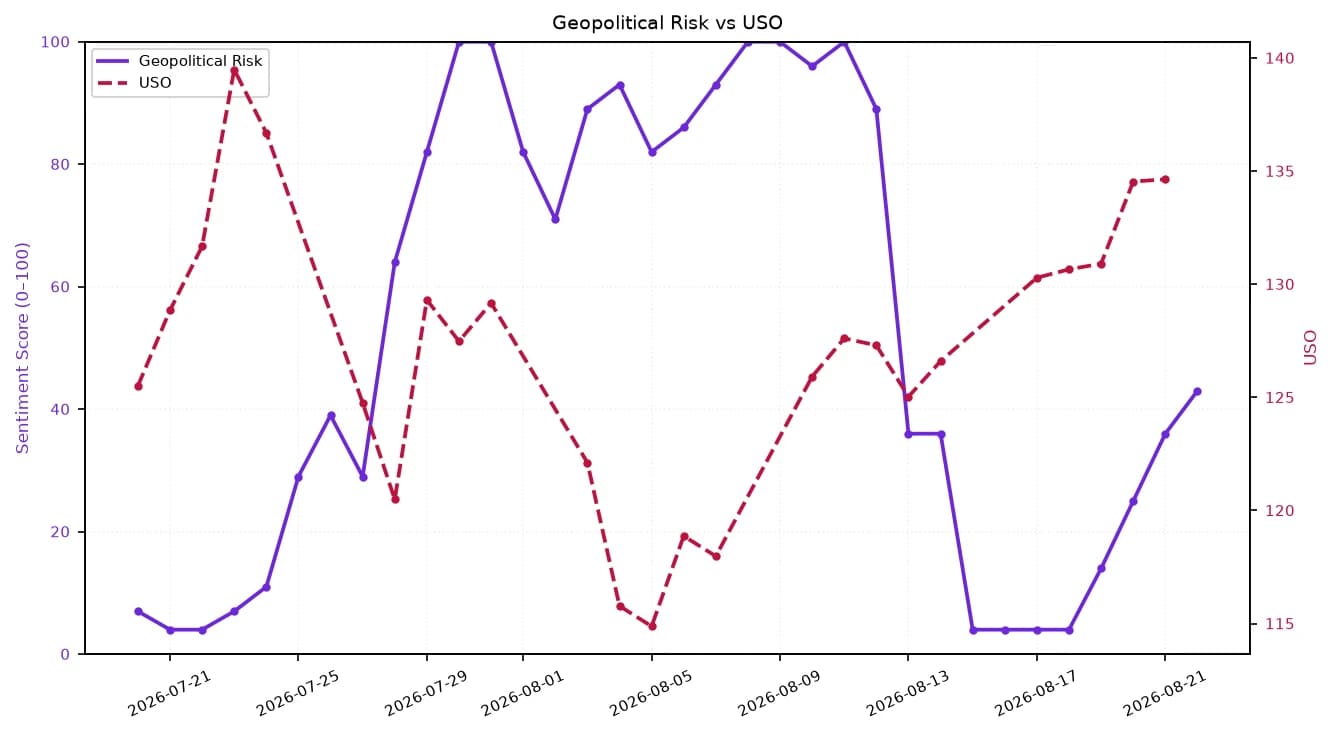
Oil has already been trading with a geopolitical premium embedded in prices. U.S. crude futures linked to USO were last around $134.64, after a sharp run higher from $112.21 in early July, while the Energy Select Sector SPDR Fund, XLE, rose to $63.64 from $55.60 over the same period. USO’s conventional technical indicators show the fund trading well above its 50-day and 200-day moving averages, with RSI at 68.4, a sign momentum remains firm. XLE’s RSI is even more stretched at 75.4, suggesting energy shares have already priced in a good deal of supply risk.
That backdrop helps explain why markets are treating the Iran story as more than another round of rhetoric. Adalytica’s Oil WTI Trade Signals gauge is at 99, or “Extreme Greed,” reflecting elevated market attention to crude. By contrast, Adalytica’s U.S. dollar trade signal sits at 1, or “Extreme Fear,” which is consistent with investors favoring hard assets and energy exposure over the currency as geopolitical tensions build.

For investors, the immediate question is whether tighter sanctions can actually bite harder than previous U.S. efforts. The bull case for energy is that a more aggressive enforcement regime could disrupt the discount barrels Iran sells into Asia, support benchmark prices and lift upstream cash flow for large-cap producers such as Exxon Mobil, Chevron and ConocoPhillips. The bear case is that enforcement leaks, buyers adapt, and the market quickly discounts the headline risk if physical flows remain intact.
The broader policy message is also important. Bessent’s language implies Washington is willing to raise the cost not just for Tehran but for any intermediary country or company that helps keep Iranian oil moving. That can complicate trade for refiners, shipping firms and regional financial institutions, while increasing the risk that other Middle East flashpoints feed into crude volatility.
The next market test will be whether the U.S. pairs the rhetoric with enforcement that meaningfully curbs exports, and whether Iran responds with countermeasures that threaten shipping lanes or regional infrastructure. Until then, investors are likely to keep treating Iranian sanctions as a crude-market catalyst first and a diplomatic story second.
| Entity | Gains | Losses |
|---|---|---|
| U.S. shale producers | ▲Higher crude prices | ▼None if prices overshoot too far |
| Iran | ▲Sanctions pressure eases only if buyers comply | ▼Export revenue, trade access |
| Energy ETFs and majors | ▲Stronger cash flows, valuation support | ▼Margin risk if volatility spikes |
| Oil importers and refiners | ▲Potentially cheaper feedstock only if sanctions fail | ▼Higher input costs, inflation pressure |