Israel is pouring hundreds of millions of dollars into a broad public-relations push to influence Americans, a sign that the political cost of the Gaza war is rising in Washington and could eventually shape U.S. policy, military aid and regional risk pricing.
Israel PR push raises U.S. policy and market risks

The campaign matters economically because U.S. support underpins Israel’s access to weapons, financing and diplomatic cover, while any erosion in that backing could alter defense procurement flows, rebuild costs and security spending across the Middle East. For investors, the issue is less about advertising and more about whether public opinion pressure starts to constrain White House decisions on arms transfers, sanctions and cease-fire diplomacy.
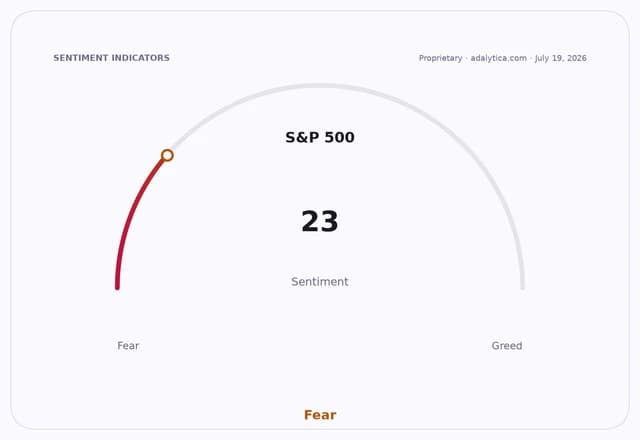
Sentiment IndicatorsⓘProprietary · adalytica.com · July 19, 2026
This is a snapshot — live sentiment, awareness and momentum for 130+ markets update continuously in the dashboard.Open AlphaPulse

The scale of the effort underscores how central the U.S. remains to Israel’s strategic and economic outlook. Tel Aviv’s spending is aimed at Americans across media, digital platforms and political channels, a reflection of how sharply the conflict has shifted from the battlefield to the information war.
That comes as markets are already weighing a more fragile global backdrop. The S&P 500, tracked by SPY, has slipped to 743.29 from a recent high of 754.81, while Adalytica’s S&P 500 Trade Signals show sentiment in “Fear” at 23, down 74 points over 30 days. The move does not directly price the Israel campaign, but it highlights investors’ sensitivity to geopolitical uncertainty and the risk that Middle East tensions spill into oil, defense, shipping and broader risk appetite.
Defense contractors remain the most immediate equity exposure. Companies such as RTX and Northrop Grumman have flagged the Middle East as a key source of operational and regulatory risk in SEC filings, and any shift in U.S.-Israel relations can feed through to order timing, export approvals and budget priorities. At the same time, prolonged conflict tends to support demand for missiles, air defense, surveillance and munitions.
The broader narrative is clear: Israel is not just fighting on the ground, but also spending to defend the political foundation of its war effort in the U.S. That makes the public-relations push economically relevant well beyond communications budgets, with implications for defense stocks, regional security premiums and the durability of U.S. support if the war drags on.
Investors will be watching for any change in Washington rhetoric, fresh polling on the conflict, and signs that U.S. aid or arms approvals become more politically constrained heading into the next policy and budget cycle.
| Entity | Gains | Losses |
|---|---|---|
| Israel government | ▲Better U.S. political support | ▼Higher reputational cost |
| U.S. defense contractors | ▲Continued aid-driven demand | ▼Policy uncertainty |
| U.S. policymakers | ▲More leverage over debate | ▼Greater domestic pressure |
| Civilian investors | ▲Clarity on geopolitical risk | ▼More volatility in risk assets |