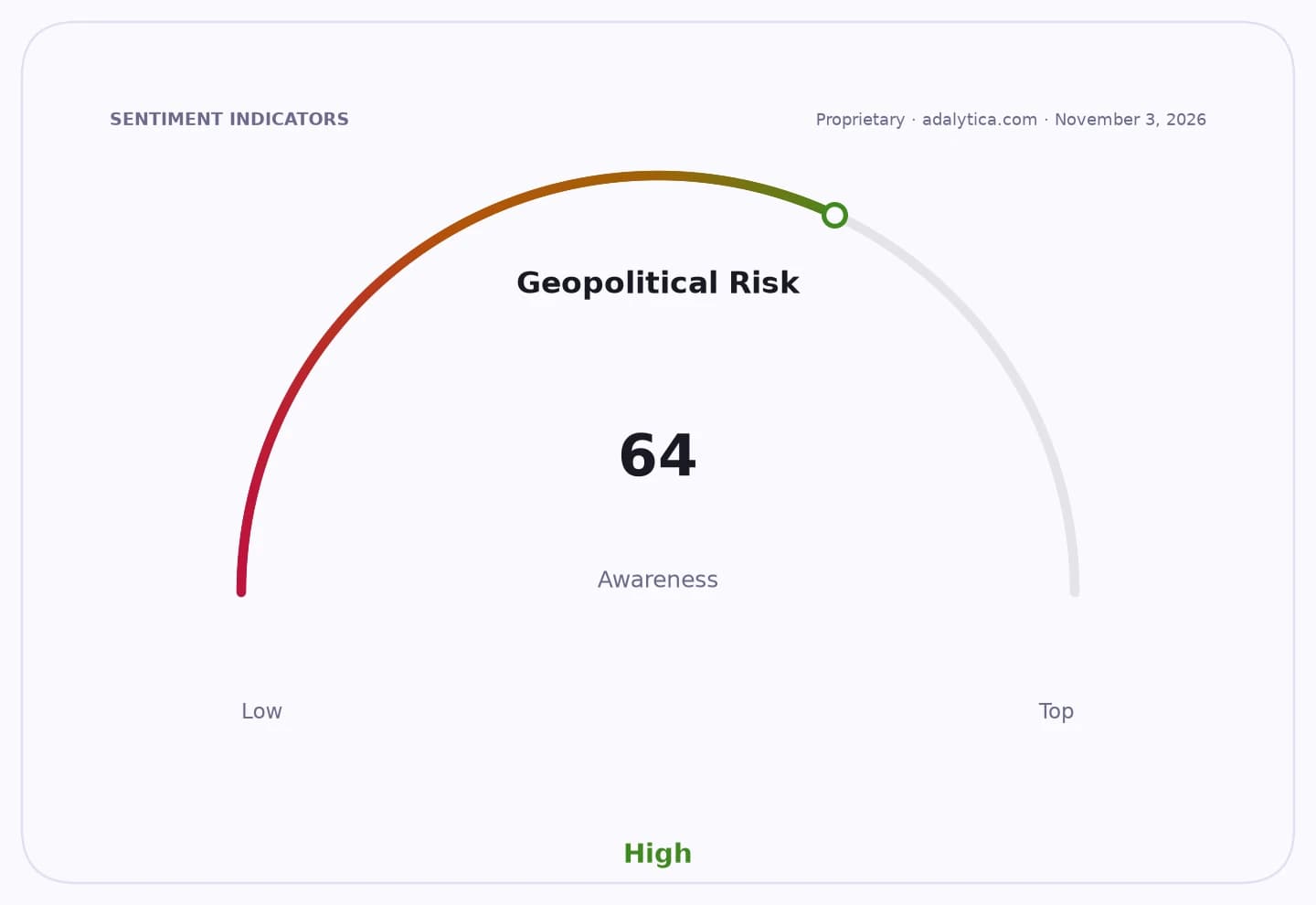
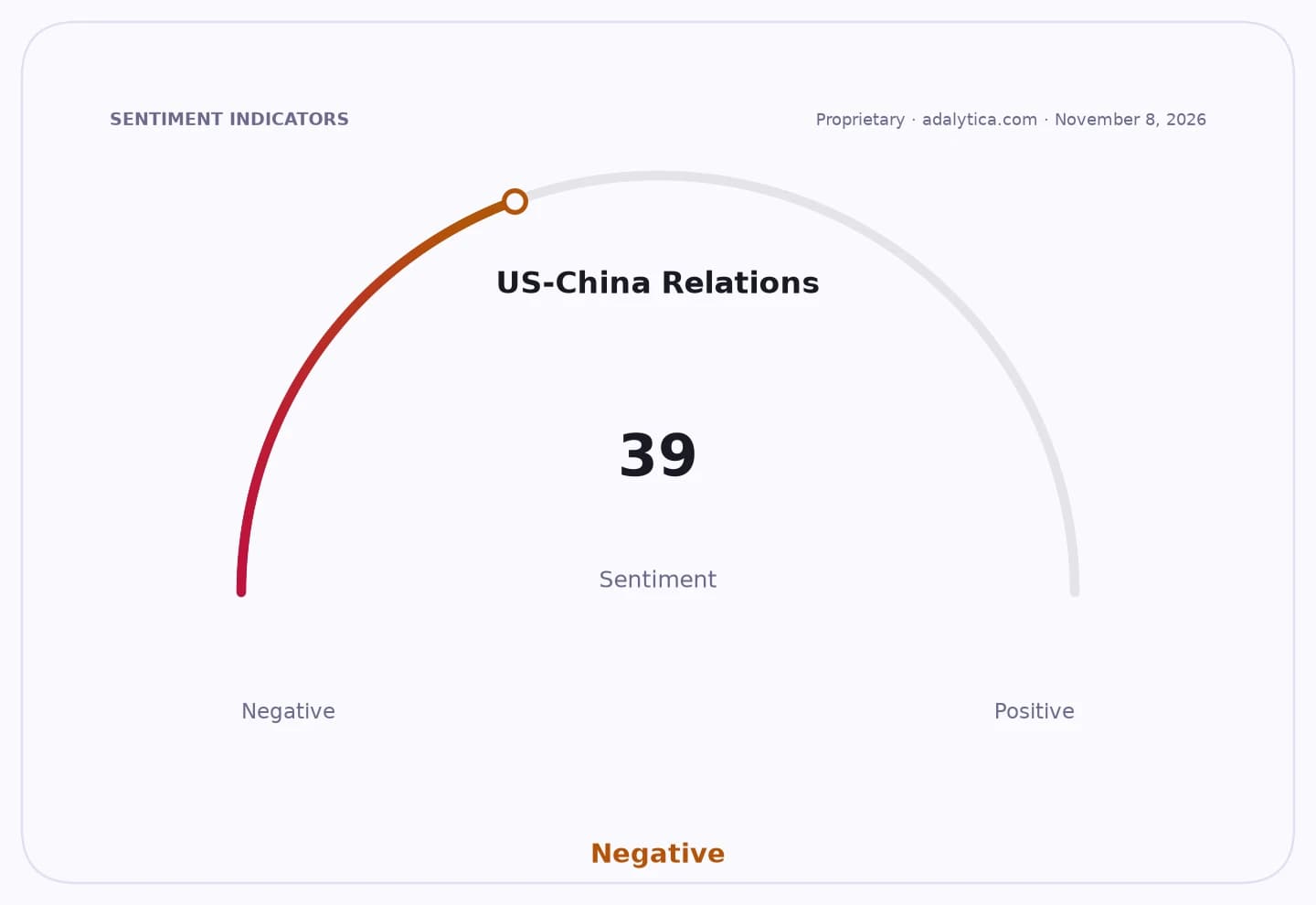
Italy’s relationship with China is shifting from old-fashioned trade arithmetic to a more strategic bet on artificial intelligence, advanced manufacturing and innovation.
Italy-China Trade Shifts Toward AI and Manufacturing
CCP Policy Direction
That is the core message of the second part of the Fondazione Italia Cina’s 2026 report, presented to the Italian Senate, which argues that despite geopolitical friction and China’s slower growth, the country remains too large and technologically important to ignore for Italian exporters and investors.
Sentiment Indicators
The report comes at a moment when China is still expanding, but at a more modest pace. Its economy grew 4.7% in the first half of 2026, with services and exports offsetting weakness in domestic demand and a still-dragging property market. For investors, that matters because China’s growth profile is no longer driven by the easy credit and construction cycle that once powered global commodity demand. Instead, the next leg is increasingly tied to productivity, industrial upgrading and technology.
That is where the report sees the real investment case. China’s AI industry topped 1.2 trillion yuan in 2025, up 40% year on year, with more than 6,600 companies active in the sector by June 2026. The country also moved into the global top 10 on the 2026 Global Innovation Index, while the Shenzhen-Hong Kong-Guangzhou cluster remained the world’s leading innovation hub for a second straight year.
For long-term investors, that is not just a geopolitical footnote. It reinforces China’s position as a manufacturing and technology engine that can shape supply chains, standards and competition across sectors from industrial equipment to software-enabled production. Italy, meanwhile, still brings design, specialized industrial know-how and premium manufacturing capabilities that can be paired with Chinese scale and speed.
The trade data in the report underlines both the opportunity and the imbalance. In the first half of 2026, China’s trade with the rest of the world reached $3.675 trillion, up 16.9% from a year earlier. The European Union still ran a trade deficit with China of about 201 billion euros. Italy’s deficit narrowed slightly as exports to China rose 19% to 8.2 billion euros, while imports increased 2% to 31.8 billion euros.
That mix matters because it suggests Italian companies are finding demand even in a slower Chinese economy, but also that the competitive gap remains wide. Lombardia remained Italy’s largest regional trading partner with China, followed by Tuscany, Veneto, Campania and Emilia-Romagna, a reminder that the exposure is concentrated among the country’s most industrialized regions.
The political backdrop is just as important. The report was presented in the Senate with lawmakers, academics and business executives in attendance, underscoring how trade with China is no longer just a corporate issue but a policy one. For Italy and the broader European Union, the challenge is to balance industrial cooperation with strategic caution at a time when Washington and Brussels are both reassessing their dependence on China.
For investors, the takeaway is straightforward: China is no longer the easy-growth story it was a decade ago, but it is still central to the future of industrial technology. The companies and funds most likely to benefit are those that can profit from selective cooperation in AI, automation and advanced manufacturing rather than broad exposure to a slowing consumer cycle. That makes the Italy-China nexus worth watching, not as a short-term trade theme, but as a multi-year investment trend.
| Entity | Gains | Losses |
|---|---|---|
| Italian industrial exporters | ▲New demand in China | ▼Pricing pressure and competition |
| Chinese AI and manufacturing firms | ▲Foreign partnerships and scale | ▼Greater scrutiny from Europe |
| Italian policymakers | ▲Better strategic visibility | ▼Need to balance openness with caution |
| EU trade balance | ▲Potential diversification | ▼Continued deficit with China |