Italy’s economy is edging closer to 1% growth, and Finance Minister Giancarlo Giorgetti is signaling that the next leg of expansion will depend less on government support and more on whether companies turn pay into a growth strategy.
Italy GDP Nears 1% as Giorgetti Backs Wage Growth

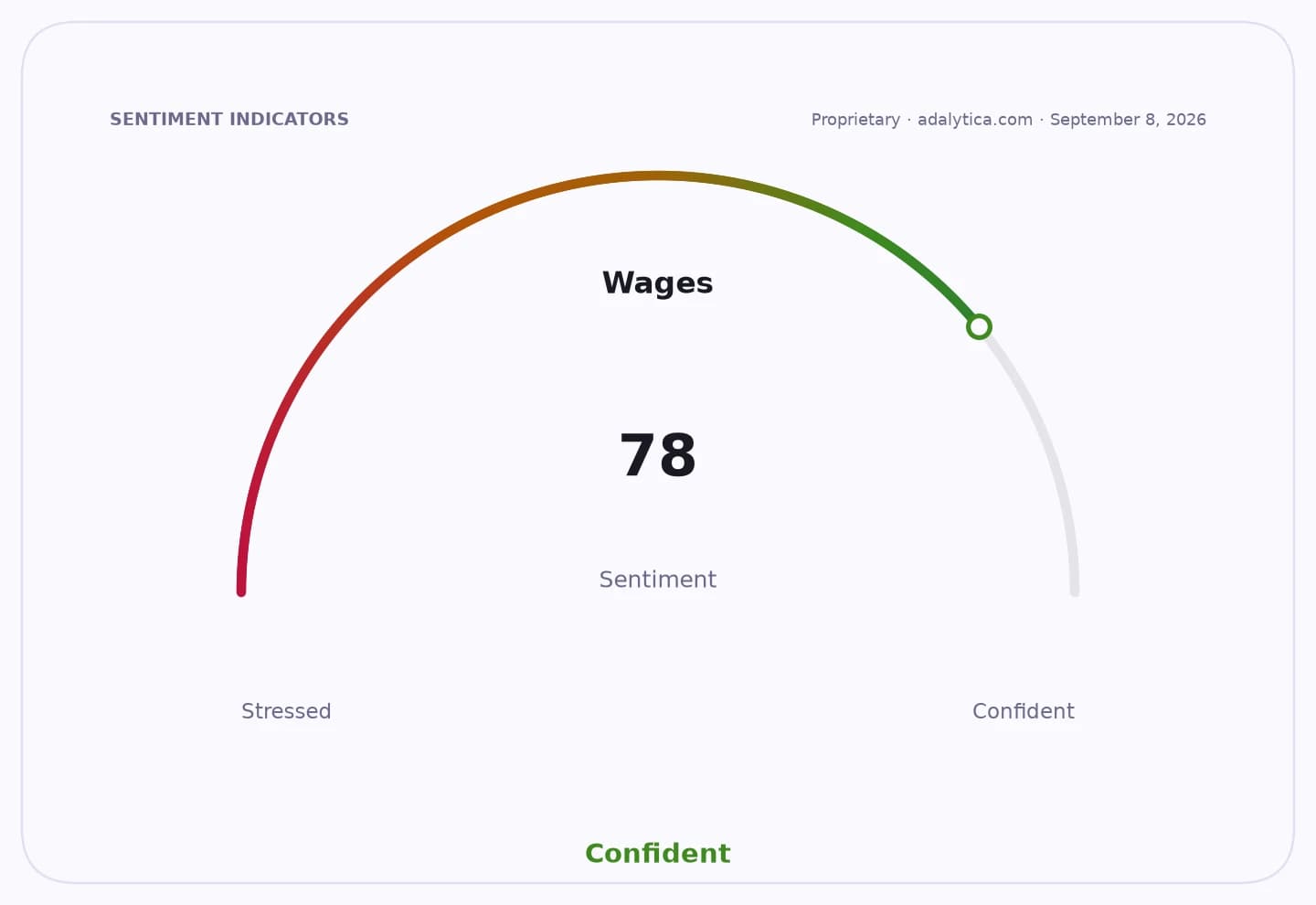
That matters because Italy is trying to break out of a low-productivity trap while carrying one of Europe’s heaviest debt loads. Giorgetti’s message from the Ambrosetti Forum in Cernobbio was simple: the state will keep using tax and contribution incentives, but businesses must start treating wages as an investment if they want to revive the cycle. In a country where domestic demand has been chronically weak, higher pay could support consumption, stabilize employment and ease the social strain of years of inflation and stagnation.
Sentiment IndicatorsⓘProprietary · adalytica.com · September 7, 2026
This is a snapshot — live sentiment, awareness and momentum for 130+ markets update continuously in the dashboard.Open AlphaPulse
Giorgetti said Italy has already captured 0.8% growth, above the 0.6% assumption in official planning documents, and could “approach 1%” if current indicators hold. For investors, that is not a boom story. It is a credibility story. Even modest upside to GDP would help Italy defend its fiscal path, reduce pressure on bond spreads and reinforce the view that the country can remain stable in a period of rising geopolitical and rate risk.
The minister also drew attention to a bigger structural problem the market keeps underpricing: Europe’s capital is flowing out while the United States turns savings into investment. He pointed to pension and retirement funds that invest almost everywhere except Italy, a hint that the real constraint on long-term growth is not just demand but where patient capital goes. That is a direct investment signal for infrastructure, defense, energy and technology, the areas Giorgetti said Europe has been too absent from, especially artificial intelligence.
Wages — 30-day sentimentadalytica.com
Explore this data interactively — full history, time series and cross-market comparisons.Open AlphaPulse
His warning on demographics adds another layer to the thesis. Italy faces what he called a demographic desert, meaning wage policy, tax incentives and efforts to bring back young workers from abroad are becoming economic policy, not just social policy. If labor supply keeps tightening, companies that fail to lift pay risk losing talent and productivity. The winners are likely to be employers with pricing power, strong automation plans or direct exposure to public incentives for hiring and investment.
The bond market backdrop also matters. Giorgetti argued that Italy’s recent financial stability gives it more room to face a possible storm in long-dated yields, a reminder that sovereign credibility is now an investable asset in its own right. If growth holds near 1% and the deficit stays close to the EU threshold, Italy could keep borrowing conditions manageable even as rate volatility returns.
The market is still missing the second-order effect here: slower growth is not a reason to avoid Italy, but a reason to focus on the few themes that can compound through it. Those include banks with domestic deposit strength, utilities tied to capex, defense suppliers, and companies exposed to labor-saving automation and energy efficiency. Giorgetti’s comments suggest the next Italian trade is not GDP beta. It is the scarcity premium attached to productivity, capital allocation and domestic reinvestment.
| Entity | Gains | Losses |
|---|---|---|
| Italian banks | ▲steadier sovereign backdrop | ▼limited loan growth |
| Domestic employers investing in wages | ▲stronger demand, tighter labor retention | ▼higher payroll costs |
| Pension and retirement funds | ▲better local deal flow if policy shifts | ▼foreign allocation bias |
| Bondholders and fiscal hawks | ▲stronger deficit credibility | ▼higher long-rate volatility risk |