Jakarta’s remaining rice fields have shrunk to just 279 hectares, or 0.42% of the capital’s total area, underscoring how urban expansion is steadily squeezing a food-producing belt that once covered much of the city’s outskirts.
Jakarta rice fields shrink to 279 hectares
The decline matters economically because it shows the capital is losing agricultural land faster than it can replace it, pushing local rice production onto a smaller and more vulnerable footprint. For a city of more than 66,000 hectares including sea, only a handful of districts still support active paddy fields, concentrated in Jakarta Utara, Jakarta Barat and Jakarta Timur. That leaves the city increasingly reliant on supply chains outside the metro area for a staple that remains politically and socially sensitive in Indonesia.
BPS data show Jakarta Utara still dominates output, accounting for 70.65% of provincial rice production, but even there harvest area fell sharply to 193.86 hectares in 2025 from 442.75 hectares in 2024. Jakarta Barat more than doubled harvest area to 54.75 hectares, while Jakarta Timur slipped to 24.92 hectares. The shifting pattern suggests the city’s rice economy is not disappearing evenly, but fragmenting as land is converted for housing, infrastructure and public projects.
For investors and policymakers, the bigger issue is what this says about land economics in the capital. Agricultural land that survives inside Jakarta is increasingly not freehold but controlled by government entities or BUMD-linked owners, limiting the normal market for farm leases and making returns depend on informal arrangements. That can keep some farmers in business, but it also reduces incentive for long-term capital investment in productivity, irrigation and mechanization. In a city where land values are driven by logistics, housing and public works, farming must compete with far higher-value uses.
The story is visible in Rorotan, where farmers say sawah have been lost to housing, RDF waste facilities, Covid burial grounds and now plans for a station. Sirojudin Abas, who manages about 3.1 hectares across four plots, said much of what remains is still cultivated by tenants rather than owners, and that some landowners collect rent only after harvest, if at all. That flexibility helps preserve production for now, but it also masks how fragile the system has become.
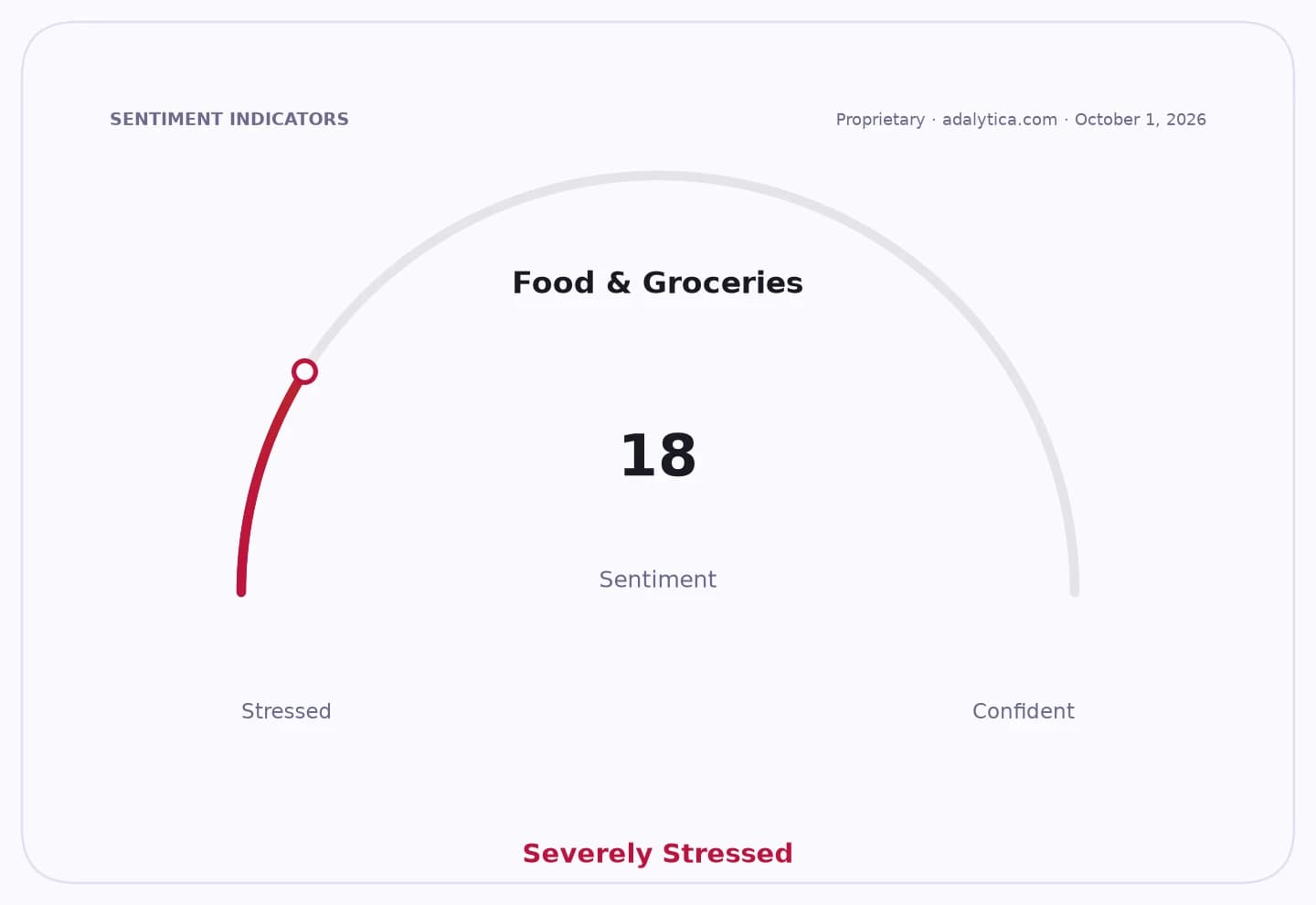
The market backdrop is more complicated. Farmers in Rorotan say traders are currently offering Rp7,700 to Rp8,000 per kilogram of unhusked rice, above Bulog’s buying price, which means private buyers are drawing grain away from the public procurement channel. At the same time, global grain-linked funds are still trading with elevated volatility, while food-spending sentiment in Adalytica’s gauge is in “Fear,” reflecting how quickly consumers can react to staple-price pressure.
The bull case is that Jakarta’s remaining paddy fields still provide a local buffer, preserve livelihoods and help maintain some urban food resilience. The bear case is that 279 hectares is too little for a city of Jakarta’s size, and every new project that consumes land makes the capital more dependent on external supply and more exposed to transport disruptions, weather shocks and price swings.
What to watch next is whether planned infrastructure near Rorotan and other outer districts accelerates the conversion of the last productive plots. If it does, Jakarta’s rice story will shift from one of urban farming to one of urban dependence, with implications for food security, land policy and the bargaining power of small farmers.
| Entity | Gains | Losses |
|---|---|---|
| Property developers and infrastructure builders | ▲More land for projects | ▼Less farmland supply |
| Rice traders and private bidders | ▲Access to grain at higher bids | ▼Bulog’s procurement share |
| Jakarta government/BUMD landholders | ▲Flexibility to repurpose land | ▼Long-term farm continuity |
| Small tenant farmers | ▲Near-term income from remaining plots | ▼Land security and scale |