Japan’s 2027 wage round is emerging as a test of whether the country’s inflation revival has become permanent, with economists split by generation over whether pay growth can stay near the mid-4% range or push above 5%.
Japan 2027 wage round tests inflation revival
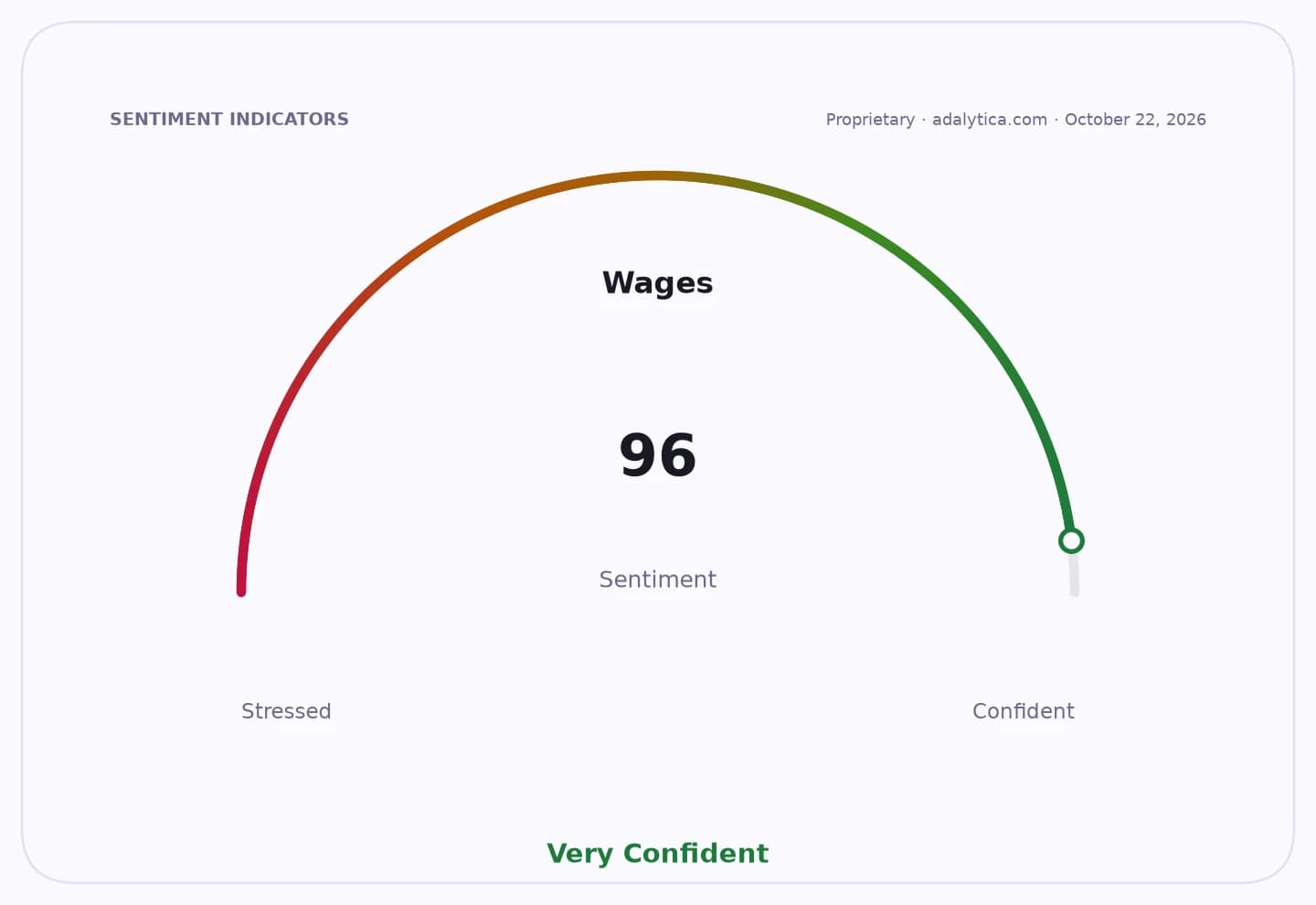
That matters because wages are now the key pillar supporting Japan’s fragile exit from decades of deflation. If pay settlements keep rising, households can preserve purchasing power, companies can pass on higher costs, and the Bank of Japan gets more confidence that inflation is being driven by demand as well as imported price pressure. If wage gains stall, the whole reflation story weakens and markets may have to rethink how far Japan’s new nominal growth cycle can run.
Sentiment IndicatorsⓘProprietary · adalytica.com · October 22, 2026
This is a snapshot — live sentiment, awareness and momentum for 130+ markets update continuously in the dashboard.Open AlphaPulse
The divide is not just about the numbers. Reuters’ interview-based reporting shows a clear split between older “deflation generation” economists, who lived through years of stagnant prices and wages and tend to be cautious, and younger “inflation generation” economists, who are more willing to see continued upside in pay. That generational lens is increasingly important in Japan, where expectations themselves shape economic outcomes. Those who spent their careers in an economy where wages barely moved are more likely to assume pressure will fade. Younger forecasters, socialized in the current inflationary regime, are more inclined to believe that labor scarcity, higher prices and stronger corporate profits will keep wage negotiations firm.
The data argues that the bullish camp has a case. Japan’s structural labor shortage is still intact, companies have been able to pass on costs, and nominal profits have expanded enough to give employers room to reward workers. The national labor confederation Rengo is due to set out its basic 2027 spring wage bargaining framework on Oct. 22, after 2026 wages rose 5.01%, the third straight year above 5%. Most economists cited by Reuters still expect 2027 wage growth to land in the high-4% range including seniority pay, but some younger forecasters see room for pay hikes to remain at roughly 3.5% for base wages and potentially top 5% overall.
What makes this more than a labor-market story is the overlap with artificial intelligence. The article points to a coming split in which AI may lift the value of senior, highly skilled workers while reducing the traditional apprenticeship path for younger staff. That has direct implications for corporate Japan: firms may have to pay more for experienced talent, invest more in training, and redesign career ladders just as they are already being forced to raise wages to attract and retain workers. In other words, AI is not only a capex theme for semiconductors and data centers; it may also become a wage and productivity theme across Japan Inc.
For investors, that creates a simple but powerful trade. A sustained wage upcycle is constructive for domestic demand, retailers, banks, insurers and service companies that benefit from a healthier consumption backdrop and stronger nominal growth. It is more challenging for labor-intensive businesses with weak pricing power and for firms that still rely on a low-wage model. The broader market implication is that Japan’s reflation trade is not just about the yen or the Bank of Japan; it is increasingly about whether employers keep paying up.
The market may be underestimating how sticky these wage gains can be. Once inflation becomes embedded in household and corporate behavior, it is harder to reverse than the old deflationary mindset assumed. The key catalyst now is whether 2027 spring talks confirm that Japan has crossed that psychological threshold. If they do, the winners will be those positioned for a durable domestic-demand recovery rather than a temporary wage burst.
| Entity | Gains | Losses |
|---|---|---|
| Japanese workers | ▲Higher pay packets | ▼Real-income erosion |
| Domestic消费-related stocks | ▲Stronger spending | ▼- |
| Labor-intensive small firms | ▲- | ▼Higher wage bills |
| Deflation-era forecasters | ▲- | ▼Narrative credibility |