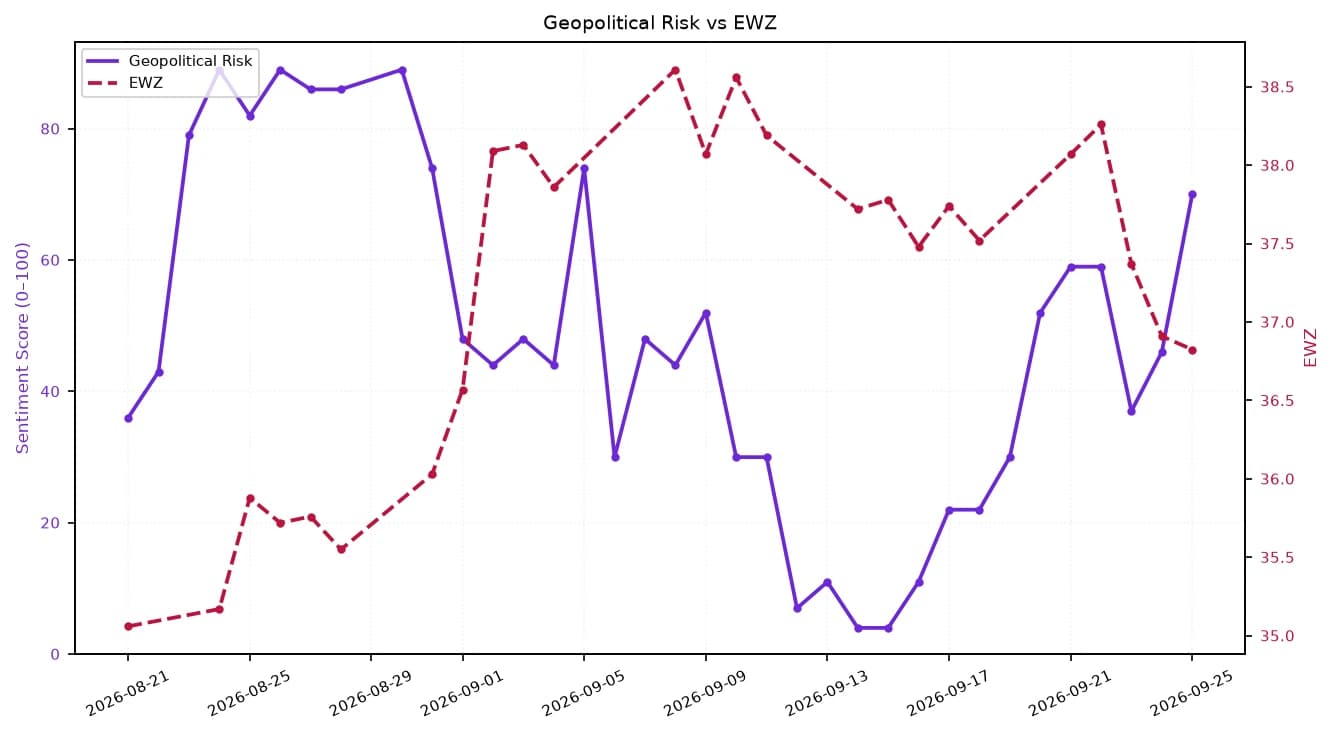
Lesotho’s failure to spend M10 billion in debt-financed funds is more than a budget slip — it is a sign that weak execution, not just scarce financing, is holding back growth and business confidence.
Lesotho Spending Failure Raises Sovereign Risk Concerns
For investors, that matters because unspent government money usually means slower infrastructure rollout, softer demand for local contractors and suppliers, and less support for an economy that already depends heavily on public spending to keep activity moving. In a small, import-dependent economy like Lesotho’s, every delayed loti of capital spending can ripple through construction, transport, retail and jobs.
Sentiment IndicatorsⓘProprietary · adalytica.com · July 25, 2026
This is a snapshot — live sentiment, awareness and momentum for 130+ markets update continuously in the dashboard.Open AlphaPulse
The broader lesson is simple: borrowing does not automatically translate into growth. If the state cannot convert debt into roads, projects or public services, then the cost of that borrowing still lands on taxpayers without the offsetting benefit of stronger output. Over time, that weakens fiscal credibility and leaves the country with less room to respond when the next shock hits.
The data context points to a wider market backdrop of caution. The U.S. dollar has been flashing fear on proprietary Adalytica trade signals, while the S&P 500 has also shown extreme fear in those readings, underscoring how quickly investors are re-rating risk across asset classes. That does not directly move Lesotho’s budget, but it does matter for frontier markets that rely on foreign funding, remittances and stable capital flows. When global risk appetite fades, governments that struggle to spend efficiently tend to lose even more room to maneuver.
There is also an important investment angle for long-term readers: this is the kind of story that separates countries and companies with real operating discipline from those that only look strong on paper. Debt can accelerate development, but only when the institutions in charge can execute. Without that, leverage becomes a drag rather than a catalyst.
For now, the key question is whether Lesotho can improve procurement, project delivery and accountability fast enough to turn borrowed money into productive assets. Until that happens, this is a cautionary tale for anyone weighing sovereign risk, infrastructure exposure or local business prospects. Worth watching, but not yet a sign of durable progress.
| Entity | Gains | Losses |
|---|---|---|
| Taxpayers | ▲avoids some waste | ▼still owe the debt |
| Contractors | ▲future project pipeline | ▼delayed payments |
| Government balance sheet | ▲slower cash drain | ▼weaker credibility |
| Long-term investors | ▲clearer risk lesson | ▼near-term confidence |