Treasury liquidity is tightening again, and that is raising the odds of sharper swings in the S&P 500 as markets lose a key source of support.
Tightening Liquidity Raises S&P 500 Volatility Risk

The Federal Reserve’s balance sheet has slipped to about $6.74 trillion, down roughly 23.97% from its 2021 peak, while the 10-year Treasury yield sits near 4.55%, keeping borrowing costs elevated. That combination matters because less system-wide liquidity and higher risk-free rates tend to compress valuations, weaken risk appetite and make equity indexes more sensitive to headlines.
Sentiment IndicatorsⓘProprietary · adalytica.com · July 21, 2026
This is a snapshot — live sentiment, awareness and momentum for 130+ markets update continuously in the dashboard.Open AlphaPulse
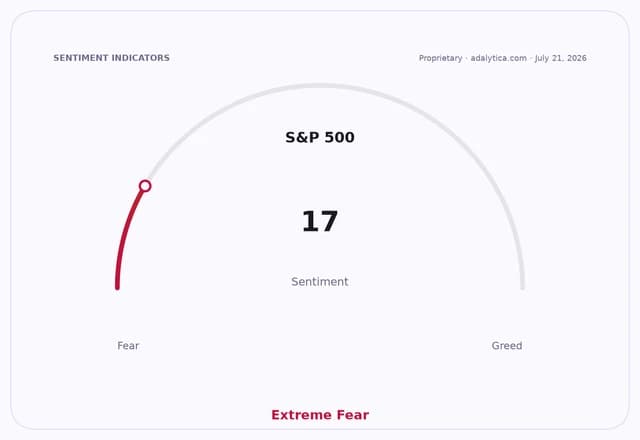
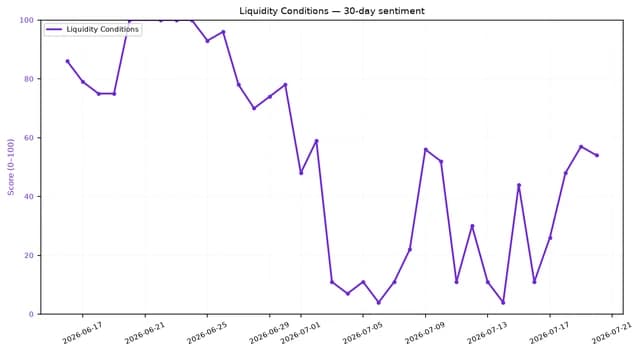
The pressure is showing up in market tone. Adalytica’s S&P 500 trade-signal snapshot is in “Fear” at 17, down 24 points in a day and 60 points over 30 days, while the financial system liquidity gauge has fallen to 54, or neutral, after a sharp 4-point daily drop. The shift suggests traders are becoming more cautious even as the S&P 500 itself holds near 742.09, just above its 50-day moving average of 743.44.
Bond market behavior is sending a similar warning. TLT, the iShares 20+ Year Treasury Bond ETF, closed at 83.89, below its 50-day average of 84.92 and its 200-day average of 86.01, while its Adalytica trade signals show “Fear” on both sentiment and awareness. That points to ongoing skepticism that duration assets can rally enough to cushion equities if growth cools or funding conditions tighten further.
For investors, the immediate implication is not necessarily a straight-line selloff, but a more fragile tape. When Treasury liquidity is being absorbed and long rates remain stubbornly high, the market usually rewards quality, cash flow and pricing power over long-duration growth and speculative exposures.
The next catalyst is the interplay between Fed balance-sheet runoff, Treasury issuance and rate expectations. If liquidity keeps draining while the 10-year yield holds above 4.5%, volatility in the S&P 500 is likely to stay elevated and any equity rally may prove harder to sustain.
| Entity | Gains | Losses |
|---|---|---|
| Cash-rich large caps | ▲Relative valuation support | ▼Less upside from cheap liquidity |
| Long-duration growth stocks | ▲Lower inflation scare if yields ease | ▼Higher discount rates |
| Treasury bond bulls | ▲Risk-off bids if growth weakens | ▼Rising yields and weaker TLT |
| Equity index traders | ▲Trading volatility opportunities | ▼Choppier, less forgiving market |