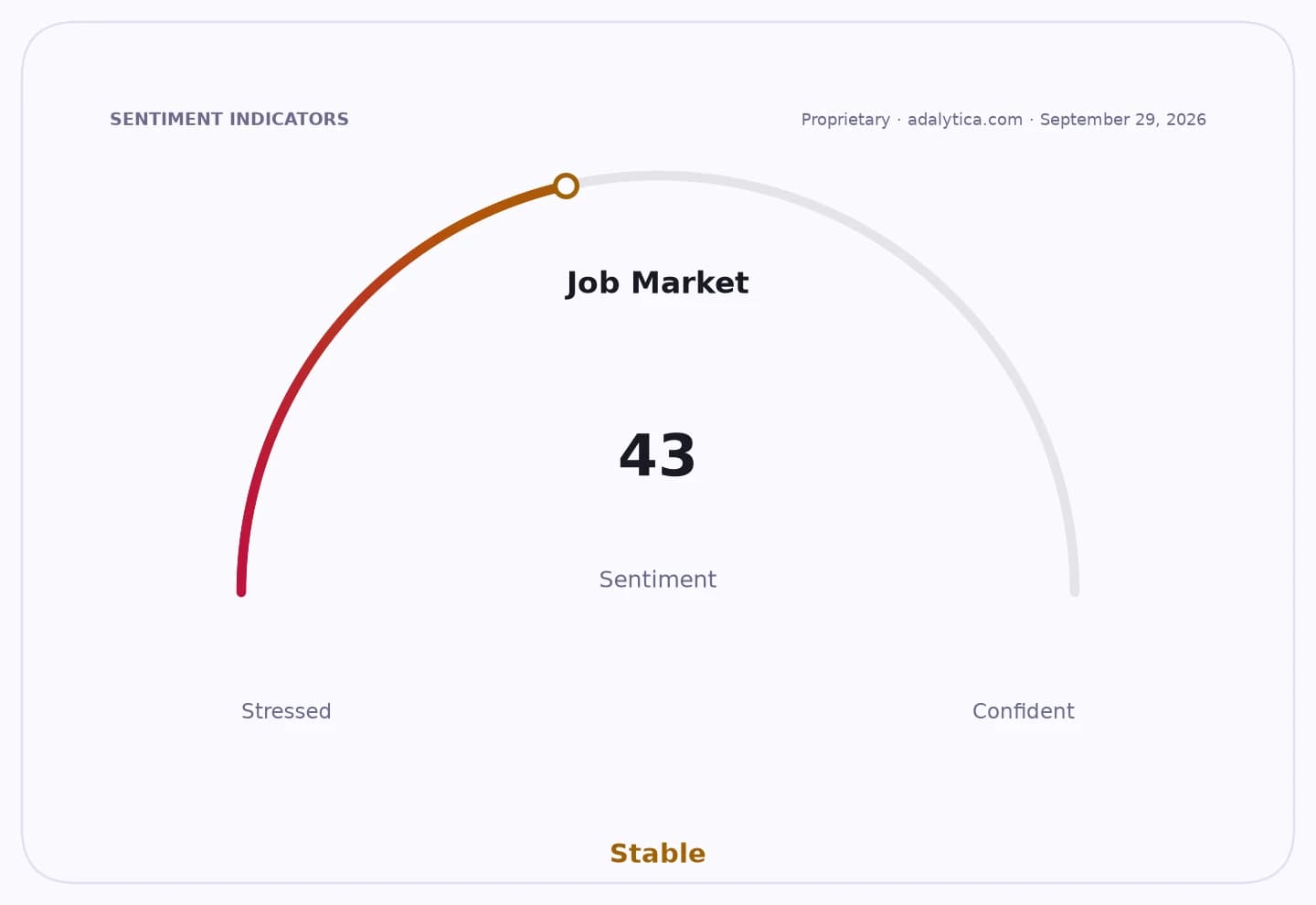
The most important shift in hiring is not wage pressure or joblessness, but a redefinition of what a career means for younger workers — and L’Oréal Group is positioning itself to win that contest by turning itself into a training platform, a mobility network and a wellbeing provider as much as an employer.
L’Oréal Uses Training And Benefits To Retain Talent
That matters economically because the labour market is moving away from the old model of linear progression toward one built on continuous reskilling, cross-border exposure and employee retention. L’Oréal says about 44% of professional skills are expected to change in coming years, underscoring why companies that can train workers faster than the market evolves will have an edge in productivity, recruitment and long-term operating resilience.
Sentiment Indicators
For investors, the appeal is twofold. First, firms that can attract and keep younger talent tend to face lower churn, better institutional knowledge and less recruitment cost over time. Second, a workforce strategy built around skills, flexibility and wellbeing can become a competitive moat in consumer businesses where innovation, brand execution and digital capability matter. In L’Oréal’s case, that strategy is being used to reinforce a global beauty business with more than 150 markets and 40 brands, while deepening ties with the next generation of workers.
The company’s approach is especially visible in internships and early-career hiring. Its L’Internship programme in Portugal and Spain runs for up to 12 months in strategic areas and has converted more than 40% of interns into permanent staff, making it not just a pipeline but a recruitment engine. That is significant in a market where new entrants increasingly want proof of development, not just a first job.
L’Oréal is also leaning on internal mobility as a talent-retention tool. Cross-functional, interdepartmental and geographic moves between Portugal and Spain give employees experience across markets and teams, while reverse mentoring lets younger staff coach senior leaders on digital trends and social change. The message is that careers are now co-created, not simply assigned.
The company is pairing that with a broader employee proposition through its Be Well and Share & Care programmes. Those initiatives cover physical and mental health, nutrition, hybrid work, flexible hours, pensions, family support and 24/7 medical and psychological assistance. In a labour market where the company cites flexibility as a decisive factor for 37% of candidates in Portugal, those benefits are not cosmetic — they are part of the cost of accessing scarce talent.
There is also a clear cultural angle. Internal communities around LGBTIQ+ inclusion and sustainability are designed to align personal values with corporate purpose, reflecting a broader shift among younger workers who increasingly screen employers on identity, responsibility and social impact. For L’Oréal, that helps turn purpose from branding into a retention mechanism.
The bull case is that this model should improve hiring efficiency, engagement and employee longevity in a skills-constrained market. The bear case is that such programmes can become expensive to maintain and difficult to scale if they do not translate into measurable productivity gains. But the direction of travel is clear: for the new generation, a career is no longer just a job — and companies that fail to adapt may struggle to compete for talent.
| Entity | Gains | Losses |
|---|---|---|
| L’Oréal Group | ▲Stronger talent pipeline | ▼Higher program costs |
| Young workers | ▲Skills, mobility, wellbeing | ▼Less traditional job stability |
| Competitors with rigid cultures | ▲Fewer expectations to meet | ▼Talent attraction disadvantage |
| Investors in people-led brands | ▲Better retention prospects | ▼Execution risk if benefits underperform |