A reported US-Russia discussion over Lukoil’s overseas assets could do more than reshuffle oil holdings: it may give Cyprus, Greece and other Eastern Mediterranean states fresh leverage in Washington’s transactional foreign policy.
Lukoil Talks Could Affect Eastern Mediterranean States

That is the economic significance of the emerging Lukoil story. If the Trump administration is indeed weighing a multi-billion-dollar energy deal as part of broader negotiations with Moscow over Ukraine, then oil assets are no longer just commercial prizes. They become bargaining chips tied to sanctions relief, market stability and the terms of any post-war settlement. For Europe, where energy security remains a strategic weakness even after the post-2022 break with Russian supply, the implications stretch well beyond Russia itself.
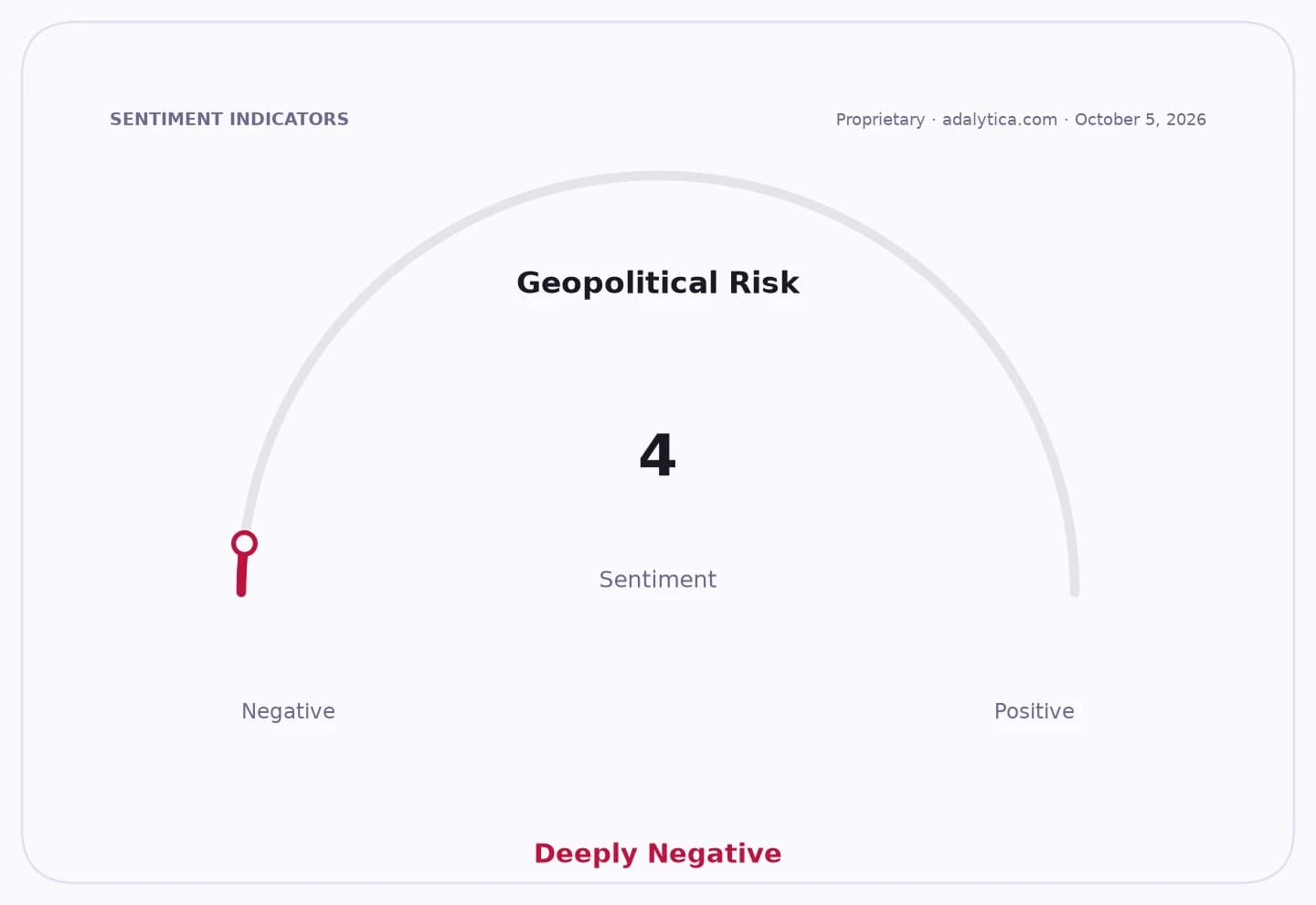
Sentiment IndicatorsⓘProprietary · adalytica.com · October 5, 2026
This is a snapshot — live sentiment, awareness and momentum for 130+ markets update continuously in the dashboard.Open AlphaPulse
The reported talks come as Ukraine’s strikes on Russian refineries have turned energy infrastructure into a frontline of the war, tightening refined-product markets and keeping oil geopolitics squarely in focus. Global benchmark Brent has been trading near the mid-$90s in recent sessions, while US crude has also remained elevated enough to keep inflation sensitivities alive. That matters for the White House because higher fuel prices feed directly into transport costs, consumer sentiment and political pressure at home.
Against that backdrop, the idea of American capital taking part in Lukoil’s international assets would amount to a reversal of the isolation strategy that followed Russia’s invasion of Ukraine in 2022. For the Kremlin, even a limited re-engagement by US investors would carry symbolic weight: it would suggest sanctions can be negotiated, not just imposed. For Washington, it would create a lever over Moscow while potentially giving US firms access to producing fields, refineries and retail fuel networks abroad.
The market angle is straightforward. Energy investors tend to prefer clarity, and a deal that ties asset sales to geopolitical concessions could tighten supply expectations in the short term while improving the value of politically exposed assets. Shares in broad US energy trackers have already reflected that backdrop. The XLE energy ETF was trading at $63.45 on Oct. 5, above its 50-day moving average of $61.91 and 200-day average of $55.98, though recent momentum has cooled as the relative strength index slipped to 37.9. USO, a proxy for crude exposure, closed at $143.99, still far above its 200-day average of $115.56 but with RSI at 33, indicating the move has paused after a strong run.
For Cyprus, the opportunity is more indirect but potentially important. Charalambos Chrysostomou’s argument is that Washington may increasingly assess countries in the region not through old alliance categories but by what strategic value they can offer. Greece brings LNG terminals, ports and military infrastructure. Turkey offers access through the Straits and proximity to the Black Sea. Cyprus adds an Eastern Mediterranean location, energy prospects and links with Greece, Israel and Egypt. In a US foreign policy shaped more by transaction than doctrine, that can translate into attention, investment and diplomatic relevance.
The bull case for Nicosia and Athens is that a broader US-Russia energy bargain would raise the value of every node in the Eastern Mediterranean energy map, from LNG import capacity to interconnectors and port logistics. The bear case is that the region becomes more exposed to great-power dealmaking, with local interests subordinated to a Washington-Moscow negotiation that may prioritize price stability and strategic concessions over European preferences or international-law arguments.
Investors should watch whether the Lukoil talks remain a one-off asset transaction or evolve into a broader framework linking sanctions, energy flows and Ukraine diplomacy. If they do, the winners are likely to be governments and companies able to convert geography into leverage. The losers could be Europe’s more passive energy consumers, and any market participant assuming Russian energy is still outside the bargaining table.
| Entity | Gains | Losses |
|---|---|---|
| Cyprus | ▲Strategic leverage | ▼Policy marginality |
| Greece | ▲Energy/infrastructure role | ▼Exposure to deal risk |
| US investors | ▲Asset access | ▼Sanctions scrutiny |
| Europe | ▲Potential supply relief | ▼Less control over terms |