Europe’s battered petrochemical sector is getting a rare vote of confidence, with LyondellBasell committing €150 million to revive its Carling site in France, a move that underlines how the industry is trying to reposition aging assets for a lower-growth, lower-carbon market.
LyondellBasell invests €150M in Carling site
The investment matters because it is not just a maintenance spend on a legacy plant. Carling has long been one of Europe’s acrylic production strongholds, and the plan to move it from coke-era industrial decline toward new industrial uses — including token-linked digital applications as well as chemical production — points to the broader struggle to keep Europe’s chemical base competitive as energy costs, weak demand and decarbonisation pressure squeeze margins.
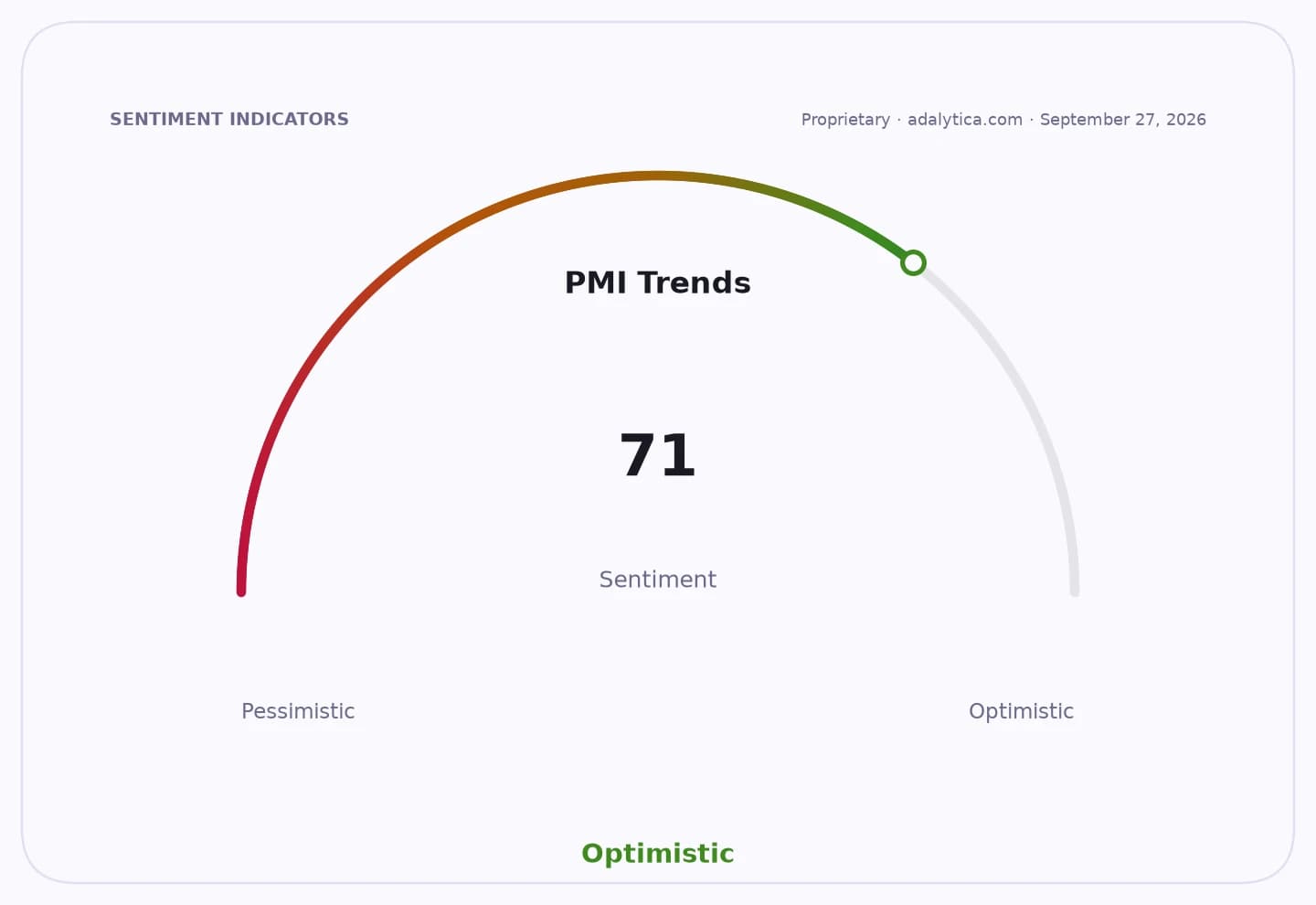
Sentiment IndicatorsⓘProprietary · adalytica.com · October 12, 2026
This is a snapshot — live sentiment, awareness and momentum for 130+ markets update continuously in the dashboard.Open AlphaPulse
For investors, the message is twofold. First, the company is willing to deploy capital into European assets even as the region’s industrial cycle remains fragile, suggesting management sees selective returns in upgrading rather than exiting. Second, the project highlights how far the sector still has to go to adapt. Chemical producers are operating in an environment where output growth is modest at best: U.S. industrial production is projected to rise only 0.18% in September after August’s 0.02% increase, while the broader producer price backdrop remains firm, with the U.S. PPI for all commodities still near 288. That combination leaves manufacturers with little pricing power and a strong incentive to hunt for efficiency, specialty products and higher-value applications.
The share price reaction around peers reflects that tension. LyondellBasell’s stock has remained well below its earlier highs this year, even after a summer bounce, while Dow and Westlake have also traded with pronounced volatility as investors continue to weigh cyclical pressure against the possibility of restructuring and asset rationalisation. The market is effectively asking which chemical assets can still earn an acceptable return in a world of high feedstock, energy and compliance costs — and which cannot.
Carling’s slow rebirth also has a political-economic dimension. France and the wider European Union have been under pressure to preserve strategic industrial capacity after years of plant closures and imports taking share. Reviving a site with established infrastructure is cheaper and faster than building anew, and it helps local governments protect jobs, tax bases and supply chains. But it also exposes the limits of Europe’s industrial policy: keeping sites alive is not the same as restoring sector-wide competitiveness.
The bull case is that Carling becomes a proof point for industrial conversion, giving LyondellBasell a foothold in higher-value products and a way to extend the life of a strategic asset. The bear case is that €150 million merely slows inevitable decline if European demand stays soft, energy prices stay elevated and the region’s chemical oversupply persists.
For investors, the key question is whether this is the start of a broader capital cycle in European chemicals or just a one-off rescue of a historically important site. Either way, Carling shows the industry’s future will depend less on volume growth than on who can recycle old industrial footprints into businesses that can still clear a return.
| Entity | Gains | Losses |
|---|---|---|
| LyondellBasell | ▲Strategic asset upgrade | ▼Near-term capital outlay |
| Carling site / Moselle region | ▲Jobs and industrial relevance | ▼Legacy coke-era model |
| European chemical sector | ▲Evidence of reinvestment | ▼Pressure from weak demand |
| Competitors with older capacity | ▲Benchmark for restructuring | ▼Higher risk of stagnation |