The biggest risk in the artificial intelligence boom is no longer just how much these companies spend — it is how much they have promised to pay later. A new analysis says Microsoft, Alphabet, Amazon, Meta and Oracle have accumulated about $2.7 trillion in contractual AI-related obligations that do not yet sit on their balance sheets, raising the prospect of heavier debt loads, rising interest costs and future profit pressure.
Microsoft, Alphabet, Amazon AI Obligations Rise
That matters because the spending spree behind AI data centers, chips, energy and network infrastructure is now outpacing operating cash flow at some of the sector’s biggest players. Flossbach von Storch Research Institute says the five companies’ fixed commitments have surged from $129 billion to $1.6 trillion, while the group has flipped from $209 billion in net cash in mid-2021 to $106 billion in adjusted net debt.
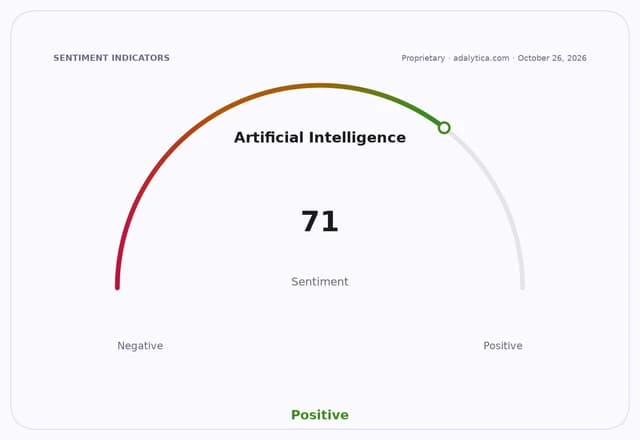
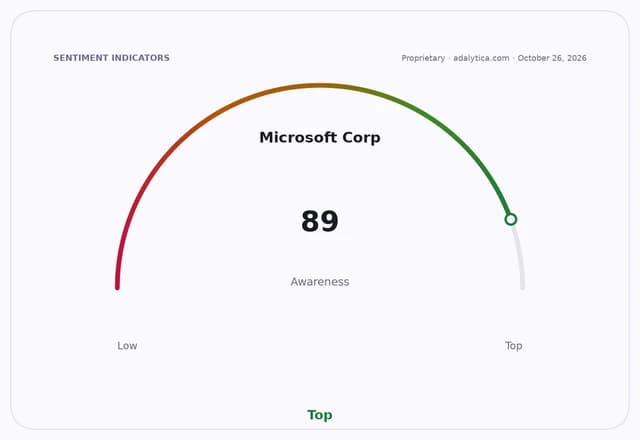
Sentiment IndicatorsⓘProprietary · adalytica.com · October 26, 2026
This is a snapshot — live sentiment, awareness and momentum for 130+ markets update continuously in the dashboard.Open AlphaPulse
The shift is already changing how investors value the sector. Moody’s has described the trend as a form of “reporting deferral,” while the Bank for International Settlements has warned of shadow debt. In practice, that means obligations such as long-term leases, data-center contracts and power agreements can remain hidden in footnotes until projects are delivered, even though they create real financing pressure long before they hit the balance sheet.
Microsoft has the largest unfinished leasing pipeline at $329 billion, much of it tied to data centers due to come online between fiscal 2027 and 2033. Meta has $279 billion in planned leases and infrastructure commitments, Alphabet has $811 billion of purchase and contract obligations, and Amazon has $130 billion in firm commitments to buy goods and services.
The funding burden is showing up in capital markets. The five hyperscalers sold about $200 billion of bonds in the first half of the year, and Goldman Sachs expects almost $500 billion for the full year. Ten-year paper from Alphabet, Amazon, Meta and Oracle now carries coupons of about 5.25% to 5.7%, far above the roughly 1% levels available in 2020.
That is a direct hit to future margins. Higher interest expense, depreciation and lease costs will increasingly eat into free cash flow, and Alphabet’s first-ever negative free cash flow since its 2004 listing underscored how quickly the economics of the AI buildout are changing. Alphabet, Amazon, Meta and Microsoft are all planning capital spending in the hundreds of billions of dollars, with Alphabet alone targeting $180 billion to $190 billion this year.
For investors, the issue is not whether AI infrastructure gets built, but who absorbs the financing risk if demand slows or the technology cycles turn faster than expected. If cloud usage or AI monetization disappoints, the companies could be left with long-dated fixed costs for data centers that are underused or need to be written down sooner than planned.
The market is already paying closer attention. Tech borrowing costs have moved above the wider U.S. corporate market on average, reversing a long-standing pattern that reflected the sector’s huge cash piles and limited need for debt. With rates still elevated and AI capex still rising, the next catalyst is whether the hyperscalers keep leaning on debt — or eventually tap equity again, which would likely be unwelcome for shareholders.
| Entity | Gains | Losses |
|---|---|---|
| Microsoft, Alphabet, Amazon, Meta, Oracle | ▲Build AI capacity fast | ▼Higher debt and future cost burden |
| Bondholders and lenders | ▲More issuance and yield | ▼Greater credit risk if cash flow weakens |
| Equity investors in hyperscalers | ▲AI growth optionality | ▼Dilution, lower free cash flow, write-down risk |
| Smaller tech rivals | ▲Less ability to match capex | ▼Competitive pressure from hyperscaler scale |