The US is heading into a financing year that could test the bond market’s capacity and, by extension, the valuations of stocks that have been powered by the AI buildout.
US borrowing surge pressures bonds and AI stocks

Ray Dalio’s estimate that the US government and American companies will need to borrow or refinance $16.6 trillion over the next year — including $13.2 trillion for the state and $3.4 trillion for corporations — captures the scale of the squeeze. The issue is not simply that borrowing is large; it is that sovereign issuance and AI-led corporate spending are rising at the same time, forcing investors to absorb competing waves of debt just as yields remain elevated.
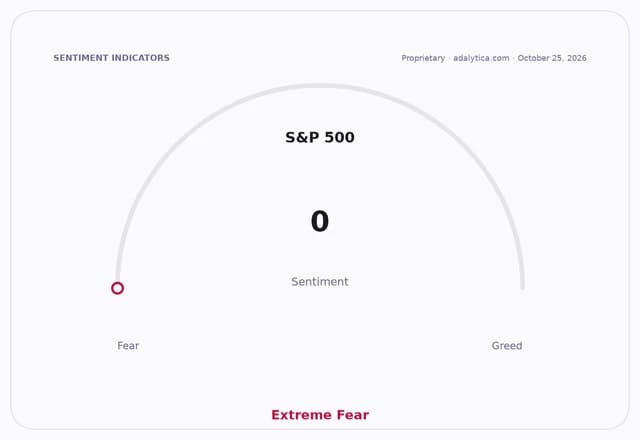
Sentiment IndicatorsⓘProprietary · adalytica.com · October 25, 2026
This is a snapshot — live sentiment, awareness and momentum for 130+ markets update continuously in the dashboard.Open AlphaPulse
That matters because higher yields increase the cost of capital across the economy. The 10-year Treasury has recently traded above 5%, while the federal funds rate is still around 3.7%, leaving financing conditions restrictive even before any extra supply hits the market. Dalio’s figures imply a refinancing treadmill that gets more expensive with each uptick in rates. On current market debt of about $32 trillion, a one percentage point rise in average borrowing costs would eventually lift annual US interest expense by more than $300 billion.
For the Treasury, the arithmetic is getting harsher. US government issuance is projected to rise to $12.1 trillion in 2026 from $11.2 trillion in 2025, then to $13.2 trillion in 2027 and $14.7 trillion in 2028, according to Dalio’s estimates. The driver is familiar: persistent deficits, higher refinancing needs and a larger interest bill. Investors have so far kept buying — US Treasury funds took in $59.3 billion in the third quarter, according to the Financial Times — but the market’s ability to keep digesting supply without demanding higher yields is the central question.
DGS10 vs FEDFUNDS — macro contextadalytica.com
Explore this data interactively — full history, time series and cross-market comparisons.Open AlphaPulse
The corporate side is no less important. Microsoft, Alphabet, Amazon, Meta and a widening set of AI infrastructure providers are spending heavily on data centers, chips and power systems, and much of that capital will be financed in debt markets. Dalio, Bloomberg and SIFMA data point to roughly $3.4 trillion of borrowing or refinancing by US companies in 2027, including $1.4 trillion of new debt. That is a formidable funding need at a time when investors are already questioning the return on some AI infrastructure projects and are growing more selective about heavily leveraged issuers.
The risk is a classic crowding-out effect. When the sovereign and the largest corporate borrowers compete for the same pool of savings, investors usually insist on higher compensation. That can hit long-duration assets first: growth stocks, unprofitable tech and any business model dependent on cheap financing. The recent weakness in AI-linked debt names, including CoreWeave, suggests the market is already starting to discriminate between companies with strong cash generation and those reliant on continued funding access.
There is still a bull case. Higher Treasury yields can attract global capital, and US government debt remains the world’s benchmark safe asset in periods of stress. On the equity side, the AI investment cycle could yet justify the spending if productivity gains and revenue growth arrive quickly enough. But the bear case is becoming harder to dismiss: if borrowing costs stay high while issuance keeps climbing, the market may force a reset in both credit spreads and equity multiples.
For investors, the key implication is that the AI boom is no longer just an earnings story. It is a funding story. If the capital required to build out AI infrastructure keeps rising faster than the cash flow it generates, the market will eventually impose a higher price on both debt and equity. That would reverberate well beyond the tech sector and into the broader stock market, where valuations have long depended on the assumption that financing would remain abundant and cheap.
| Entity | Gains | Losses |
|---|---|---|
| US Treasury | ▲Steady demand for safe assets | ▼Higher interest expense |
| AI megacaps | ▲Access to funding for expansion | ▼Higher borrowing costs |
| Bond investors | ▲Higher yields | ▼Greater duration risk |
| Equity investors | ▲Potential AI growth upside | ▼Multiple compression risk |